❌ Not for Human Consumption
●
✅ For Research Use Only
●
All products are intended strictly for laboratory research purposes only
●
❌ Not for Human Consumption
●
✅ For Research Use Only
●
All products are intended strictly for laboratory research purposes only
●

Cyanocobalamin Vs. Methylcobalamin: Comparing Molecular Stability In Laboratory Storage Conditions

Important Notice: The content of this article is intended strictly for licensed professional researchers, academic institutions, and qualified laboratory personnel. Vitamin B12 Cyanocobalamin discussed herein is sold For Research Use Only (RUO) and is Not For Human Consumption, Therapeutic, Diagnostic, or Veterinary Use. No statements in this article should be interpreted as medical advice, and no product referenced has been evaluated by the FDA for any purpose related to the prevention, diagnosis, treatment, or cure of any disease or condition. This information is provided for educational and scientific reference only.
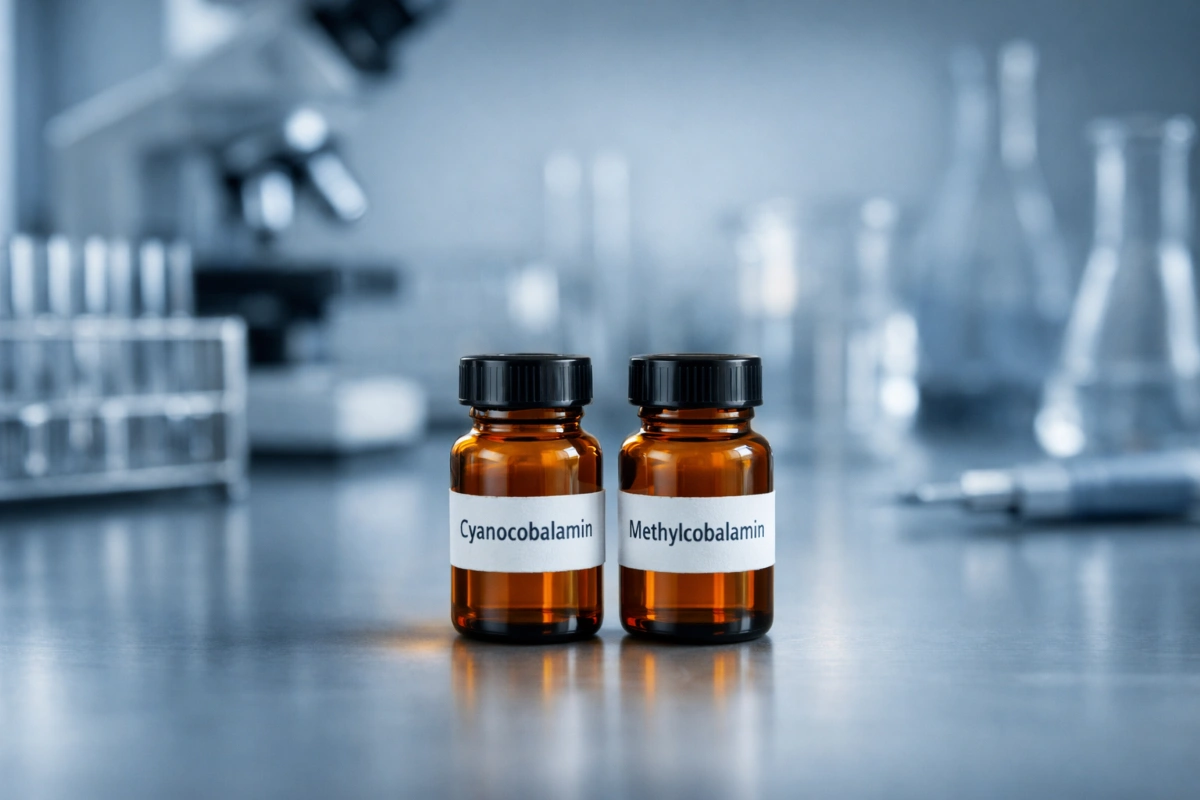
Cyanocobalamin and methylcobalamin share the corrin-ring architecture characteristic of the B12 family, but their divergent upper axial ligands (a cyano group versus a methyl group) produce meaningfully different behaviors under laboratory storage conditions (Temova Rakuša et al., 2022).
For researchers conducting reference-standard work, reagent calibration, method validation, or stability-indicating assay development, understanding the molecular stability profiles of these two compounds is not a peripheral concern. It directly influences reproducibility, data integrity, and the validity of any downstream comparative analysis. This article provides an action-oriented, technically grounded overview intended to support laboratory decision-making regarding storage, handling, and analytical workflow design for a Vitamin B12 reference material and its related laboratory forms.
Again, all discussion is presented for research and educational purposes only. This is not a consumer product comparison, a therapeutic assessment, or a clinical recommendation.
Structural Foundations Of Cyanocobalamin And Methylcobalamin
The Shared Corrin Scaffold
Both cyanocobalamin (CAS 68-19-9) and methylcobalamin (CAS 13422-55-4) are members of the cobalamin class, characterized by a central cobalt atom coordinated within a corrin macrocycle (PubChem CID 166596686; FDA GSRS). The lower axial position is occupied by a 5,6-dimethylbenzimidazole moiety connected via a nucleotide loop (Calvillo et al., 2022). The critical structural divergence occurs at the upper axial ligand, where these molecules differ in the group bonded to the central cobalt atom (Temova Rakuša et al., 2022).
The Axial Ligand Distinction
- Cyanocobalamin bears a cyanide (CN) group at the upper axial position (Kozlowski et al., 2016). This ligand is not naturally occurring in human metabolism in meaningful quantities and is introduced during the industrial isolation process (Calvillo et al., 2022).
- Methylcobalamin bears a methyl (CH₃) group at the upper axial position, a biologically active coenzyme form involved in methyl-transfer reactions in biochemical pathways (as described in biochemistry literature) (Calvillo et al., 2022).
This ligand distinction, while seemingly minor, produces significant differences in photochemical reactivity (Jones, 2017).
Core Stability Variables In Laboratory Environments
Before comparing the two compounds, it helps to enumerate the environmental stressors most relevant to cobalamin storage:
- Photolytic exposure, particularly UV and visible light in the 330 to 560 nm range (Shell & Lawrence, 2015).
- Thermal conditions, including ambient, refrigerated (2 to 8 °C), and frozen (minus 20 °C) storage (Temova Rakuša et al., 2022).
- Aqueous pH, which defines stability envelopes in buffered solutions (Temova Rakuša et al., 2022).
- Oxidative environment, including exposure to oxidizing agents (Temova Rakuša et al., 2022).
- Moisture content, since cyanocobalamin is very hygroscopic in the anhydrous form (DailyMed cyanocobalamin label).
- Redox contaminants, such as oxidizing or reducing agents (Temova Rakuša et al., 2022).
Several of these variables interact differently with the cyano and methyl axial ligand forms (Hadinata Lie et al., 2020), and thorough stability and sterility evaluation during method development helps ensure reliable analytical outputs.
Stability Profile Of Cyanocobalamin In Laboratory Storage
Cyanocobalamin is widely regarded in peer-reviewed literature as the most stable cobalamin form (Temova Rakuša et al., 2022).
Photostability
Cyanocobalamin demonstrates superior resistance to photolytic cleavage compared with methylcobalamin (Temova Rakuša et al., 2022). Amber glass containers, aluminum-foil overwraps, or storage in dark cabinets generally provide sufficient protection for extended bench-side use.
Thermal Tolerance
Solid cyanocobalamin has been reported to be stable even at elevated temperatures for a few hours, and some suppliers recommend storage at 2 to 8 °C (Temova Rakuša et al., 2022). The USP monograph calls for tight, light-resistant containers at controlled room temperature, so ultra-low temperature storage is not required (USP Cyanocobalamin monograph).
pH Dependence In Solution
In aqueous buffered systems, cyanocobalamin exhibits its highest stability window between approximately pH 4.0 and 7.0 (Temova Rakuša et al., 2022). Strongly acidic or alkaline conditions can accelerate decomposition, and researchers conducting HPLC or UV-Vis characterization should verify buffer compatibility prior to method lock. Thoughtful reconstitution solvent selection is a key determinant of solution-phase stability outcomes.
Oxidative And Moisture Considerations
Cyanocobalamin is very hygroscopic in the anhydrous form, so desiccated storage remains best practice (DailyMed cyanocobalamin label).
Stability Profile Of Methylcobalamin In Laboratory Storage
Methylcobalamin presents a meaningfully different stability profile, and researchers should plan their storage protocols accordingly (Hadinata Lie et al., 2020).
Marked Photolability
The cobalt-to-methyl bond is considerably more photolabile than the cobalt-to-cyano bond (Kozlowski et al., 2016). Exposure to light can initiate homolytic cleavage of the Co-C bond, producing degradation products such as hydroxocobalamin and related species (Jones, 2017). This means methylcobalamin requires protection from light in laboratory storage and handling.
Thermal Sensitivity
Methylcobalamin has been reported to be more sensitive to elevated temperatures than cyanocobalamin, although findings are inconsistent (Hadinata Lie et al., 2020). Long-term storage typically benefits from refrigerated or frozen conditions, and researchers should minimize time at ambient temperature during handling (Temova Rakuša et al., 2022).
Solution-Phase Instability
In aqueous solution, methylcobalamin has been reported to degrade more rapidly than cyanocobalamin at pH 3 and pH 9 (Hadinata Lie et al., 2020). Freshly prepared working solutions are strongly preferred, and stability-indicating HPLC protocols are often necessary to monitor any drift during extended analytical runs.
Sensitivity To Redox Environment
Methylcobalamin is more reactive in redox-active environments, such as in the presence of ascorbic acid (Hadinata Lie et al., 2020). Reducing or oxidizing agents in buffers can accelerate decomposition (Temova Rakuša et al., 2022).
Side-By-Side Comparative Summary
| Stability Parameter | Cyanocobalamin | Methylcobalamin |
|---|---|---|
| Photostability | Relatively high | Low; requires protection from light |
| Recommended storage (solid) | Controlled room temperature in light-resistant containers (USP); some suppliers recommend 2 to 8 °C | Minus 20 °C (supplier recommendation) |
| Solution-phase stability | Good at pH 4 to 7 | Markedly reduced at pH 3 and pH 9; prefers fresh preparation |
| Stability with ascorbic acid (reducing agent) | Higher | Reduced; more redox-sensitive |
| Typical handling protocol | Amber container, cool dry storage | Amber container, cold storage |
| Reference-standard shelf-life considerations | Generally longer working window | Generally shorter working window |
This table reflects general trends reported in the published literature and is intended as a framework for laboratory planning (Temova Rakuša et al., 2022; Hadinata Lie et al., 2020; USP Cyanocobalamin monograph). Researchers should always validate stability parameters against their own lot-specific Certificate of Analysis and internal method verification data.
Practical Laboratory Storage Best Practices
For researchers working with either cobalamin form in a laboratory setting, the following general practices support data integrity. For a deeper procedural walkthrough, see this guide on lyophilized storage protocols used in comparable research contexts.
- Container selection: Use amber glass vials or light-excluding polypropylene containers. Avoid clear borosilicate for long-term storage.
- Temperature control: Store solid powders in accordance with the Certificate of Analysis recommendations. For methylcobalamin, err toward colder storage. For cyanocobalamin, the USP monograph specifies controlled room temperature in light-resistant containers, and some suppliers recommend 2 to 8 °C (USP Cyanocobalamin monograph).
- Desiccation: Include desiccant packs in storage containers and allow vials to equilibrate to room temperature before opening to prevent condensation on cold glass.
- Aliquoting: Prepare single-use aliquots to minimize freeze-thaw cycles and repeated atmospheric exposure. This is particularly important for methylcobalamin.
- Light exclusion during handling: Conduct weighing and solution preparation under reduced ambient light conditions, ideally in a low-light weighing enclosure.
- Documentation: Maintain detailed lot records, open-date logs, and periodic identity/purity reverification through UV-Vis or HPLC methods validated in your laboratory.
- Buffer compatibility: Verify the stability envelope of any buffered working solution prior to method lock. Do not assume cross-compatibility between the two cobalamin forms.
Implications For Research Workflow Design
The stability differences outlined above carry practical consequences for how research projects are structured.
Researchers designing vitamin B12 analytical methods often quantify cobalamins as cyanocobalamin, an approach favored for improving analyte stability (Wang et al., 2023). When methylcobalamin is the analyte of interest, additional controls, shorter preparation-to-analysis windows, and more rigorous light and temperature management become necessary.
For investigators conducting stability-indicating method development, working with both forms in parallel can provide useful comparative data, but each requires its own independently validated handling protocol.
Regulatory And Purpose-Of-Use Context
Cyanocobalamin supplied for research use is distributed strictly as a reference chemical for laboratory investigation. It is not formulated, packaged, labeled, or intended for administration to humans or animals. It is not a dietary supplement, not a drug product, and not a medical device. No claims are made, implied, or endorsed regarding the prevention, treatment, mitigation, cure, or diagnosis of any condition, disease, or physiological state.
Purchasers and end-users are solely responsible for ensuring compliance with all applicable federal, state, local, and institutional regulations governing the acquisition, storage, handling, and disposal of research chemicals. Institutional biosafety and chemical hygiene plans should always be consulted.
Conclusion
Cyanocobalamin and methylcobalamin, while closely related members of the cobalamin class, exhibit meaningfully different molecular stability profiles in laboratory storage environments (Temova Rakuša et al., 2022). Cyanocobalamin generally offers superior photostability and solution-phase robustness (Hadinata Lie et al., 2020). Methylcobalamin, with its more photolabile profile, demands more rigorous handling protocols to preserve analytical integrity.
Understanding these differences is foundational to designing reproducible research workflows, maintaining data quality, and selecting the appropriate cobalamin form for a given investigative purpose. When sourcing either compound for laboratory research, always verify supplier quality documentation, confirm lot-specific Certificates of Analysis, and align storage protocols with established chemical hygiene practices. Working with a dedicated research chemical supplier that provides transparent documentation supports reproducibility across extended investigative programs.
FAQs
Which form of B12 is more stable for long-term laboratory storage, cyanocobalamin or methylcobalamin?
Cyanocobalamin is the more stable of the two forms for long-term laboratory storage (Temova Rakuša et al., 2022). Cyanocobalamin also has stronger resistance to photolytic cleavage than methylcobalamin (Hadinata Lie et al., 2020). For reference-standard work, calibration curves, or method validation studies that require a consistent analyte over extended periods, cyanocobalamin is typically the more practical choice. Remember, this product is strictly For Research Use Only and is not for human consumption.
What storage temperature should I use for cyanocobalamin in solid powder form?
The USP monograph calls for cyanocobalamin to be kept in tight, light-resistant containers at controlled room temperature (USP Cyanocobalamin monograph), and some suppliers recommend 2 to 8 °C (Temova Rakuša et al., 2022). Use a desiccated container either way. Many lots tolerate brief ambient-temperature excursions during weighing and aliquoting without measurable degradation, but always defer to the storage instructions printed on your lot-specific Certificate of Analysis. Ultra-low temperature storage (minus 20 °C or lower) is generally not required for solid-state cyanocobalamin.
Does methylcobalamin really require strict light exclusion during handling?
Yes. Methylcobalamin is markedly photolabile, and light exposure can initiate homolytic cleavage of the cobalt-to-methyl bond, producing degradation species such as hydroxocobalamin (Jones, 2017). Always perform weighing, reconstitution, and aliquoting under reduced-light conditions, use amber glass vials or aluminum-foil-wrapped containers, and minimize open-container time. If your workflow requires extended handling, consider a low-light weighing enclosure to preserve analytical integrity.
Can I use the same buffer system for both cyanocobalamin and methylcobalamin in solution-phase work?
Do not assume cross-compatibility. While both compounds show reasonable behavior in mildly acidic to neutral aqueous buffers, methylcobalamin degrades meaningfully faster at pH 3 and pH 9 and is more sensitive to reducing agents such as ascorbic acid (Hadinata Lie et al., 2020). Validate each buffer system independently for the specific cobalamin form in use, run stability-indicating HPLC checks during extended analytical runs, and prepare fresh working solutions of methylcobalamin whenever possible rather than relying on stored aqueous stocks.
How can I verify that my cyanocobalamin reference standard remains within specification over time?
Establish a periodic reverification schedule using validated UV-Vis spectrophotometry or HPLC methods benchmarked against your original Certificate of Analysis. Track absorbance maxima (cyanocobalamin shows characteristic peaks near 278, 361, and 550 nm; USP Cyanocobalamin monograph), monitor any shifts or new peaks that suggest degradation, and maintain detailed open-date and lot-tracking records. Reverification frequency should be driven by your internal quality management plan and the criticality of the downstream application. All such testing must remain within a research laboratory context, as this product is not intended for human, therapeutic, diagnostic, or veterinary use.
Final Disclaimer:
Vitamin B12 Cyanocobalamin is sold strictly For Research Use Only (RUO). It is not intended for human consumption, therapeutic use, diagnostic use, veterinary use, cosmetic use, or use in or on the body in any form. This product has not been evaluated by the U.S. Food and Drug Administration (FDA) for any medical, nutritional, or dietary purpose. The content of this article is provided for educational and informational purposes for licensed professional researchers, academic institutions, and qualified laboratory personnel only. Nothing in this article constitutes medical advice, a health claim, or a recommendation for any use outside of controlled laboratory research. Users are responsible for compliance with all applicable laws and regulations governing the acquisition, storage, handling, and disposal of research chemicals.
References
- Temova Rakuša Ž, Roškar R, Hickey N, Geremia S. Vitamin B12 in Foods, Food Supplements, and Medicines – A Review of Its Role and Properties with a Focus on Its Stability. Molecules. 2022;28(1):240. Source
- National Center for Biotechnology Information. PubChem Compound Summary for CID 166596686, Cyanocobalamin. Source
- U.S. Food and Drug Administration. Global Substance Registration System record: Methylcobalamin, UNII BR1SN1JS2W. Source
- Calvillo Á, Pellicer T, Carnicer M, Planas A. Bioprocess Strategies for Vitamin B12 Production by Microbial Fermentation and Its Market Applications. Bioengineering (Basel). 2022;9(8):365. Source
- Kozlowski PM, Garabato BD, Lodowski P, Jaworska M. Photolytic properties of cobalamins: a theoretical perspective. Dalton Trans. 2016;45(11):4457-4470. Source
- Jones AR. The photochemistry and photobiology of vitamin B12. Photochem Photobiol Sci. 2017;16(6):820-834. Source
- Shell TA, Lawrence DS. Vitamin B12: a tunable, long wavelength, light-responsive platform for launching therapeutic agents. Acc Chem Res. 2015;48(11):2866-2874. Source
- American Regent, Inc. Cyanocobalamin injection, solution. FDA label (Description section). DailyMed, U.S. National Library of Medicine. Updated October 31, 2023. Source
- Hadinata Lie A, Chandra-Hioe MV, Arcot J. Sorbitol enhances the physicochemical stability of B12 vitamers. Int J Vitam Nutr Res. 2020;90(5-6):439-447. Source
- United States Pharmacopeia. Cyanocobalamin [monograph]. USP-NF Revision Bulletin, official June 1, 2016. Source
- Wang M, Schuster K, Asam S, Rychlik M. Challenges in the determination of total vitamin B12 by cyanidation conversion: insights from stable isotope dilution assays. Anal Bioanal Chem. 2023;415(23):5797-5807. Source