❌ Not for Human Consumption
●
✅ For Research Use Only
●
All products are intended strictly for laboratory research purposes only
●
❌ Not for Human Consumption
●
✅ For Research Use Only
●
All products are intended strictly for laboratory research purposes only
●

Reconstitution Guidelines For Methylcobalamin Research Compounds

Written By: Gary Hite, Research Content Writer
Reviewed By: Natalie Kunsman, M.D., Board-Certified Physician
Last Reviewed: July 19, 2026
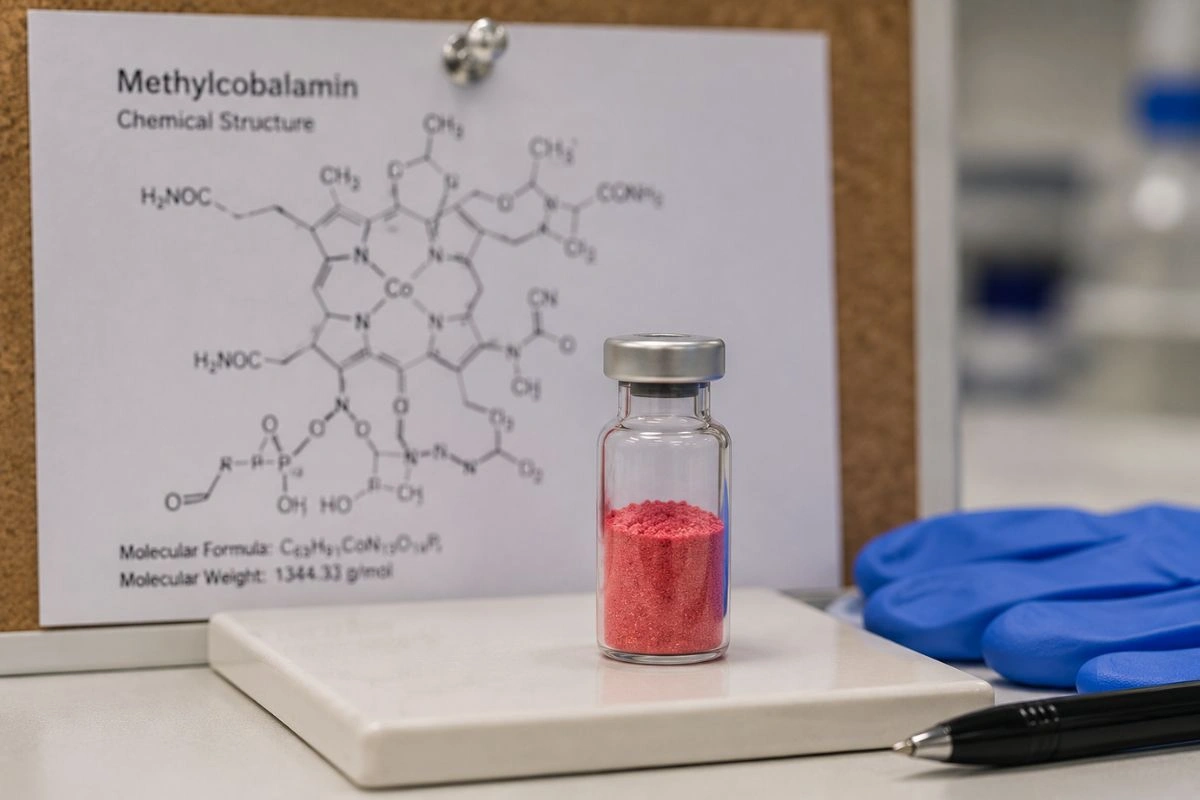
Methylcobalamin, the biologically active coenzyme form of cobalamin (commonly grouped within the B12 family of compounds), holds considerable value in laboratory research settings. Investigators across biochemistry, molecular biology, and analytical chemistry regularly work with methylcobalamin to study methyl transfer reactions, one-carbon metabolism pathways, and cobalamin-dependent enzyme kinetics.
What sets methylcobalamin apart from other cobalamin forms such as cyanocobalamin or hydroxocobalamin is the presence of a methyl group coordinated to the central cobalt ion. This structural feature gives methylcobalamin distinct photochemical, electrochemical, and reactivity properties that researchers must account for during preparation and handling. The cobalt-carbon bond in methylcobalamin is notably photolabile, meaning exposure to visible and ultraviolet light can cleave this bond and convert the compound into inactive degradation products.
For research teams planning to incorporate methylcobalamin into their experimental workflows, understanding these physicochemical characteristics before reconstitution is not optional. It is the foundation for producing reliable, reproducible results.
Disclaimer: B12 Peptide (methylcobalamin) is sold strictly for research purposes only and is not intended for human consumption. The information presented in this article serves educational and laboratory research purposes only. Nothing in this content constitutes medical advice, a therapeutic claim, or an endorsement for any use outside of approved research settings. All researchers must comply with applicable institutional, local, state, and federal regulations when handling research compounds.
Reconstitution Protocol: Solvent Selection and Technique
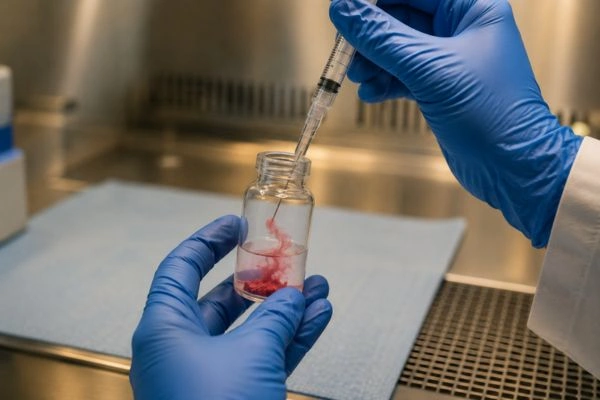
Reconstitution of methylcobalamin demands more care than many researchers initially expect. The compound’s sensitivity to light, oxygen, and pH means that the reconstitution environment, solvent choice, and physical technique all influence the quality of the final solution.
Preparing the Workspace
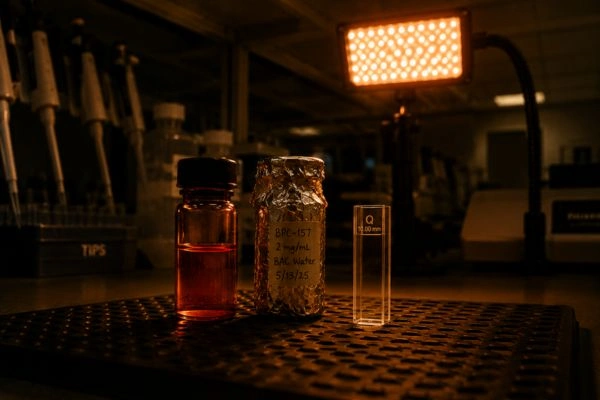
Methylcobalamin reconstitution should ideally take place under reduced lighting conditions. Standard fluorescent laboratory lighting and direct sunlight can initiate photodegradation within minutes of the compound entering solution. Amber or red-filtered lighting provides an effective alternative that allows researchers to work comfortably while protecting the compound. If specialized lighting is unavailable, dimming overhead lights and working quickly will reduce exposure.
Gather all materials before opening the methylcobalamin vial:
- Lyophilized or crystalline methylcobalamin (for research use only)
- Reconstitution solvent (deionized water, sterile water, or appropriate buffer)
- Sterile syringes or calibrated micropipettes
- Amber glass vials or foil-wrapped containers for the reconstituted solution
- Alcohol swabs for septum sterilization
- Nitrile gloves and standard laboratory PPE
- Laboratory notebook or electronic lab notebook for documentation
Selecting the Appropriate Solvent
Solvent choice depends on the downstream analytical or experimental application.
- Deionized water is suitable for most spectroscopic studies, HPLC analysis, and general characterization work. It provides a clean baseline without ionic interference.
- Sterile water is recommended when the reconstituted solution will be used in cell culture environments or biological assays where microbial contamination must be eliminated.
- Phosphate buffer (pH 7.0 to 7.5) helps maintain solution stability for experiments that extend over several hours. Methylcobalamin is most stable near neutral pH, and buffered solutions resist the gradual pH drift that can occur in unbuffered aqueous preparations.
- DMSO may be used as an initial solvent for preparing concentrated stock solutions before dilution into aqueous buffers. This approach is useful when preparing serial dilutions or when the experimental protocol requires a known organic co-solvent fraction.
Executing the Reconstitution
- Allow the methylcobalamin vial to reach room temperature (20 to 25 degrees Celsius) before opening. This prevents condensation from introducing unwanted moisture to the powder.
- If the vial has a rubber septum, sterilize it with an alcohol swab and allow it to dry.
- Add the calculated volume of solvent slowly. Direct the liquid against the inner wall of the vial rather than onto the powder. This prevents splashing and reduces the risk of localized concentration gradients.
- Allow the compound to dissolve with gentle swirling. Do not vortex aggressively. Methylcobalamin typically dissolves readily in aqueous solvents, producing a characteristic reddish-pink to orange solution depending on concentration and solvent.
- Verify dissolution visually. The solution should be uniformly colored with no visible particulate matter or undissolved residue.
- Immediately transfer the reconstituted solution to an amber glass vial or wrap the original vial in aluminum foil to protect against photodegradation.
- Label the container with the compound identity, concentration, solvent, date, lot number, and preparer initials.
Light Sensitivity and Environmental Controls
Photolability is the single most critical handling concern for methylcobalamin research compounds. Unlike cyanocobalamin, which features a relatively stable cobalt-cyanide bond, the cobalt-carbon bond in methylcobalamin is readily cleaved by photons in the visible and near-UV spectrum. This makes environmental controls a non-negotiable aspect of any research protocol involving this compound.
Understanding the Photodegradation Pathway
When exposed to light, methylcobalamin undergoes homolytic cleavage of the Co-C bond, releasing a methyl radical and generating aquacobalamin (or hydroxocobalamin, depending on solution conditions). This degradation is irreversible under standard laboratory conditions. The resulting product has different spectroscopic, electrochemical, and catalytic properties than the parent compound, meaning photodegraded samples will produce inaccurate data in any assay that depends on intact methylcobalamin.
The rate of photodegradation depends on light intensity, wavelength, temperature, and solution composition. Studies in the published literature have documented measurable degradation within minutes of exposure to standard laboratory fluorescent lighting.
Practical Light Protection Strategies
Use amber glassware throughout the workflow. From reconstitution through storage and experimental use, amber glass vials, flasks, and cuvettes significantly reduce the amount of photolytically active light reaching the solution.
Wrap clear containers in aluminum foil. When amber glassware is unavailable, tightly wrapping clear glass or plastic containers in foil provides an effective, low-cost alternative.
Work under red or amber light. Wavelengths above approximately 600 nm have substantially less energy to cleave the Co-C bond. Red darkroom safelights or amber LED panels allow comfortable work while minimizing photodegradation risk.
Minimize time in solution before measurement. Prepare reconstituted methylcobalamin as close to the time of use as practical. If the experimental protocol involves incubation periods, conduct these in the dark (wrapped containers or darkened incubators).
Purge with inert gas. For experiments where both photodegradation and oxidative degradation are concerns, purging the headspace of the vial with nitrogen or argon before sealing provides an additional layer of protection.
Verifying Compound Integrity
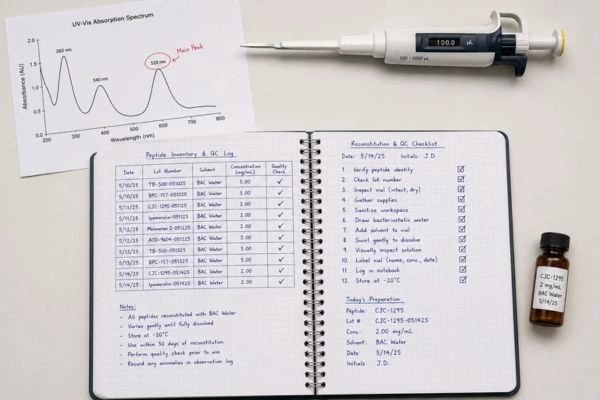
UV-Vis spectroscopy is the most accessible method for confirming that methylcobalamin has not undergone significant photodegradation. Intact methylcobalamin exhibits characteristic absorption maxima near 260 nm, 340 nm, and 525 nm. A decrease in the 525 nm band or a shift in the spectral profile relative to a freshly prepared reference standard indicates degradation has occurred.
Stability, Storage, and Shelf Life Considerations
Proper storage of both the lyophilized starting material and the reconstituted solution directly affects how long the compound remains usable and how consistent your experimental results will be across days, weeks, or months of research activity.
Lyophilized Storage
Methylcobalamin in its dry, lyophilized, or crystalline form is significantly more stable than in solution. Store the unopened container under the following conditions:
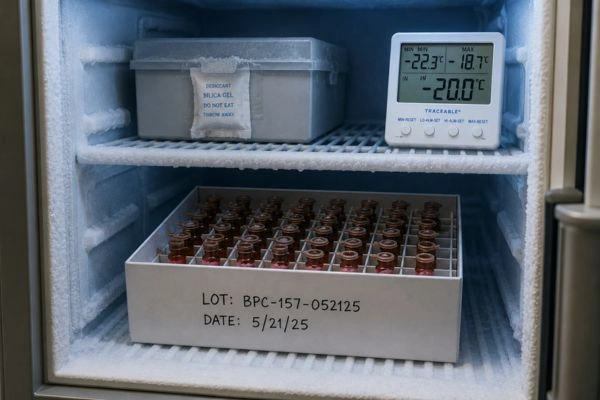
- Temperature: Minus 20 degrees Celsius is the standard recommendation for long-term storage. Some researchers store at 2 to 8 degrees Celsius for shorter periods (weeks to a few months), but lower temperatures provide a wider margin of safety against slow degradation.
- Light: Store in the original opaque or amber container. If the manufacturer’s packaging is translucent, place the vial inside an opaque secondary container or wrap in aluminum foil before placing it in the freezer.
- Moisture: Ensure the vial seal is intact. Desiccant packets in the storage container can provide additional protection against humidity, which is particularly important in humid laboratory environments or when the freezer is opened frequently.
Under these conditions, lyophilized methylcobalamin typically remains stable for the duration stated on the certificate of analysis (COA), often 12 months or longer from the date of manufacture.
Reconstituted Solution Storage
Once in solution, methylcobalamin is subject to accelerated degradation from light, heat, and dissolved oxygen. Follow these guidelines to maximize the useful life of your reconstituted stock:
- Short-term (1 to 7 days): Store at 2 to 8 degrees Celsius in an amber vial or foil-wrapped container. Keep the vial sealed and upright. Buffered solutions (pH 7.0 to 7.5) tend to retain integrity longer than unbuffered preparations.
- Medium-term (1 to 4 weeks): Prepare single-use aliquots in amber microcentrifuge tubes or foil-wrapped low-binding tubes. Store at minus 20 degrees Celsius. Aliquoting eliminates repeated freeze-thaw cycles, which can concentrate solutes, shift pH, and accelerate degradation.
- Long-term (beyond 4 weeks): Store aliquots at minus 80 degrees Celsius for maximum preservation. Even at this temperature, periodic quality checks using UV-Vis spectroscopy are recommended to confirm the compound remains within acceptable integrity parameters.
Freeze-Thaw Cycle Management
Each freeze-thaw event subjects the solution to ice crystal formation, transient concentration changes at the freezing front, and potential pH fluctuation. For a photosensitive compound like methylcobalamin, these stresses compound the risk of degradation. Prepare aliquots sized to your typical single-experiment usage at the time of reconstitution. This practice is the single most effective way to extend the functional shelf life of your reconstituted stock.
Documentation, Quality Control, and Reproducibility Standards
Thorough documentation and routine quality verification transform good laboratory practice into defensible, publishable research. For methylcobalamin studies in particular, where the compound’s sensitivity introduces additional variables, rigorous record-keeping is essential.
Certificate of Analysis Review
Before reconstituting any lot of methylcobalamin, examine the COA for the following:
- Purity. Typically determined by HPLC. Research-grade methylcobalamin is commonly supplied at 95% or greater purity. Note the specific purity value for your lot, as this affects concentration calculations.
- Identity confirmation. The COA should include UV-Vis absorption data and, for higher-grade material, mass spectrometry confirmation of molecular weight (1,344.4 g/mol for methylcobalamin).
- Peptide or compound content. The net active content as a percentage of total weight accounts for residual moisture, counterions, and salts. Use this value when calculating your reconstitution volume to achieve the desired molar concentration.
- Lot number and expiration. Record the lot number in your notebook for every experiment. If you observe unexpected results, this information enables you to cross-reference with the supplier and with other researchers using the same lot.
Analytical Verification After Reconstitution
Implement at least one of the following quality checks when working with a new lot, after extended storage, or when troubleshooting inconsistent data:
- UV-Vis spectroscopy is the fastest and most practical check. Compare the absorption spectrum of your reconstituted solution against published reference spectra for methylcobalamin. Confirm the presence and relative intensity of peaks near 260, 340, and 525 nm.
- HPLC analysis provides a more detailed purity profile and can detect degradation products that may not be obvious from UV-Vis data alone.
- Mass spectrometry offers definitive molecular weight confirmation and can identify specific degradation fragments if the compound has partially decomposed.
Building a Standard Operating Procedure
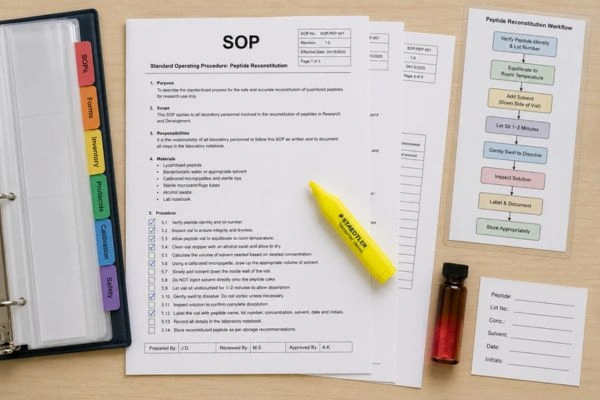
For laboratories that work with methylcobalamin regularly, developing a written SOP for reconstitution, handling, and storage ensures that every team member follows the same protocol. A well-constructed SOP should include:
- Required materials and equipment
- Step-by-step reconstitution instructions with solvent options
- Light protection and environmental control requirements
- Labeling standards for reconstituted vials and aliquots
- Storage temperature and duration guidelines
- Quality check schedule and acceptance criteria
- Waste disposal procedures for expired or degraded solutions
Standardization across researchers and time points is the backbone of reproducible science. When every variable from solvent choice to storage temperature is documented and controlled, your data stands on solid ground.
Conclusion
Methylcobalamin rewards the researcher who respects its chemistry. The compound’s photolabile cobalt-carbon bond demands what most peptides and reagents do not: active environmental control from the moment the vial is opened. Work under amber or red-filtered lighting, direct your solvent against the vial wall, and transfer the reconstituted solution into amber glassware immediately, not after finishing other tasks. Aliquot into single-use volumes before the solution ever enters a freezer, store at −20°C or −80°C depending on your timeline, and verify integrity with UV-Vis spectroscopy at the 525 nm band whenever you open a new lot or revisit stored stock. Document every reconstitution event completely, including solvent, concentration, lighting conditions, and dissolution observations. Build these steps into a written SOP so that every researcher in your lab follows the same protocol. Control the light, control the temperature, and let your data speak with confidence.
Disclaimer: B12 Peptide (methylcobalamin) is sold strictly for research purposes only and is not intended for human consumption. The information presented in this article serves educational and laboratory research purposes only. Nothing in this content constitutes medical advice, a therapeutic claim, or an endorsement for any use outside of approved research settings. All researchers must comply with applicable institutional, local, state, and federal regulations when handling research compounds.
Frequently Asked Questions
Why does methylcobalamin require light protection during reconstitution?
Methylcobalamin contains a cobalt-carbon bond that is cleaved by photons in the visible and near-UV spectrum, producing aquacobalamin or hydroxocobalamin, compounds with entirely different reactivity and spectroscopic profiles. This photodegradation begins within minutes under standard fluorescent lab lighting and is irreversible. Work under amber or red-filtered light (wavelengths above 600 nm), use amber glassware at every stage, and wrap any clear containers in aluminum foil before the compound ever enters solution.
What solvent should I use to reconstitute methylcobalamin?
Select your solvent based on your downstream application. Use deionized water for spectroscopic studies and HPLC analysis where a clean ionic baseline matters. Choose sterile water when the solution will contact cell cultures or biological assays. Use a phosphate buffer at pH 7.0–7.5 for experiments extending over several hours, as the buffer prevents pH drift that accelerates degradation. Reserve DMSO for preparing concentrated stock solutions that will be diluted into aqueous buffers.
How do I confirm that my reconstituted methylcobalamin has not degraded?
Run a UV-Vis absorption spectrum and check for characteristic peaks near 260 nm, 340 nm, and 525 nm. A decrease in the 525 nm band or a visible shift in the spectral profile compared to a freshly prepared reference standard signals that photodegradation or oxidative breakdown has occurred. For more detailed assessment, use reverse-phase HPLC to detect degradation products or mass spectrometry to confirm the intact molecular weight of 1,344.4 g/mol.
How should I store reconstituted methylcobalamin to maximize its shelf life?
For use within one to seven days, store in an amber vial at 2–8°C, sealed and upright. For one to four weeks, prepare single-use aliquots in amber or foil-wrapped low-binding microcentrifuge tubes and store at −20°C. For anything beyond four weeks, move aliquots to −80°C and run periodic UV-Vis checks to confirm integrity. Never store reconstituted solutions in frost-free freezers, as their warming cycles introduce the temperature fluctuations that drive degradation.
Why is aliquoting at the time of reconstitution so important for methylcobalamin?
Each freeze-thaw cycle subjects the solution to ice crystal formation, transient concentration shifts, and pH fluctuations, stresses that compound the photodegradation risk already inherent to methylcobalamin. By dividing the full volume into single-use aliquots immediately after dissolution, you ensure that each experiment draws from material that has been frozen and thawed exactly once. Size each aliquot to match your typical single-experiment volume so nothing is refrozen, and label every tube with compound identity, concentration, solvent, date, and lot number.