❌ Not for Human Consumption
●
✅ For Research Use Only
●
All products are intended strictly for laboratory research purposes only
●
❌ Not for Human Consumption
●
✅ For Research Use Only
●
All products are intended strictly for laboratory research purposes only
●

Stability Profile Of AOD-9604 Under Various Laboratory Storage Conditions

Written By: Gary Hite, Research Content Writer
Reviewed By: Natalie Kunsman, M.D., Board-Certified Physician
Last Reviewed: July 21, 2026
AOD-9604, a modified fragment of human growth hormone corresponding to amino acids 177 through 191, is a widely studied peptide in academic and laboratory research. Investigators working with receptor binding assays, peptide characterization studies, and cellular signaling research rely on AOD-9604 as a consistent, well-characterized research tool.
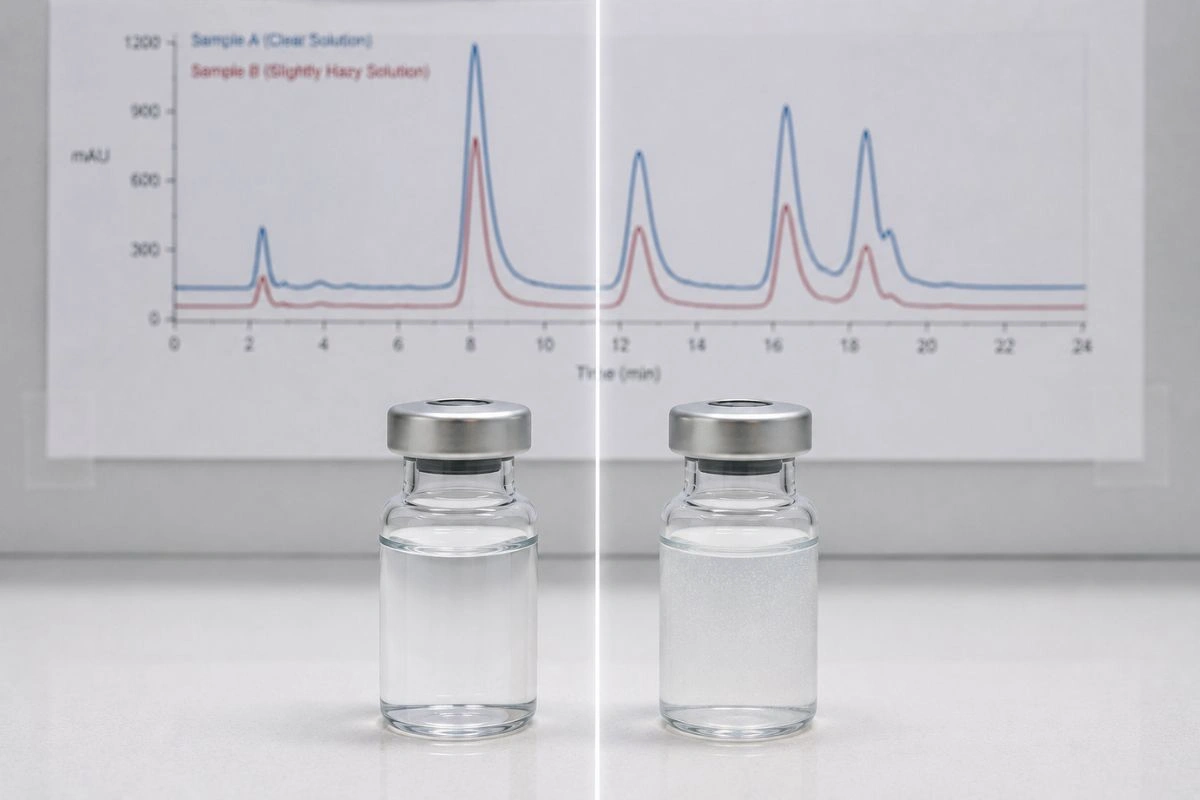
Stability is not a secondary concern in peptide research. It is a primary variable that determines whether your data is meaningful or compromised. A peptide that has partially degraded introduces unknown variables into every result it touches. Fragmented or aggregated AOD-9604 can produce false negatives in binding assays, inconsistent dose-response curves, and irreproducible findings.
For these reasons, understanding how AOD-9604 behaves under different storage conditions is essential knowledge for any research team incorporating this peptide into its workflow. The stability profile outlined below provides practical, actionable guidance for preserving peptide integrity from the moment the vial arrives in your laboratory through the final experimental time point.
Disclaimer: AOD-9604 is sold strictly for research purposes only and is not intended for human consumption. This article is provided for educational and laboratory research use only. Nothing herein constitutes medical advice, a therapeutic recommendation, or an endorsement for any application outside of controlled research environments. Researchers must comply with all applicable institutional, local, state, and federal regulations.
Lyophilized Stability: Temperature and Packaging Variables
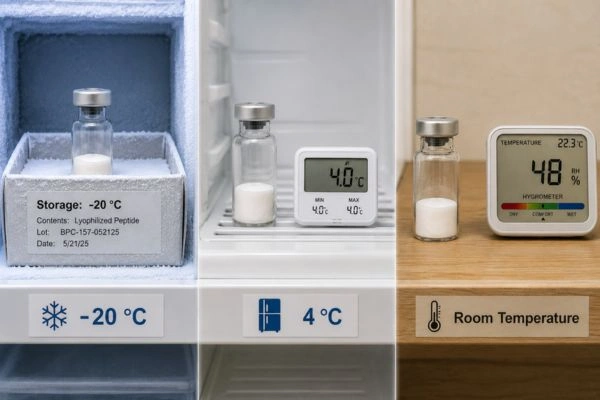
In its lyophilized (freeze-dried) form, AOD-9604 exhibits its highest stability. The removal of water during lyophilization dramatically slows hydrolytic and oxidative degradation pathways, giving the dry powder a shelf life that far exceeds that of the reconstituted solution.
Storage temperature remains the most influential variable for lyophilized stability. At minus 20 degrees Celsius, properly sealed AOD-9604 retains its stated purity for the full duration listed on the certificate of analysis, often 12 to 24 months from the date of manufacture. At 2 to 8 degrees Celsius (standard refrigeration), the peptide remains stable for shorter windows, typically several months, though gradual moisture ingress can shorten this if the vial seal is compromised.
Room temperature storage (20 to 25 degrees Celsius) is acceptable only for brief transit periods. Extended storage at ambient conditions accelerates low-level degradation, particularly in environments with elevated humidity. Moisture absorption by the lyophilized powder can initiate hydrolysis of peptide bonds before the vial is even opened.
Packaging integrity plays a supporting role. Vials with intact crimped seals and inert gas headspace (nitrogen or argon) outperform those that have been opened, partially used, and resealed. Once a lyophilized vial is opened, reconstitute the full contents promptly rather than attempting to reseal and store the remaining powder.
Reconstituted Solution Stability: The Critical Transition
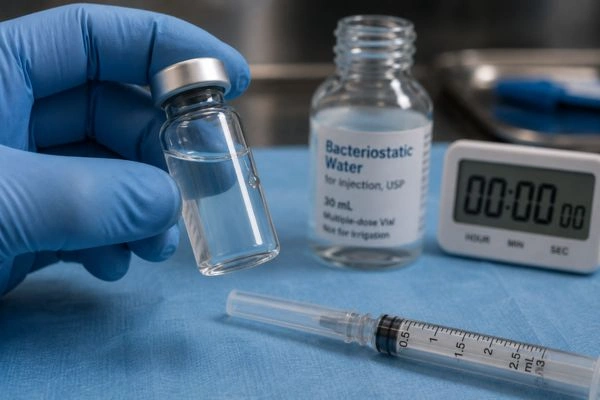
The moment AOD-9604 enters solution, its stability profile changes significantly. Water reintroduces hydrolytic pathways, dissolved oxygen enables oxidative degradation, and microbial contamination becomes a relevant risk factor. Managing these variables determines how long your reconstituted stock remains experimentally viable.
At refrigerated temperatures (2 to 8 degrees Celsius), reconstituted AOD-9604 in bacteriostatic water typically maintains acceptable integrity for 7 to 14 days. Bacteriostatic water’s 0.9% benzyl alcohol content suppresses microbial growth but does not halt chemical degradation. Researchers who plan to use the solution within this window should store the vial upright, sealed, and protected from light.
For storage beyond two weeks, freezing is necessary. Single-use aliquots stored at minus 20 degrees Celsius extend usable life to several weeks. Storage at minus 80 degrees Celsius provides the longest preservation window for reconstituted peptide solutions, often maintaining integrity for one to three months depending on solvent composition and handling practices.
Sterile water preparations, lacking the antimicrobial protection of benzyl alcohol, should be used within 24 to 48 hours when refrigerated or aliquoted and frozen immediately after reconstitution. Phosphate-buffered saline (PBS) preparations follow similar timelines, though the buffering capacity helps maintain pH stability throughout storage.
Freeze-Thaw Degradation and Aliquoting Strategies
Repeated freeze-thaw cycling is among the most damaging and most preventable sources of peptide degradation in laboratory settings. Each cycle subjects AOD-9604 to ice crystal formation, localized concentration spikes at the freezing front, transient pH shifts, and mechanical stress on the peptide backbone.
Published data on similar peptide fragments demonstrate measurable purity loss after as few as three to five freeze-thaw cycles. The practical recommendation is clear: minimize cycles to the greatest extent possible, and ideally eliminate them entirely through disciplined aliquoting.
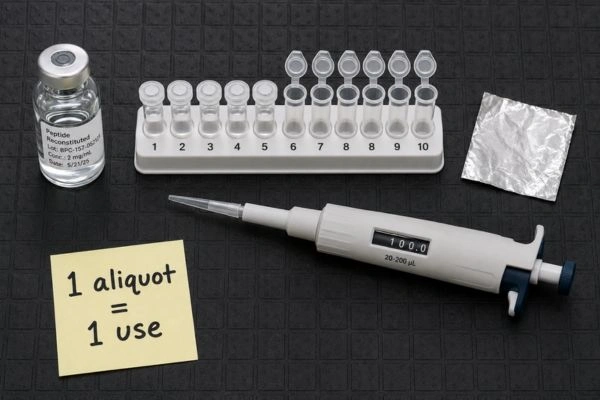
The most effective strategy is to prepare single-use aliquots at the time of reconstitution. Calculate the volume needed for a single experiment, dispense that volume into individual sterile, low-binding microcentrifuge tubes, and transfer to the freezer immediately.
When an aliquot is needed, thaw it at room temperature or on ice, use the full contents, and discard the tube. Never refreeze a thawed aliquot. This approach pays substantial dividends in data consistency and reagent longevity across the full life of the stock.
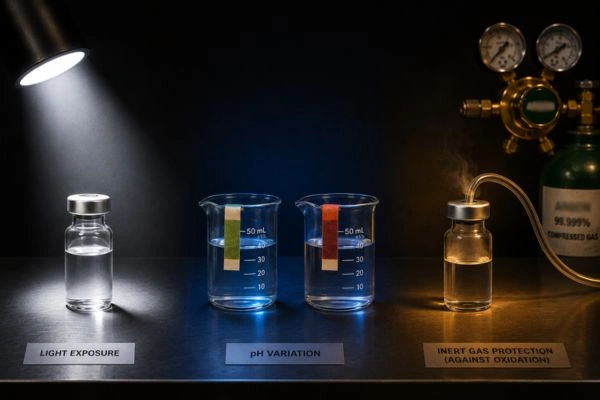
Environmental Stressors: Light, pH, and Oxidation
Beyond temperature, several environmental factors influence AOD-9604 stability in solution. Accounting for each of these in your storage and handling protocols strengthens the overall reliability of your experimental system.
Light exposure. While AOD-9604 is not as acutely photosensitive as some chromophore-containing compounds, prolonged exposure to UV and visible light can contribute to gradual degradation over days to weeks. Storing reconstituted solutions in amber vials or wrapping clear containers in aluminum foil is a low-effort measure that provides meaningful protection.
pH. AOD-9604 is most stable in solutions near neutral pH (6.5 to 7.5). Acidic conditions (below pH 5) can promote acid-catalyzed hydrolysis of peptide bonds, while strongly alkaline conditions (above pH 9) accelerate base-catalyzed degradation and potential deamidation of asparagine residues. If your experimental protocol requires non-neutral conditions, prepare the adjusted solution immediately before use rather than storing it at extreme pH values.
Dissolved oxygen. Oxidative degradation, particularly of methionine residues, is a well-documented pathway for peptide breakdown in aqueous solution. Purging the vial headspace with nitrogen or argon gas before sealing reduces dissolved oxygen levels and slows oxidative damage. This step is especially valuable for solutions that will be stored for more than a few days.
Adsorption losses. At low concentrations (low micromolar range and below), AOD-9604 molecules can adsorb to glass and plastic surfaces, reducing effective concentration. Low-binding tubes and siliconized glassware mitigate this effect. Including a small amount of carrier protein (such as BSA at 0.1%) in the storage buffer is another common strategy, though researchers must confirm that the carrier does not interfere with downstream assays.
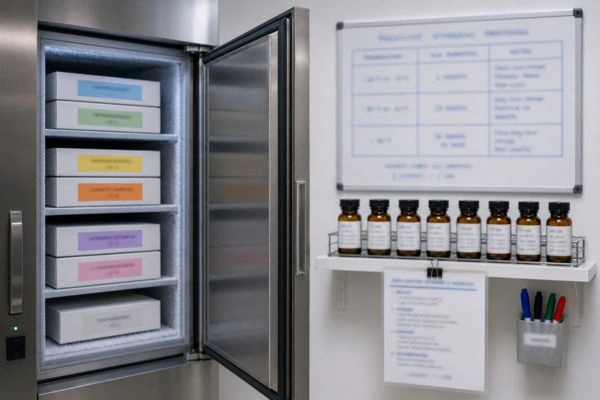
Practical Storage Recommendations for Research Teams
Translating stability data into daily laboratory practice requires clear, accessible guidelines that every team member can follow without ambiguity. The table below summarizes the key storage conditions and expected stability windows for AOD-9604.
Lyophilized AOD-9604: Store at minus 20 degrees Celsius in the original sealed vial. Protect from moisture and light. Expected stability of 12 to 24 months per COA specifications. Avoid frost-free freezers.
Reconstituted in bacteriostatic water: Refrigerate at 2 to 8 degrees Celsius for up to 14 days. For longer storage, aliquot and freeze at minus 20 or minus 80 degrees Celsius. Protect from light.
Reconstituted in sterile water or PBS: Use within 48 hours if refrigerated. For longer storage, aliquot and freeze immediately. Single-use aliquots at minus 80 degrees Celsius offer the longest viable window.
General best practices: Eliminate freeze-thaw cycles through single-use aliquoting. Use amber or foil-wrapped containers. Purge headspace with inert gas when possible. Document every storage variable in your laboratory notebook.
By building these practices into your standard operating procedures, you protect the integrity of AOD-9604 throughout its lifecycle in your laboratory and ensure that your data reflects the true behavior of the peptide.
Conclusion
Stability is not something you verify after an experiment fails; it is something you build into every step of your workflow from the start. Store lyophilized AOD-9604 at minus 20 degrees Celsius in its original sealed vial, and reconstitute the full contents promptly once opened. Move reconstituted solutions into single-use aliquots immediately, freeze them at minus 20 or minus 80 degrees Celsius, and never refreeze a thawed tube. Shield every container from light with amber glass or aluminum foil, purge headspace with nitrogen or argon to limit oxidative damage, and keep solutions near neutral pH at all times. Record storage temperatures, solvent types, aliquot volumes, and freeze-thaw history for every vial in your notebook. These are not aspirational suggestions; they are the minimum standard for generating data you can trust, reproduce, and defend. Control your storage conditions, and your peptide will perform as expected.
Disclaimer: AOD-9604 is sold strictly for research purposes only and is not intended for human consumption. This article is provided for educational and laboratory research use only. Nothing herein constitutes medical advice, a therapeutic recommendation, or an endorsement for any application outside of controlled research environments. Researchers must comply with all applicable institutional, local, state, and federal regulations.
Frequently Asked Questions
How long does lyophilized AOD-9604 remain stable, and what is the best storage temperature?
Store lyophilized AOD-9604 at minus 20 degrees Celsius in its original sealed vial, protected from moisture and light. Under these conditions, the peptide typically retains its stated purity for 12 to 24 months as indicated on the certificate of analysis. Refrigeration at 2 to 8 degrees Celsius is acceptable for shorter periods of several months, but avoid room temperature storage beyond brief transit windows, as ambient humidity can introduce moisture that initiates hydrolysis before you ever open the vial.
How long can I use reconstituted AOD-9604 before it degrades?
The timeline depends on your solvent and storage temperature. Reconstituted in bacteriostatic water and refrigerated at 2 to 8 degrees Celsius, AOD-9604 remains viable for 7 to 14 days. Sterile water or PBS preparations should be used within 48 hours if refrigerated, or aliquoted and frozen immediately. For any storage beyond two weeks, transfer single-use aliquots to minus 20 or minus 80 degrees Celsius, where integrity can be maintained for one to three months depending on handling practices.
Why are freeze-thaw cycles so damaging, and how do I avoid them?
Each freeze-thaw event exposes AOD-9604 to ice crystal formation, localized concentration spikes, transient pH shifts, and mechanical stress on the peptide backbone. Published data on similar peptide fragments show measurable purity loss after as few as three to five cycles. Eliminate this risk entirely by preparing single-use aliquots at the time of reconstitution. Calculate the volume needed for one experiment, dispense it into a sterile low-binding tube, freeze it, and discard the tube after a single use.
What environmental factors beyond temperature should I control during storage?
Three factors deserve active attention. First, shield all solutions from UV and visible light using amber vials or aluminum foil wrapping. Second, maintain solution pH between 6.5 and 7.5, as acidic conditions promote hydrolysis and alkaline conditions accelerate deamidation. Third, reduce dissolved oxygen by purging the vial headspace with nitrogen or argon before sealing. For dilute preparations in the low micromolar range, also account for surface adsorption losses by using low-binding tubes or adding 0.1% BSA as a carrier protein after confirming compatibility with your assay.
Should I avoid frost-free freezers for storing AOD-9604?
Yes. Frost-free freezers cycle through periodic warming phases to prevent ice buildup on internal surfaces. These temperature fluctuations can introduce moisture into sealed vials and subject both lyophilized powder and frozen aliquots to low-level thermal stress that accumulates over weeks and months. Use a standard manual-defrost freezer set to minus 20 degrees Celsius for routine storage, or a minus 80 degrees Celsius ultra-low freezer for long-term preservation. This single equipment choice removes a hidden source of degradation that many researchers overlook.