❌ Not for Human Consumption
●
✅ For Research Use Only
●
All products are intended strictly for laboratory research purposes only
●
❌ Not for Human Consumption
●
✅ For Research Use Only
●
All products are intended strictly for laboratory research purposes only
●

BPC-157: Origin, Sequence, And Peptide Chemistry Overview

Written By: Gary Hite, Research Content Writer
Reviewed By: Natalie Kunsman, M.D., Board-Certified Physician
Last Reviewed: July 24, 2026
BPC-157 doesn’t occur in nature. The 15 amino acid sequence that shows up in catalog listings, preclinical papers, and laboratory protocols is a synthesized fragment of a much larger parent protein originally isolated from porcine gastric juice in the early 1990s. That distinction matters for any laboratory verifying material identity, designing stability protocols, or interpreting published preclinical data against the compound on the bench.
This article covers the molecular origin, primary structure, chemical properties, and synthesis methodology behind BPC-157 as a reference for researchers and academics working with the peptide in a controlled laboratory setting.
Disclaimer: BPC-157 is supplied strictly for in vitro research and laboratory investigation. It is not for human consumption, not for diagnostic use, not for therapeutic use, and not approved by the FDA for any clinical application.
Origin: From Gastric Juice Protein to Synthesized Fragment
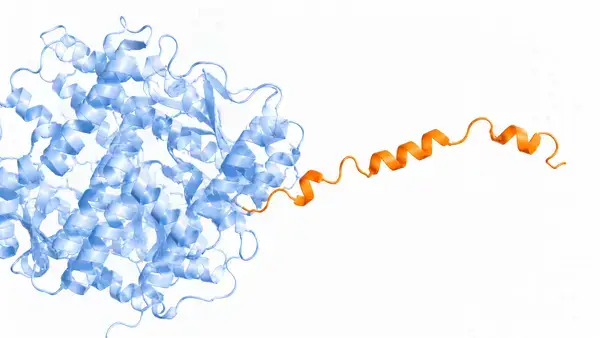
The “BPC” in BPC-157 stands for Body Protection Compound, the working name for a roughly 40 kilodalton protein characterized at the University of Zagreb School of Medicine starting in 1991. The original isolation work focused on a gastric fluid fraction with measurable activity in cytoprotection assays in animal models.
BPC-157 itself is not the parent protein. It’s a partial sequence of 15 amino acids identified by the Zagreb group as a putatively active region. Once the sequence was published, the molecule moved out of biochemistry and into synthetic peptide chemistry territory. Every milligram of BPC-157 in a research vial today is produced by solid phase peptide synthesis, not by extraction from biological material.
The compound has appeared in the literature under several designations. PL-14736 shows up in older preclinical filings from Pliva, the Croatian pharmaceutical company that held early development interest. Catalog suppliers typically list it under IUPAC fragment naming or simply as “BPC-157.” All three references describe the same pentadecapeptide.
Primary Sequence and Amino Acid Composition
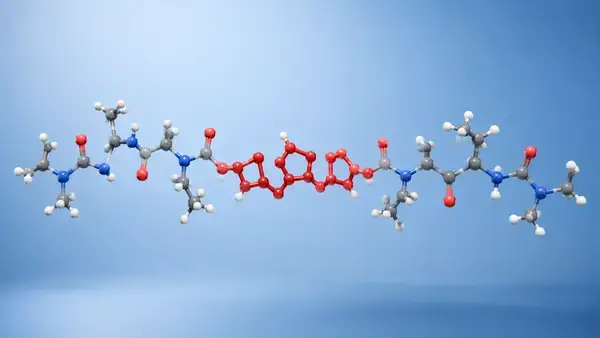
The pentadecapeptide sequence, written N-terminus to C-terminus in standard one letter code:
GEPPPGKPADDAGLV
In three letter notation:
Gly-Glu-Pro-Pro-Pro-Gly-Lys-Pro-Ala-Asp-Asp-Ala-Gly-Leu-Val
A few features stand out for researchers reading the sequence cold. The three consecutive prolines at positions 3, 4, and 5 create a rigid kinked region. Proline residues resist standard peptide bond rotation and force a kink in the backbone, which means BPC-157 doesn’t fold the way most short peptides of comparable length fold. The second proline at position 8 reinforces that conformational constraint. Circular dichroism and NMR signatures of the molecule are consistent with this proline driven rigidity.
The two aspartic acid residues at positions 10 and 11 contribute negative charge density in a tight region. The single lysine at position 7 contributes positive charge. At physiological pH the molecule carries a small net negative charge.
No cysteine. No disulfide bridges. No glycosylation sites. No phosphorylation handles. The molecule is structurally simple for a peptide its size, which is part of why it became attractive as a research target in the first place.
Molecular Formula and Physical Constants
For documentation, reference, and certificate of analysis verification:
- Molecular formula: C62H98N16O22
- Average molecular weight: approximately 1419.55 g/mol
- Monoisotopic mass: approximately 1418.71 Da
- CAS number: 137525-51-0
- Sequence length: 15 residues
- Net charge at pH 7.4: approximately negative 1
Catalog material is most commonly supplied as either the acetate salt or the trifluoroacetate (TFA) salt. Acetate is generally preferred for cell based research because residual TFA above roughly 50 parts per million can interfere with cell viability assays and skew downstream readouts. Some suppliers offer arginate salt forms, which adjusts solubility characteristics in aqueous buffers. Always check the certificate of analysis to confirm which counterion is present, because mass calculations and concentration math shift depending on salt form.
Why the Chemistry Resists Gastric Acid Hydrolysis
One of the more cited claims in BPC-157 literature is stability in simulated gastric juice. The chemistry behind that observation is worth understanding because it informs how the compound behaves in vitro.
Most peptides hydrolyze rapidly in low pH environments with pepsin present. BPC-157 resists that hydrolysis to a measurable degree in published in vitro stability studies from the Zagreb group. The structural explanation centers on three factors:
- Proline rich regions resist pepsin cleavage. Pepsin preferentially cleaves at hydrophobic and aromatic residues. BPC-157 contains no phenylalanine, no tryptophan, and no tyrosine. The only hydrophobic residues are leucine and valine, both at the C-terminus.
- The rigid backbone kink from the three consecutive prolines reduces accessibility of the surrounding amide bonds to protease active sites.
- No labile bonds in classic protease cleavage positions. The aspartate residues sit in the middle of the molecule, away from pepsin’s preferred recognition sites.
This profile affects how the compound behaves in long term storage solutions and in any in vitro assay that includes acidic buffers. It does not, and the literature does not claim it does, translate to any specific in vivo outcome in humans.
Synthesis: Solid Phase Peptide Synthesis with Fmoc Chemistry
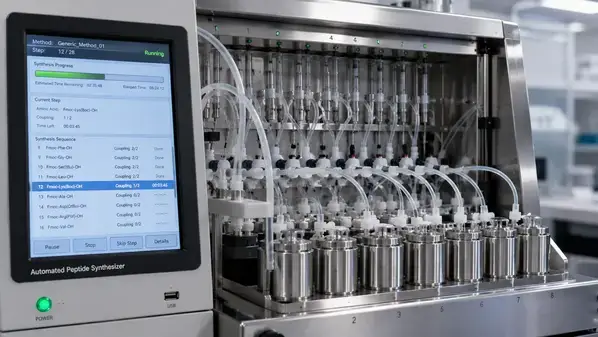
Research grade BPC-157 is almost exclusively produced via solid phase peptide synthesis (SPPS) using the Fmoc (9-fluorenylmethoxycarbonyl) protecting group strategy. The general workflow runs C-terminus to N-terminus.
The C-terminal valine residue is loaded onto a Wang resin or 2-chlorotrityl chloride resin. Each subsequent residue is coupled in stepwise fashion, with Fmoc deprotection between cycles using 20 percent piperidine in dimethylformamide. Coupling reagents are typically HBTU or HATU with DIEA as base.
The three consecutive prolines present a known synthesis challenge. Proline coupling is slower than coupling to most other amino acids, and the secondary amine character of proline can cause incomplete couplings if reaction times aren’t extended. Quality suppliers run double couplings at the Pro-Pro-Pro region and verify completion via Kaiser test or chloranil test between steps. Skipping that verification is the most common source of truncation impurities in BPC-157 crude product.
After full chain assembly, the peptide is cleaved from the resin using a TFA cocktail (typically TFA with triisopropylsilane and water in a 95:2.5:2.5 ratio) and precipitated in cold diethyl ether. Crude product is purified by reverse phase HPLC, usually on a C18 column with acetonitrile/water gradients buffered with 0.1 percent TFA. Final purity is verified by analytical HPLC and confirmed by mass spectrometry, with research grade material typically specified at 98 percent or higher by HPLC area.
If you’re sourcing material to replicate a published protocol, check the COA for:
- Purity by HPLC area percentage
- Mass confirmation by ESI-MS or MALDI-TOF
- Residual TFA content if relevant to your assay
- Water content by Karl Fischer titration for precise concentration work
- Counterion identity and content
Stability, Storage, and Handling for Laboratory Use
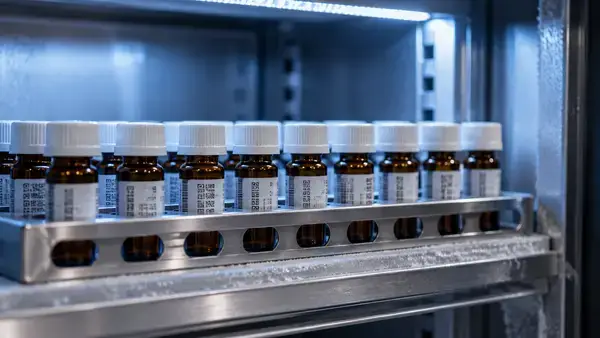
Lyophilized BPC-157 in sealed amber vials stored at minus 20 degrees Celsius is the standard reference condition. The compound is stable for extended periods under those conditions, with most suppliers specifying 24 to 36 months when unopened.
Once reconstituted in bacteriostatic water or saline, working solution stability shortens considerably. Aqueous solutions at neutral pH stored at 4 degrees Celsius show measurable degradation over weeks rather than months. For long term storage of reconstituted material, aliquot and freeze at minus 80 degrees Celsius to minimize freeze thaw cycles, which are the single largest source of peptide degradation in working solutions.
One practical lab note: BPC-157 dissolves readily in water and standard aqueous buffers. It does not require DMSO or other organic cosolvents. If you encounter a protocol calling for DMSO solubilization of BPC-157, the protocol is either accommodating a different solubility issue (impurity profile, unusual salt form) or the author has confused the compound with a different peptide. Verify before you reconstitute.
What the Chemistry Doesn’t Tell You
The structural and synthesis details above describe the molecule. They don’t describe biological activity, mechanism of action, or any clinical application. The published preclinical literature on BPC-157 is substantial in scope but limited to in vitro systems and animal models. No human clinical efficacy or safety data supports any therapeutic claim. The FDA has not approved BPC-157 for any use in humans.
Researchers handling the compound should treat it the way any uncharacterized research chemical is handled: gloves, eye protection, fume hood for powder weighing, and standard chemical hygiene protocols. Any laboratory work involving live cells, animal models, or other biological systems requires appropriate institutional review and approval before initiation.
Conclusion
The chemistry of BPC-157 rewards careful documentation more than it rewards clever protocols. A 15 residue pentadecapeptide with a proline driven kink, no disulfide bonds, and a CAS registry entry from the early 1990s is not a complicated molecule to source or store. What separates reproducible research from frustrated retries is the paperwork: confirmed sequence by mass spec, verified purity by HPLC, identified counterion on the COA, and known water content before any concentration calculation.
Treat the molecule as what it is. A synthesized fragment of a parent gastric juice protein, produced by Fmoc SPPS, supplied for in vitro investigation under standard chemical hygiene practice. Researchers who run that verification workflow before the first assay run cleaner data downstream. Those who skip it end up debugging the peptide instead of the experiment.
FAQs
Is BPC-157 a naturally occurring peptide?
No. BPC-157 is a synthesized 15 amino acid fragment of a larger Body Protection Compound protein originally characterized from porcine gastric juice by the University of Zagreb research group in the early 1990s. The pentadecapeptide sold for research purposes is produced exclusively through solid phase peptide synthesis and does not exist in this 15 residue form in any biological tissue. Every research vial on the market today is laboratory synthesized material.
What is the molecular formula and weight of BPC-157?
The molecular formula is C62H98N16O22, with an average molecular weight of approximately 1419.55 g/mol and a monoisotopic mass near 1418.71 Da. The CAS registry number is 137525-51-0. These values apply to the free peptide. Catalog material supplied as acetate, TFA, or arginate salts will report higher mass values on the COA reflecting counterion mass, which needs to be accounted for in any concentration calculation.
What is the difference between BPC-157 acetate and BPC-157 TFA?
The two forms differ only in the counterion paired with the basic residues of the peptide. Acetate is generally preferred for cell based in vitro work because residual trifluoroacetate above roughly 50 parts per million can interfere with cell viability and downstream assay readouts. TFA salt is more common as a default output of reverse phase HPLC purification. Always confirm the counterion on the certificate of analysis before designing concentration ranges, because the salt form changes the mass of dispensed material.
How should BPC-157 be stored in a research laboratory?
Lyophilized BPC-157 in sealed amber vials stored at minus 20 degrees Celsius remains stable for 24 to 36 months according to most supplier specifications. Once reconstituted in aqueous buffer, working solutions show measurable degradation over weeks at 4 degrees Celsius. For longer term storage of reconstituted material, aliquot into single use volumes and freeze at minus 80 degrees Celsius. Freeze thaw cycles are the largest source of peptide degradation in working solutions, so aliquoting matters more than the freezer temperature alone.
Is BPC-157 approved for human use?
No. BPC-157 has not been evaluated or approved by the FDA for any use in humans. The published literature is limited to in vitro systems and animal models. The compound is supplied strictly for laboratory research and educational purposes by professional researchers and academic institutions. It is not for human consumption, not for veterinary application, and not for any diagnostic or therapeutic purpose. Purchasers assume full responsibility for compliance with applicable regulations governing research chemicals.