❌ Not for Human Consumption
●
✅ For Research Use Only
●
All products are intended strictly for laboratory research purposes only
●
❌ Not for Human Consumption
●
✅ For Research Use Only
●
All products are intended strictly for laboratory research purposes only
●

CJC-1295 With DAC Vs Without DAC: Half-Life And Pharmacokinetic Comparisons

Written By: Gary Hite, Research Content Writer
Reviewed By: Natalie Kunsman, M.D., Board-Certified Physician
Last Reviewed: July 26, 2026
Disclaimer: For Research Use Only. Not for human consumption. This article is written for credentialed researchers, academic laboratories, and pharmaceutical scientists studying GHRH analogs in preclinical models. Nothing in this piece constitutes medical advice, a therapeutic claim, or a recommendation for use in humans. All compounds referenced are intended solely for in vitro and validated preclinical research.
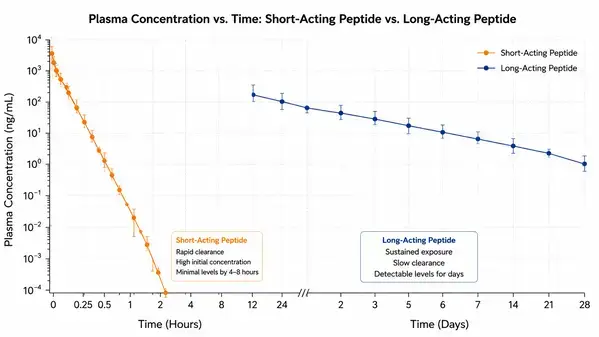
The half-life difference between CJC-1295 with DAC and CJC-1295 without DAC is not incremental. It’s three orders of magnitude. The non-DAC variant (Modified GRF 1-29) shows a plasma half-life of approximately 30 minutes in preclinical pharmacokinetic studies. The DAC variant, in the 12-subject pharmacokinetic study by Teichman et al. published in the Journal of Clinical Endocrinology and Metabolism in 2006, showed an estimated half-life of 5.8 to 8.1 days following a single subcutaneous administration (PMID: 16352683).
That single quantitative gap drives almost every experimental design decision a researcher will make with these compounds.
Same backbone, one structural addition
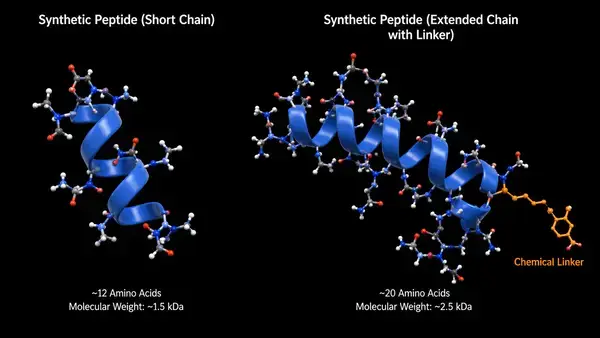
Both variants share an identical 29-residue peptide backbone derived from the first 29 amino acids of human GHRH. Both share the same four amino acid substitutions that distinguish CJC-1295 from native GRF(1-29): D-Ala at position 2 (blocks DPP-IV cleavage), Gln at position 8 (reduces asparagine deamidation), Ala at position 15 (improves bioactivity), and Leu at position 27 (prevents methionine oxidation). This tetrasubstituted backbone is sometimes called Modified GRF 1-29, or Mod GRF.
What separates the two variants is a single structural addition. CJC-1295 with DAC appends a lysine residue at position 30, conjugated to a maleimidopropionic acid (MPA) linker. The non-DAC variant stops at residue 29.
That’s the entire molecular difference. One amino acid extension. One reactive linker. Everything else about the peptide is the same: the same receptor target (GHRHR on anterior pituitary somatotrophs), the same signaling cascade (Gs/cAMP/PKA), the same downstream pharmacology when bound.
The covalent albumin-binding mechanism is what matters
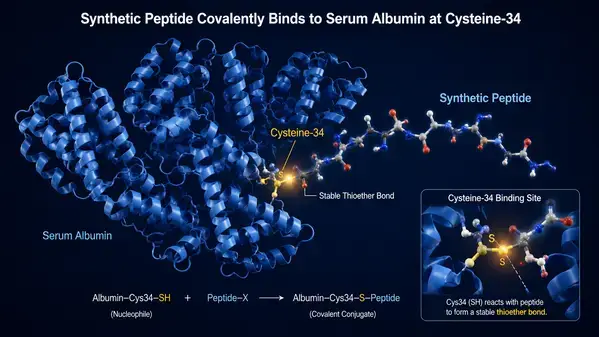
This is the part that gets misrepresented in casual summaries. The DAC linker doesn’t just “bind” albumin. The maleimide group on the MPA linker reacts chemically with the free thiol on cysteine-34 of serum albumin, forming a covalent thioether bond. That’s not reversible equilibrium binding the way a small molecule might associate with a plasma protein. It’s irreversible covalent chemistry that happens within minutes of subcutaneous administration in research models.
The consequence is that the peptide effectively inherits albumin’s pharmacokinetic profile. Human serum albumin has a circulatory half-life of roughly 19 to 21 days. CJC-1295 DAC’s measured half-life of 5.8 to 8.1 days reflects the peptide-albumin conjugate clearing more rapidly than free albumin, but vastly slower than any free peptide of comparable molecular weight would clear. The MPA-Cys34 thioether is doing nearly all the pharmacokinetic work.
The non-DAC variant has no albumin-anchoring chemistry. Its 30-minute half-life is what you get when you take native GHRH(1-29), make it DPP-IV resistant, and let it move through the body unconjugated. The four substitutions buy you a 4 to 5x improvement over native GHRH (which has a circulatory half-life of about 7 minutes). The DAC modification, by contrast, buys you a 300 to 400x improvement.
The pharmacodynamic profiles are not just “longer” vs “shorter”
Here’s the point most surface-level comparisons miss. The two variants don’t produce the same pharmacological output stretched across different timescales. They produce qualitatively different downstream profiles.
In the Teichman 2006 dataset, a single subcutaneous administration of CJC-1295 DAC in healthy adult subjects produced sustained, non-pulsatile elevation of plasma GH (2 to 10 fold above baseline) for at least 6 days, with plasma IGF-1 elevated 1.5 to 3 fold for 9 to 11 days. With repeated administration, IGF-1 remained above baseline for up to 28 days. That’s tonic, sustained prolonged receptor interaction time.
CJC-1295 without DAC produces something fundamentally different. Because the compound clears the plasma compartment within roughly 90 minutes (about three half-lives), it produces a discrete GH pulse, then drops out, allowing the somatotroph and the somatostatin feedback loop to return to baseline. A 2008 human pharmacokinetic study (24 subjects, 100 mcg administered three times daily for 30 days) found that pulsatile GH release was preserved with no measurable attenuation in signaling response observed.
This is the design consideration: tonic versus pulsatile GHRHR activation are not interchangeable for most research questions. If your hypothesis depends on preserving endogenous pulsatility, the DAC version invalidates the experimental design. If your hypothesis depends on sustained receptor activation over multi-day windows, the non-DAC version requires impractical administration frequency to approximate it.
What this means for experimental design
The choice between variants should be driven by what the research model is actually testing. Some scenarios where each variant typically fits:
CJC-1295 with DAC is generally selected when researchers need:
- Sustained GHRHR activation over multi-day windows for chronic exposure studies
- Reduced administration frequency in long-running preclinical models
- Research involving prolonged GHRHR signaling exposure windows
- IGF-1 dependent versus IGF-1 independent pathway dissociation studies
CJC-1295 without DAC is generally selected when researchers need:
- Preserved pulsatile GH release that mimics endogenous physiology
- Acute mechanistic studies of GHRHR signaling kinetics
- Combination protocols with GHS-R1a agonists where pulse timing matters
- Rapid washout for dose-response curve construction
- Structure-activity studies isolating the receptor binding kinetics from the confound of albumin conjugation
The non-DAC version is also more frequently chosen for early-stage in vitro and ex vivo work where the long persistence of the DAC variant would interfere with washout protocols between experimental conditions.
Identity verification matters more here than for most peptides
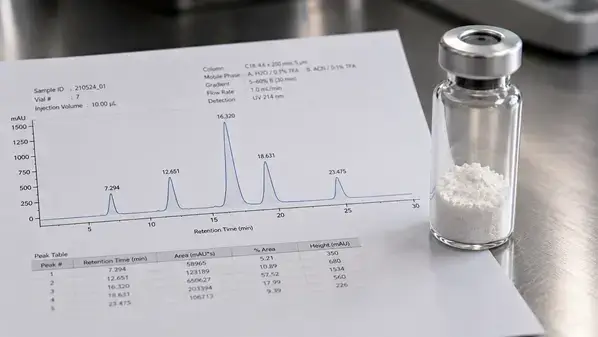
Because the backbone is identical between the two variants and the molecular weight difference is small (the DAC variant is approximately 3647 Da; the non-DAC variant approximately 3367 Da), receiving the wrong version from a supplier is a real failure mode that can derail a research program for weeks before the pharmacokinetic data reveals the substitution.
For research laboratories ordering either variant, the verifications that catch this mistake are:
- HPLC purity reports above 98 percent with peak identity confirmation
- Mass spectrometry data confirming the correct molecular weight (the 280 Da delta between variants is detectable on standard MS workflows)
- Batch-specific Certificate of Analysis documentation matching the order specification
- Third-party analytical verification when the research design is sensitive to identity confirmation
This is one area where supplier selection isn’t interchangeable. The two variants look similar on a label, sit in similar vials, and would behave identically in the first 20 minutes of any preclinical assay before their pharmacokinetic profiles diverge.
The DAC concept itself was the real scientific contribution
A point worth making, because it gets buried in product comparisons: CJC-1295 was the proof-of-concept compound for ConjuChem Biotechnologies’ Drug Affinity Complex platform. The validation question wasn’t whether the peptide stimulated GHRHR (that was already established for the GRF(1-29) fragment). The validation question was whether covalent in vivo albumin conjugation via Cys34 thiol chemistry could extend peptide half-life from minutes to days without abolishing receptor activity.
Teichman 2006 answered that question affirmatively, and the DAC concept has since been applied to other investigational peptide conjugates in development. CJC-1295 with DAC is, in a sense, the reference compound for an entire bioconjugation strategy. That’s part of why it remains a useful research tool independent of any GH axis question: the underlying chemistry has applications across peptide pharmacology research.
Conclusion: The procurement decision starts before the experiment
The choice between CJC-1295 with DAC and CJC-1295 without DAC starts with one question your protocol must answer before procurement: does the experimental design require pulsatile or sustained GHRHR activation? If the answer is pulsatile, the 30-minute half-life of the non-DAC variant is the feature, not the limitation. If sustained, the 5.8 to 8.1 day half-life of the DAC variant, earned through covalent thioether bonding to albumin Cys-34, is what your model needs.
Before placing an order, three checks are worth running: confirm the supplier’s HPLC purity is above 98 percent, verify mass spectrometry data matches the expected molecular weight for the variant ordered, and request a batch-specific Certificate of Analysis. Identity confusion between the two variants is the most common failure mode in this product category. Catch it before the experiment runs, not after the pharmacokinetic data comes in wrong.
FAQs
What is the half-life difference between CJC-1295 with DAC and CJC-1295 without DAC?
The two variants differ by roughly 300 times in plasma half-life. CJC-1295 without DAC (Modified GRF 1-29) clears with a half-life of approximately 30 minutes in preclinical pharmacokinetic studies. CJC-1295 with DAC shows a half-life of 5.8 to 8.1 days following subcutaneous administration in research models, per the Teichman et al. 2006 JCEM dataset. This gap is the single most important variable separating the two compounds for experimental design purposes.
Why does the DAC modification extend the half-life so dramatically?
The DAC linker contains a maleimidopropionic acid (MPA) group that forms a covalent thioether bond with cysteine-34 of serum albumin within minutes of administration. This is irreversible covalent chemistry, not equilibrium binding. The peptide effectively inherits albumin’s circulation profile, where human serum albumin itself has a half-life of about 19 to 21 days. The albumin conjugation also shields the peptide from renal clearance, compounding the half-life extension.
Can researchers substitute one variant for the other in an experimental protocol?
Generally, no. The two variants produce qualitatively different pharmacodynamic profiles, not just the same effect on different timescales. The non-DAC variant produces discrete pulsatile GHRHR activation that mimics endogenous physiology. The DAC variant produces sustained, non-pulsatile prolonged receptor interaction time over multi-day windows. Substituting one for the other typically invalidates the experimental design and produces results that answer a different research question than the one originally posed.
Which variant is preferred for combination research with GHS-R1a agonists like Ipamorelin?
The non-DAC variant is generally selected for these combination protocols. The acute pulsatile pharmacokinetic profile of Modified GRF 1-29 is compatible with the time-course design of dual-pathway GHRHR plus GHS-R1a studies. Sustained GHRHR activation from the DAC variant can confound the pulse-timing analysis these protocols rely on. The synergy hypothesis between the two receptor pathways is mechanistically grounded, though researchers should note that demonstrated synergy in human trials remains an active area of investigation.
How can a research lab verify they received the correct CJC-1295 variant?
Three checks catch identity errors before they reach the experiment. First, request the supplier’s HPLC purity data and confirm it exceeds 98 percent with peak identity matching the variant specification. Second, verify mass spectrometry data: the DAC variant is approximately 3647 Da; the non-DAC variant approximately 3367 Da. The 280 Da delta is detectable on standard MS workflows. Third, require a batch-specific Certificate of Analysis matching the order. Because both variants share the same backbone, label confusion is a documented failure mode worth catching upstream of any in vitro work.