❌ Not for Human Consumption
●
✅ For Research Use Only
●
All products are intended strictly for laboratory research purposes only
●
❌ Not for Human Consumption
●
✅ For Research Use Only
●
All products are intended strictly for laboratory research purposes only
●

How Is The Purity Of Melanotan 2 Verified By HPLC And Mass Spectrometry?

Written By: Gary Hite, Research Content Writer
Reviewed By: Natalie Kunsman, M.D., Board-Certified Physician
Last Reviewed: October 13, 2026
Disclaimer: Melanotan 2 (MT-2) is sold strictly for in vitro research and laboratory use only. It is not approved by the FDA for human consumption, therapeutic use, or clinical application. No information in this article constitutes medical advice, and nothing here should be interpreted as a recommendation for human use. All references to research describe published preclinical or analytical studies conducted in controlled laboratory settings. Researchers must comply with all applicable federal, state, and institutional regulations when handling this compound.
Two analytical methods do the heavy lifting. Reverse-phase high-performance liquid chromatography (RP-HPLC) measures how much of a sample is actually Melanotan 2 versus impurities. Mass spectrometry (MS) confirms that the molecule in the main HPLC peak has the correct molecular weight of 1,024.18 Da. Neither method alone is enough. HPLC tells you the quantity is right. MS tells you the identity is right. A valid certificate of analysis (COA) for research-grade MT-2 reports both.
HPLC and mass spectrometry are the two primary analytical techniques the United States Pharmacopeia (USP) recognizes for identity, purity, and assay determinations of peptide active pharmaceutical ingredients. For a cyclic heptapeptide like MT-2, with its lactam bridge and D-amino acid substitution, these methods catch problems that visual inspection or simple solubility tests can’t detect.
What is HPLC peptide purity testing?
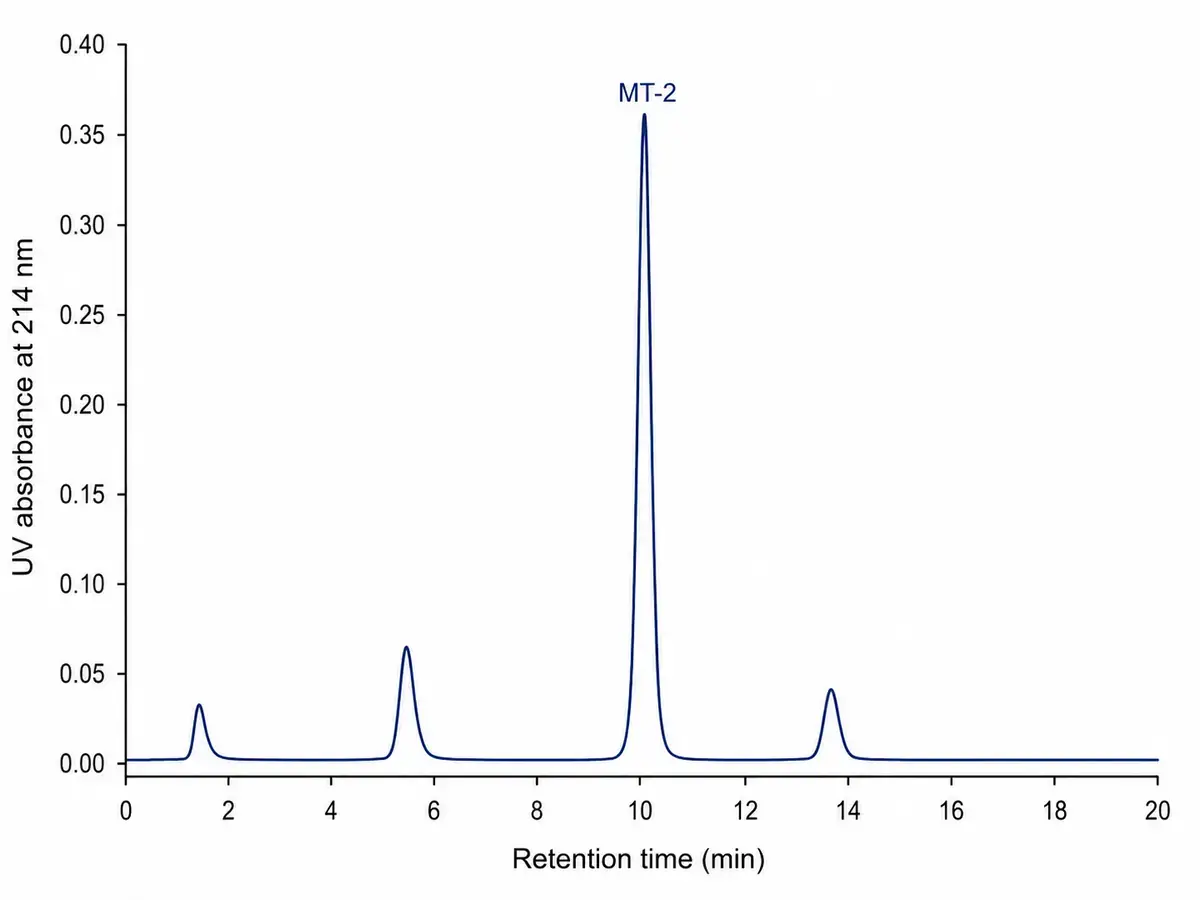
HPLC peptide purity testing is a chromatographic method that separates a peptide sample into its individual components based on differences in hydrophobicity, then quantifies each component by UV absorbance at 214 nm. The target peptide’s peak area, divided by total peak area, equals the purity percentage reported on a certificate of analysis. Research-grade peptides typically require 98% or higher purity by this method to produce reproducible experimental results.
That 214 nm wavelength matters. Peptide bonds absorb UV light at that frequency, so the detector responds to every peptide fragment in the sample, not just the target molecule. If deletion sequences, oxidized variants, or truncated chains are present, they show up as separate peaks on the chromatogram.
How does reverse-phase HPLC separate Melanotan 2 from its impurities?
The method works by exploiting differences in how strongly each molecule sticks to the column packing material. A C18 silica column (typically 4.6 x 150 mm, 5-micrometer particle size) is the standard stationary phase. The mobile phase is a gradient of water and acetonitrile, both containing 0.1% trifluoroacetic acid (TFA) as an ion-pairing agent.
MT-2 is dissolved in the mobile phase and injected into the column. As the acetonitrile concentration increases over time, molecules release from the C18 surface and flow to the UV detector. Less hydrophobic impurities elute first. The intact MT-2 molecule elutes at a characteristic retention time that’s reproducible run to run.
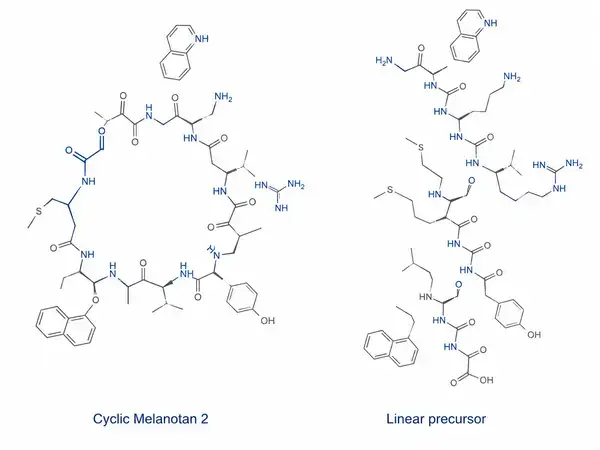
The cyclic structure of Melanotan 2 makes its chromatographic behavior different from linear peptides of similar size. The lactam bridge between the Asp and Lys side chains constrains the molecule into a compact ring. That ring has a distinct hydrophobic surface area compared to the same sequence in linear form. So linear (uncyclized) MT-2, a common synthesis byproduct, elutes at a different retention time than the correctly cyclized product. A well-optimized HPLC method separates the two cleanly.
What impurities does HPLC detect in Melanotan 2 samples?
Crude Melanotan 2 straight from solid-phase peptide synthesis (SPPS) typically contains only 40 to 60% target peptide. The rest is a mix of process-related impurities. The most common ones fall into four categories.
Deletion sequences are fragments where one or more amino acids failed to couple during synthesis. For a seven-residue peptide like MT-2 (sequence: Ac-Nle-cyclo[Asp-His-D-Phe-Arg-Trp-Lys]-NH2), missing even one residue changes the molecular weight and elution time.
Incomplete cyclization products are linear versions of MT-2 where the lactam bridge between Asp and Lys didn’t form. These have the same molecular weight as the cyclic product but a different three-dimensional shape, and they separate on the HPLC column because of their different hydrophobic profiles.
Oxidized variants, especially tryptophan oxidation products, appear when the indole ring on Trp picks up an oxygen atom during synthesis or storage. These show up as a peak slightly ahead of the main MT-2 peak.
Residual protecting groups and salts (mainly TFA salts) from the synthesis and cleavage process account for additional peaks and baseline noise.
How does mass spectrometry confirm Melanotan 2 identity?
HPLC tells you how pure the sample is. Mass spectrometry answers a different question: is the molecule in that main peak actually Melanotan 2?
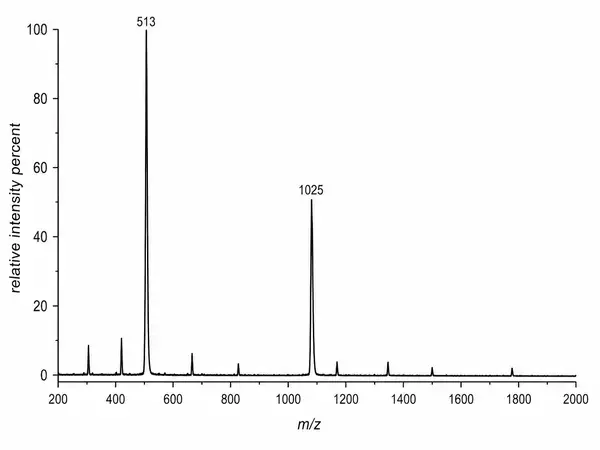
The method works by ionizing the peptide and measuring its mass-to-charge ratio (m/z). For MT-2, the expected monoisotopic molecular weight is 1,024.18 Da. The two most common ionization techniques for peptide verification are electrospray ionization (ESI) and matrix-assisted laser desorption/ionization (MALDI).
ESI-MS is the more common choice for routine peptide QC because it couples directly to the HPLC system. The peptide elutes from the column, enters the electrospray source, picks up one or more protons, and the mass analyzer records the resulting [M+H]+ ion at m/z 1,025.18 or the [M+2H]2+ ion at m/z 513.09. Matching these values to the theoretical mass within 0.1% tolerance confirms the peptide’s identity.
MALDI-TOF (time-of-flight) mass spectrometry offers a complementary approach. The sample is mixed with a UV-absorbing matrix compound, spotted on a metal plate, and hit with a laser pulse. The laser energy transfers to the peptide, sending it flying through a vacuum tube toward a detector. Heavier molecules take longer to arrive. MALDI-TOF works well for confirming molecular weight when ESI produces noisy spectra from salt-heavy samples.
What can mass spectrometry catch that HPLC alone misses?
Two molecules with similar hydrophobicity can co-elute (overlap) on an HPLC column, producing what looks like a single peak. Mass spectrometry resolves this problem. If the main HPLC peak contains both correctly cyclized MT-2 and a closely related impurity, the mass spectrum shows two distinct m/z values instead of one.
This matters for Melanotan 2 specifically because of the D-Phe residue at position 4. The D-phenylalanine and its L-isomer have identical molecular weights, so standard mass spectrometry won’t distinguish them. But racemization at this position, where the D-form converts to the L-form, changes the peptide’s biological activity profile in receptor binding studies. Detecting this requires a separate chiral HPLC analysis or tandem mass spectrometry (MS/MS) fragmentation, not standard single-stage MS alone.
This is a gap that most certificates of analysis don’t address. A COA showing 99% purity by HPLC and the correct molecular weight by MS does not confirm that the D-Phe residue maintained its stereochemistry. Researchers running melanocortin receptor binding assays should ask their supplier whether chiral analysis was performed, especially for MC1R, MC3R, MC4R, and MC5R selectivity studies.
How do you read a Melanotan 2 certificate of analysis?
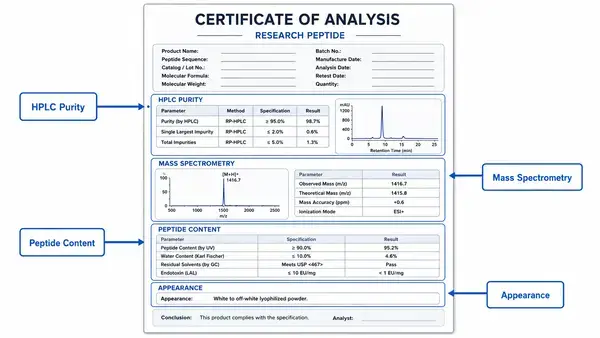
A properly documented COA for research-grade MT-2 should include at minimum five data points.
| Test | Method | Acceptable result |
| Appearance | Visual | White to off-white lyophilized powder |
| Purity | RP-HPLC at 214 nm | 98% or higher |
| Identity | ESI-MS or MALDI-TOF | Observed mass within 0.1% of 1,024.18 Da |
| Peptide content | Nitrogen analysis or amino acid analysis | 80% or higher (accounts for salt and moisture) |
| Solubility | Dissolution test | Soluble in sterile water or dilute acetic acid |
The purity percentage on a COA is an HPLC area-percent value. It represents the main peak’s area divided by total chromatogram area. A value of 99.2% means 99.2% of the UV-absorbing material in the sample eluted as a single peak at the expected MT-2 retention time.
But that number doesn’t capture non-UV-absorbing impurities like residual solvents, inorganic salts, or moisture. That’s why peptide content (sometimes listed as “net peptide content”) is a separate line item. A vial labeled as 10 mg of MT-2 with 99% HPLC purity and 82% peptide content actually contains about 8.2 mg of active peptide and 1.8 mg of counterions and water.
For researchers calculating molar concentrations for in vitro assays, peptide content matters more than HPLC purity for accurate dosing.
What makes Melanotan 2 purity verification different from linear peptides?
Most purity testing articles treat all peptides the same. They’re not. MT-2’s cyclic structure introduces analytical challenges that don’t apply to a simple linear chain.
The lactam bridge forces the molecule into a rigid conformation. That rigidity means MT-2 interacts with the C18 column surface differently than its linear precursor. The cyclic form typically elutes later (higher acetonitrile concentration) because the ring exposes a more defined hydrophobic face to the stationary phase. In practice, this means that the HPLC gradient program needs to be optimized specifically for cyclic peptides to get a clean separation between MT-2 and its linear byproduct.
The norleucine (Nle) substitution at position 1 also affects chromatographic behavior. Nle is more hydrophobic than the methionine it replaces in the native alpha-MSH sequence. This shifts the retention time later compared to an alpha-MSH fragment of the same length.
And the acetyl cap on the N-terminus plus the amide on the C-terminus both affect how the molecule ionizes in the mass spectrometer. ESI of MT-2 produces strong [M+2H]2+ ions at m/z 513 because the two basic residues (Arg and His) readily pick up protons. The doubly charged ion is often more abundant than the singly charged [M+H]+ ion at m/z 1,025, which can confuse researchers who expect to see the molecular weight directly in the spectrum.
What role does third-party testing play in peptide purity verification?
A COA generated by the same lab that synthesized the peptide is a starting point. Independent third-party testing adds a layer of verification that the synthesis lab can’t provide on its own.
Third-party labs run the same RP-HPLC and mass spectrometry tests but without any commercial interest in the result. The FDA has stated that research-use-only (RUO) labeling is not a shield against enforcement when vendors make implied therapeutic claims. According to FDA enforcement data from early 2026, the agency issued 41 warning letters related to research peptide labeling violations in the first quarter alone.
For laboratories purchasing MT-2 for preclinical melanocortin receptor studies, requesting a third-party COA is a reasonable quality control step, especially when results will be published or submitted for peer review. Reproducibility depends on knowing the exact purity and identity of the starting material.
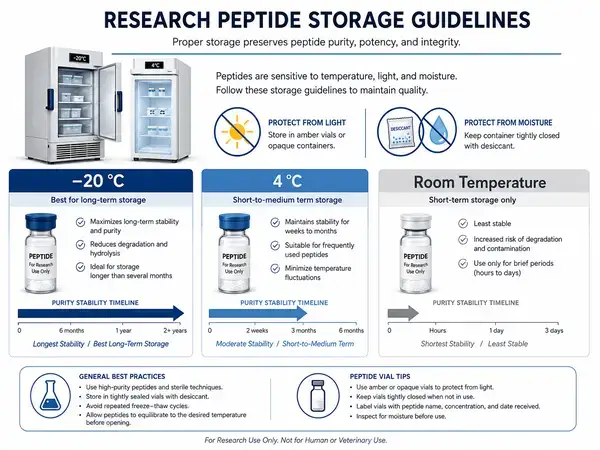
How should researchers store Melanotan 2 to preserve purity after verification?
Purity degrades. The HPLC and mass spec results on a COA reflect the sample at the time of testing. How the peptide is handled after that determines whether the purity holds.
Lyophilized (freeze-dried) MT-2 should be stored at -20 degrees Celsius or colder, protected from light, in a sealed container with desiccant. Under these conditions, lyophilized peptides maintain their stated purity for 12 to 24 months. At room temperature, tryptophan oxidation accelerates and purity drops measurably within weeks.
Once reconstituted in bacteriostatic water or another appropriate solvent, the working solution should be aliquoted into single-use volumes and stored at -20 degrees Celsius. Repeated freeze-thaw cycles degrade cyclic peptides faster than linear ones because the lactam bridge is susceptible to hydrolysis under pH shifts that occur during freezing.
Researchers who suspect degradation can re-run an HPLC analysis on the reconstituted sample. A shift in retention time or the appearance of new peaks not present on the original COA indicates breakdown.
Why both methods matter for Melanotan 2 research
HPLC and mass spectrometry answer two separate questions about the same vial, and skipping either one leaves a blind spot. HPLC quantifies how much of the sample is one compound. Mass spectrometry confirms that compound is actually Melanotan 2, with the correct 1,024.18 Da molecular weight and intact cyclic structure. A 99% HPLC purity reading means nothing if the dominant peak is the wrong molecule. A confirmed mass spec identity means nothing if 30% of the vial is deletion fragments.
For researchers running melanocortin receptor binding assays or other in vitro studies with MT-2, both data points belong on the COA before the vial gets opened. And for cyclic peptides specifically, asking about chiral analysis of the D-Phe residue is one more step most labs skip but reproducible science demands. The analytical methods exist. The question is whether your supplier uses all of them.
FAQs
What purity level should researchers look for when purchasing Melanotan 2?
Research-grade Melanotan 2 should show 98% or higher purity by RP-HPLC. Crude synthesis produces only 40 to 60% target peptide. Multiple chromatographic purification steps are needed to reach the 98%+ threshold. For receptor binding assays and other in vitro studies, higher purity reduces interference from deletion sequences and oxidized variants.
Does HPLC testing confirm the identity of Melanotan 2?
No. HPLC confirms purity (how much of the sample is one compound) but not identity (what that compound is). Mass spectrometry is required to confirm that the main HPLC peak has the expected molecular weight of 1,024.18 Da. A valid COA includes both tests.
What is the difference between HPLC purity and peptide content on a COA?
HPLC purity measures the percentage of UV-absorbing peptide material that elutes as the target peak. Peptide content measures the total mass fraction that is actual peptide versus counterions, salts, and moisture. A 10 mg vial with 99% HPLC purity and 82% peptide content contains roughly 8.2 mg of active Melanotan 2 peptide.
Can mass spectrometry detect racemization in Melanotan 2?
Standard single-stage mass spectrometry cannot detect racemization because D-Phe and L-Phe have identical molecular weights. Detecting the conversion of D-phenylalanine to L-phenylalanine at position 4 requires chiral HPLC or tandem MS/MS fragmentation analysis, which most standard COAs do not include.
How long does Melanotan 2 maintain its stated purity after testing?
Lyophilized MT-2 stored at -20 degrees Celsius or colder, protected from light, with desiccant, maintains purity for 12 to 24 months. At room temperature, tryptophan oxidation can reduce purity within weeks. Reconstituted solutions should be aliquoted and frozen, and repeated freeze-thaw cycles should be avoided.
Is third-party testing required for research peptides?
It’s not legally mandated for research-use-only compounds, but it’s a practical quality control measure. Third-party labs run HPLC and mass spectrometry independently of the synthesis lab. This matters most for studies headed toward publication or peer review, where material provenance affects reproducibility.
Is Melanotan 2 approved by the FDA for any use?
No. Melanotan 2 is not FDA-approved for human consumption, therapeutic use, or clinical application. It is classified as a research chemical. The FDA has taken enforcement action against vendors who market research peptides with implied therapeutic claims. All Melanotan 2 sold by Penguin Peptides is for in vitro research use only.