❌ Not for Human Consumption
●
✅ For Research Use Only
●
All products are intended strictly for laboratory research purposes only
●
❌ Not for Human Consumption
●
✅ For Research Use Only
●
All products are intended strictly for laboratory research purposes only
●

What Is CJC No DAC Ipamorelin? Peptide Half-Life And The Drug Affinity Complex Explained

Research Use Only, Important Notice: CJC No DAC Ipamorelin is sold, supplied, and described on this site strictly for in vitro laboratory research and academic investigation by qualified professionals. It is not a drug, not a dietary supplement, and not for human or veterinary use. It is not intended to diagnose, treat, cure, mitigate, or prevent any disease or condition, and it has not been evaluated or approved by the FDA for any therapeutic purpose. By continuing to read, you acknowledge that this material is educational in nature and is directed exclusively toward licensed researchers, scientists, and academic institutions.
Within the landscape of investigational peptide science, few combinations have attracted as much laboratory interest as CJC-1295 without DAC paired with Ipamorelin, often abbreviated simply as CJC No DAC Ipamorelin. Scientists studying growth hormone (GH) axis signaling in animal and cell-based models frequently reference this pairing when designing protocols around pulsatile hormone release, receptor specificity, and short-duration pharmacokinetic profiling.
This article, published by Penguin Peptides, is written for researchers, graduate students, laboratory managers, and academic professionals who want a clear, compliant overview of:
- What the peptide complex known as CJC No DAC Ipamorelin is at a structural and biochemical level
- How the Drug Affinity Complex (DAC) modification changes peptide behavior
- Why peptide half-life is a critical variable in research model design
- How this combination is typically handled in controlled laboratory settings
Nothing in this article constitutes medical advice, a treatment recommendation, or any suggestion of human use. All content is provided for educational and research purposes only.
What Is CJC-1295 (No DAC)?
CJC-1295 is the research nomenclature for a synthetic analog of Growth Hormone-Releasing Hormone (GHRH). Specifically, it is a modified version of the first 29 amino acids of endogenous GHRH, sometimes labeled in the literature as Modified GRF (1-29) or MOD GRF 1-29.
The molecule was engineered in a laboratory setting to resist enzymatic degradation by incorporating four amino acid substitutions that reduce susceptibility to dipeptidyl peptidase-IV (DPP-IV) cleavage. This increases its stability compared to unmodified GHRH, which has an extremely short functional window in biological systems.
CJC-1295 exists in two distinct research forms:
- CJC-1295 with DAC, which contains a Drug Affinity Complex modification
- CJC-1295 without DAC (No DAC), the unconjugated, shorter-acting research form
The CJC-1295 No DAC form is studied when investigators specifically want a peptide that more closely mimics the pulsatile release pattern of endogenous GHRH in animal models, rather than a sustained circulating concentration.
Understanding the Drug Affinity Complex (DAC)
The Drug Affinity Complex (DAC) is a chemical modification, typically involving a maleimidopropionic acid (MPA) linker, designed to covalently bind the peptide to circulating serum albumin in biological systems. In research contexts, DAC conjugation is studied because it:
- Extends functional half-life by anchoring the molecule to albumin, a long-circulating plasma protein
- Reduces renal clearance of the peptide
- Produces a more sustained concentration curve in pharmacokinetic studies
The “No DAC” version omits this albumin-binding modification entirely. This is an intentional design choice in many research applications. By removing DAC, investigators obtain a peptide whose clearance more closely resembles native GHRH, useful when the experimental model is designed to study short, distinct signaling events rather than prolonged exposure.
Why the DAC Distinction Matters for Researchers
| Feature (in research models) | CJC-1295 With DAC | CJC-1295 No DAC |
|---|---|---|
| Albumin binding | Yes (via MPA linker) | No |
| Reported research half-life profile | Extended (days range in literature) | Short (minutes to low hours in literature) |
| Typical research rationale | Sustained exposure studies | Pulsatile / short-window signaling studies |
| Combination with short-acting GHRPs | Less common in pulsatility models | Frequently paired with Ipamorelin |
Researchers specifically investigating longer-exposure kinetics often turn to the CJC-1295 with DAC form instead. Selecting between DAC and No DAC is therefore not a matter of which is “stronger.” It is a matter of which pharmacokinetic profile the research question demands.
What Is Ipamorelin?
Ipamorelin research peptide is a synthetic pentapeptide (five amino acids) classified in the research literature as a Growth Hormone Secretagogue (GHS) and a selective ghrelin receptor (GHS-R1a) agonist. It was developed as a research tool to study the ghrelin signaling pathway with greater selectivity than earlier-generation GHRPs.
In laboratory investigations, Ipamorelin is noted for its receptor selectivity profile in animal and in vitro models. Researchers studying GH axis mechanisms often select Ipamorelin precisely because of this selectivity, which helps isolate variables in experimental design.
Like CJC-1295 No DAC, Ipamorelin has a relatively short half-life in biological systems as reported in published research literature, generally on the order of approximately two hours, though exact figures vary by study methodology and model.
Why CJC No DAC + Ipamorelin Is Studied as a Combination
The pairing of CJC-1295 No DAC with Ipamorelin is of interest to researchers because the two peptides act on complementary pathways of the GH axis in preclinical models:
- CJC-1295 No DAC is studied as a GHRH analog, engaging the GHRH receptor pathway
- Ipamorelin is studied as a ghrelin receptor agonist, engaging the GHS-R1a pathway
When used together in animal and in vitro research models, investigators can explore how these two receptor systems interact, how they modulate downstream signaling, and how pulsatile versus tonic stimulation patterns differ in their biochemical outputs.
Reminder: The discussion above describes what has been reported in peer-reviewed research literature regarding animal models and cell-based systems. It is not a description of human effects, human use, or any clinical application. CJC No DAC Ipamorelin is not for human consumption.
Peptide Half-Life: A Core Variable in Research Model Design
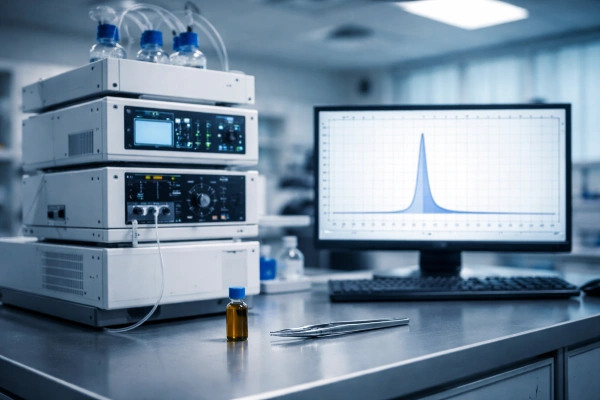
Half-life (t½) is the time required for the concentration of a compound to decrease by half in a biological system. For peptide researchers, half-life is not a trivia figure. It directly shapes:
1. Experimental Timing and Sampling Intervals
Short-half-life peptides demand tighter sampling windows. If a research peptide clears rapidly from the model system, blood draws, tissue harvests, or assay reads need to be scheduled accordingly to capture meaningful data.
2. Dose-Response Study Design
Peptides with short half-lives produce sharper, more defined concentration peaks. This can be desirable when researchers want to correlate a specific exposure event to a specific downstream biochemical response.
3. Receptor Desensitization Studies
Sustained-exposure peptides (such as DAC-modified analogs) are often used when investigators want to model continuous receptor engagement. Short-half-life peptides like CJC No DAC and Ipamorelin are more suitable for studies where researchers specifically want to avoid prolonged receptor occupancy.
4. Pulsatile Versus Tonic Signaling
The endogenous GH axis is famously pulsatile. Research combinations like CJC No DAC + Ipamorelin are often selected in literature because their kinetic profile is considered more consistent with natural pulsatility in animal models than longer-acting analogs would be.
Structural Summary at a Glance
CJC-1295 No DAC
- Modified GHRH analog based on the first 29 amino acids of GHRH
- Four amino acid substitutions to resist DPP-IV degradation
- No Drug Affinity Complex and no albumin-binding linker
- Short half-life profile in research models
Ipamorelin
- Synthetic pentapeptide
- Selective GHS-R1a (ghrelin receptor) agonist in research models
- Studied for its receptor selectivity in preclinical literature
- Short half-life profile in research models
The Combination
- Pairs a GHRH-pathway research peptide with a ghrelin-pathway research peptide
- Used in academic and preclinical investigations of GH axis signaling
- Selected specifically for its short, pulsatile kinetic profile
Laboratory Handling Considerations (For Qualified Researchers Only)
The following points are general laboratory best-practice notes drawn from peptide-handling literature. They are not instructions for use in humans or animals outside of appropriately credentialed, regulated research environments.
- Storage: Lyophilized research peptides are typically stored per the certificate of analysis, often refrigerated or frozen, protected from light and moisture. For reconstituted material, consult published peptide storage practices appropriate to the research environment.
- Reconstitution: Only performed in accredited laboratory environments by qualified personnel using appropriate bacteriostatic or sterile diluents as specified in research protocols. Our reconstitution solvent guide walks through the differences between common laboratory diluents.
- Documentation: All peptide use should be logged per the institution’s research compliance and chain-of-custody standards.
- Disposal: Consistent with institutional biohazard and chemical waste protocols.
- Purity Verification: Researchers should review the Certificate of Analysis (COA) and consider independent HPLC/MS verification where protocols require.
This material is supplied for in vitro and preclinical laboratory study only. It should be handled exclusively by individuals trained in laboratory peptide research and in compliance with all applicable institutional, federal, state, and local regulations.
Compliance, Legal, and Regulatory Notice
CJC No DAC Ipamorelin, as offered by this company, is a research chemical made available to qualified professionals for laboratory and academic purposes. The following points are non-negotiable:
- This product is not a medication, pharmaceutical, or nutritional supplement.
- This product is not approved by the U.S. Food and Drug Administration for any therapeutic indication.
- This product is not for human or veterinary consumption, ingestion, injection, inhalation, topical application, or any form of bodily administration outside of legitimate, IACUC-approved or IRB-approved research where applicable.
- No statement in this article, or anywhere on this website, should be interpreted as a claim that this product treats, cures, prevents, mitigates, or improves any disease, condition, body composition outcome, or physiological state in humans.
- This product is not a GLP-1 receptor agonist, is not a substitute or analog of any FDA-approved pharmaceutical product, and should not be compared to, confused with, or substituted for any commercial prescription medication.
- Purchase and use of this product is limited to individuals and institutions that are legally permitted to obtain research chemicals and that agree, by purchasing, to use the material strictly for non-clinical laboratory research.
Misuse of research chemicals is a serious issue. Researchers are fully responsible for ensuring that their handling, storage, and disposal of this material complies with the laws and regulations of their jurisdiction.
Conclusion
CJC No DAC Ipamorelin occupies a defined niche in peptide science: a short-half-life, dual-pathway research combination used by qualified investigators to explore GH axis signaling and pulsatile release kinetics in preclinical models. Selecting between the DAC and No DAC form is a study-design decision driven by the experimental question, not a measure of potency. If your protocol calls for sharp, short-window signaling events rather than sustained receptor engagement, the No DAC form is typically the appropriate research tool.
Before introducing this compound into any study, review the Certificate of Analysis, confirm reconstitution and storage protocols with your institution, and document chain-of-custody per standard laboratory compliance practice. Researchers sourcing from Penguin Peptides should verify that their intended use falls strictly within legitimate in vitro or IACUC-approved preclinical frameworks. This material is supplied for laboratory research only, not for human consumption, and carries no therapeutic claim whatsoever.
FAQs
How does the half-life of CJC-1295 No DAC compare to CJC-1295 with DAC in research models?
Published research literature reports CJC-1295 No DAC with a short half-life measured in minutes to a low number of hours, while the DAC-modified form can persist in circulation for days due to albumin binding. Investigators choose based on whether the study calls for pulsatile or sustained exposure.
Why do researchers pair CJC-1295 No DAC with Ipamorelin in the same protocol?
The two peptides engage complementary pathways in preclinical models: CJC-1295 No DAC acts on the GHRH receptor pathway, while Ipamorelin acts on the ghrelin (GHS-R1a) receptor pathway. Pairing them lets investigators study receptor interaction and combined pulsatile signaling in animal and in vitro systems.
Is CJC No DAC Ipamorelin related to GLP-1 receptor agonists?
No. CJC-1295 No DAC and Ipamorelin target the growth hormone axis through the GHRH and ghrelin receptors respectively. They are structurally and mechanistically unrelated to GLP-1 receptor agonists and should not be compared to, confused with, or substituted for any FDA-approved pharmaceutical product.
What should researchers verify before introducing CJC No DAC Ipamorelin into a study?
Confirm the Certificate of Analysis, review purity data (HPLC and MS where available), validate lot numbers, follow reconstitution and storage guidance appropriate to your laboratory, and ensure the study protocol is approved by the relevant institutional review body (such as IACUC for animal research).
Is CJC No DAC Ipamorelin legal, and can it be used outside a laboratory?
It is legal to supply and purchase strictly as a research chemical for bona fide laboratory use by qualified professionals. It is not approved by the FDA, is not a drug, supplement, or cosmetic, and is not intended or permitted for human consumption, personal use, clinical application, or any use outside of a controlled research environment.
Final Disclaimer: The content of this article is intended solely for educational and research-informational purposes for qualified professionals. CJC No DAC Ipamorelin is for laboratory research use only. It is not for human consumption, not for veterinary use, not a drug, not a supplement, and makes no medical claims of any kind. It has not been evaluated by the FDA. Any unauthorized use outside of a controlled research environment is prohibited and is the sole responsibility of the individual undertaking such use. Always consult your institution’s research compliance office before initiating work with any research peptide.