❌ Not for Human Consumption
●
✅ For Research Use Only
●
All products are intended strictly for laboratory research purposes only
●
❌ Not for Human Consumption
●
✅ For Research Use Only
●
All products are intended strictly for laboratory research purposes only
●

HPLC Verification Of Glow Multi-Peptide Blends In The Lab

Written By: Gary Hite, Research Content Writer
Reviewed By: Natalie Kunsman, M.D., Board-Certified Physician
Last Reviewed: September 15, 2026
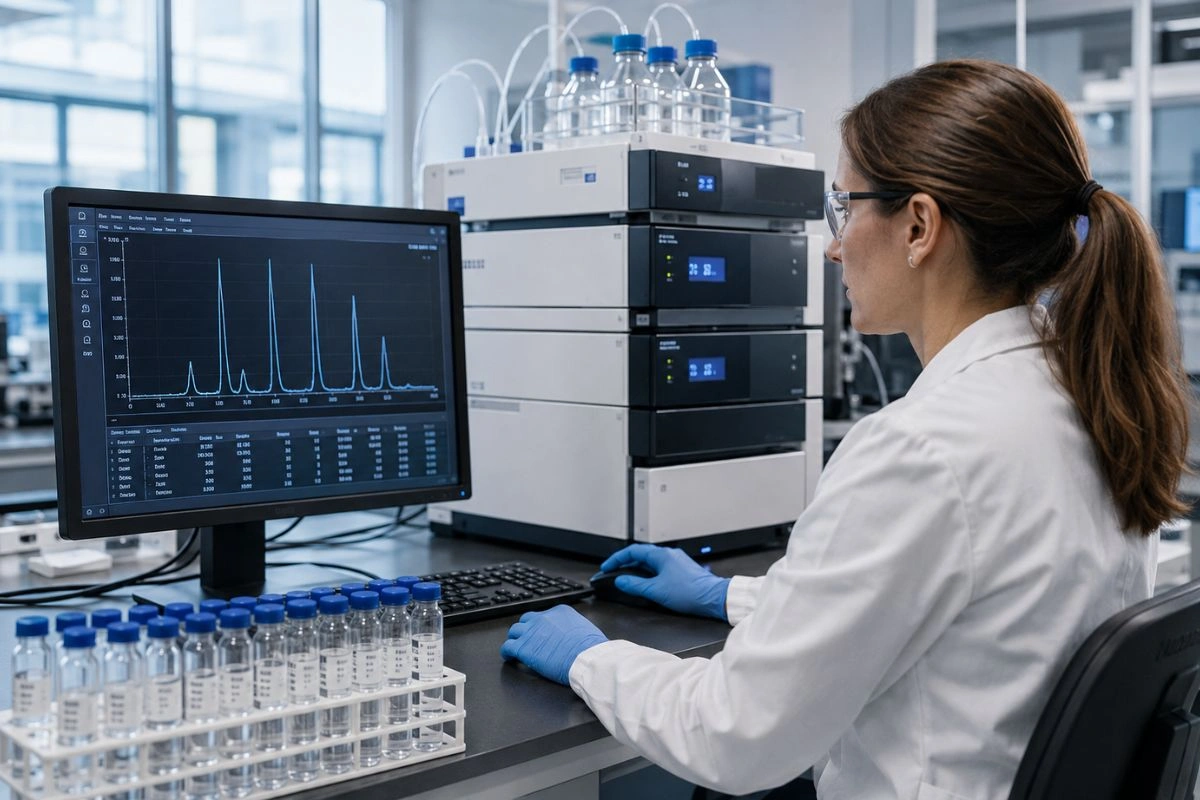
Verifying a single peptide is one challenge. Verifying a blend of several peptides in one sample is a more demanding one, and it is exactly the task that quality control of GLOW requires. GLOW is a multi-peptide research blend, which means a single analytical method must resolve, identify, and quantify several distinct peptides at once. High-performance liquid chromatography (HPLC) is the central tool for this work, but applying it to a blend calls for method choices and quality control considerations that go beyond single-peptide analysis. This article details those considerations, written for analytical chemists, peptide scientists, and academic researchers.
Disclaimer: GLOW is intended strictly for laboratory research and educational use only. It is not for human consumption and not for any diagnostic or therapeutic application. The information below describes analytical quality control for qualified researchers and academic professionals.
Why Multi-Peptide Blends Demand Rigorous QC
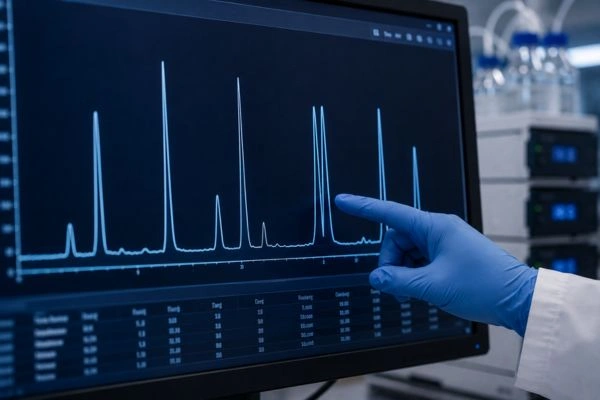
A blend introduces complexity that a single peptide never presents. Several components, each with its own structure and physicochemical behavior, must be separated from one another and from their respective impurities within a single chromatographic run. The presence of multiple peaks raises the risk that two components, or a component and an impurity, co-elute and obscure one another.
On top of separation, a blend carries a specified composition, so quality control must confirm not only that each peptide is present and pure but that it is present in the intended amount and ratio. Each of these requirements adds a layer that single-peptide methods do not have to address, which is why blend QC demands a more deliberate analytical approach from the start.
Understanding GLOW as an Analytical Challenge
GLOW is a multi-peptide research blend, and the peptides commonly found in such blends, including GHK-Cu, BPC-157, and a thymosin beta-4 fragment (often referred to as TB-500), span a wide range of analytical properties. They differ in size, from a small tripeptide to substantially larger sequences, and in hydrophobicity and charge, which means they elute across a broad span of a chromatographic gradient.
One component, GHK-Cu, is a copper-peptide complex rather than a plain peptide, giving it a distinct spectral signature and its own stability considerations. A method built for the blend must therefore accommodate analytes that behave quite differently, resolving each one cleanly despite their varied chemistry. Recognizing this diversity at the outset is the foundation of a sound blend QC method.
Developing an HPLC Method That Resolves Every Component
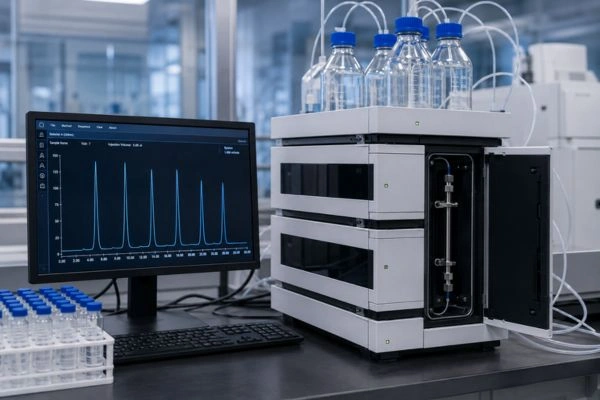
Reversed-phase HPLC (RP-HPLC) on a C18 column is the usual starting point, run with a gradient of water and acetonitrile modified with an ion-pairing agent such as trifluoroacetic acid or, for mass spectrometry compatibility, formic acid. The central objective for a blend is baseline resolution of every component from every other component and from closely eluting impurities.
Achieving this often requires careful gradient optimization, since a shallow gradient may be needed to separate components that elute close together, while column choice, temperature, flow rate, and mobile phase composition all contribute to selectivity. Researchers should identify the critical peak pairs, those that elute closest together, and tune the method until those pairs are reliably resolved. A method that separates the easy components but allows a critical pair to merge is not fit for blend QC.
Detection and Peak Purity with Diode Array Detection
Detection by ultraviolet absorbance at approximately 214 nanometers captures the peptide bond signal shared by all components, but a blend benefits from more than a single wavelength. A photodiode array, or diode array detector (DAD), records the full ultraviolet and visible spectrum across each peak, which serves two valuable purposes.
First, it allows peak purity assessment: if a peak’s spectrum is not consistent across its width, it signals that more than one species may be co-eluting under what appears to be a single peak. Second, it captures the distinct spectral features of components such as the GHK-Cu complex, whose copper coordination produces absorbance beyond the range of a plain peptide. Using diode array detection turns the detector from a simple peak counter into a tool that actively guards against hidden co-elution.
Confirming the Identity of Each Component
Resolving and detecting peaks is not the same as knowing what each peak is. For a blend, identity must be confirmed for every component. The first step is matching the retention time of each peak to that of an authentic reference standard run under identical conditions.
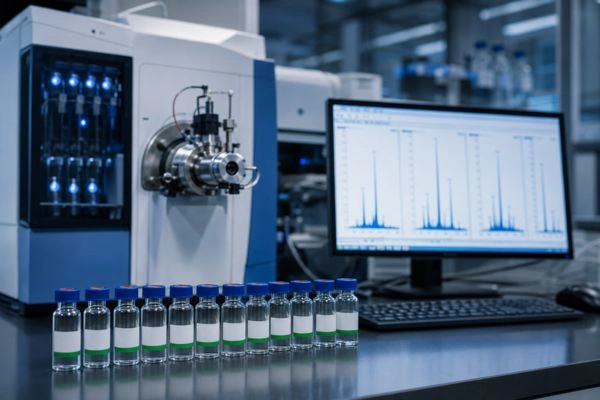
Retention matching alone, however, can be ambiguous when many peaks are present, so coupling the separation to mass spectrometry as liquid chromatography mass spectrometry (LC-MS) provides definitive confirmation by assigning a mass to each component. LC-MS also reveals whether a single chromatographic peak actually contains more than one mass, catching co-elution that even diode array detection might miss. Confirming identity component by component, with both retention and mass evidence, is essential to trusting a blend’s profile.
Verifying Content and Component Ratio
A blend is defined not only by which peptides it contains but by how much of each is present. Quantifying content in a blend is more involved than in a single-peptide sample because each peptide has its own detector response, or response factor, driven by its structure and the wavelength used. A component with aromatic residues and one without will not produce the same signal per unit mass, so a single calibration cannot serve all components.
Accurate quantitation requires an individual calibration curve for each peptide, built from its own reference standard. With per-component calibration in place, researchers can report the content of each peptide and confirm that the measured ratio matches the intended composition of the blend. Verifying the ratio is often the defining quality control step for a multi-peptide product.
Stability and Interference Considerations for Blends
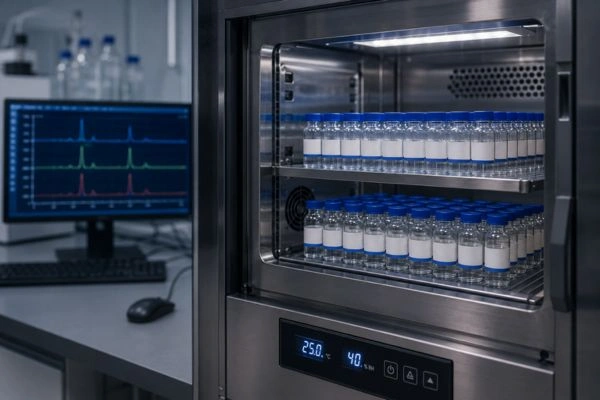
Components in a blend do not exist in isolation, and their behavior together deserves attention. Peptides can differ in stability, and a metal-peptide complex such as GHK-Cu introduces its own considerations around the integrity of the copper coordination over time and under different conditions. A blend’s chromatographic profile can therefore shift if one component degrades faster than the others, so monitoring the profile over storage helps confirm that the composition remains as expected.
Researchers should also watch for interferences, including matrix components and any interaction between peptides that could affect peak shape or recovery. Assessing mass balance, confirming that the main components and identified impurities account for the expected total, adds a further check on the completeness of the analysis.
Method Validation and System Suitability for Blends
Validating a blend method extends every single-peptide validation parameter across multiple analytes. Specificity must be demonstrated for the whole blend, confirming that the method separates each component from the others and from impurities and blank interference. Linearity, the limit of detection, and the limit of quantification must be established for each component individually, as must precision and accuracy through recovery experiments for each peptide.
Robustness testing confirms that the method holds up under small, deliberate variations in conditions. System suitability checks then run with each analysis, and for a blend these center on resolution of the critical peak pairs, along with theoretical plates, tailing factor, and injection repeatability. Passing system suitability confirms the method is resolving the blend as validated before any result is reported.
Building a Reliable Blend Verification Workflow
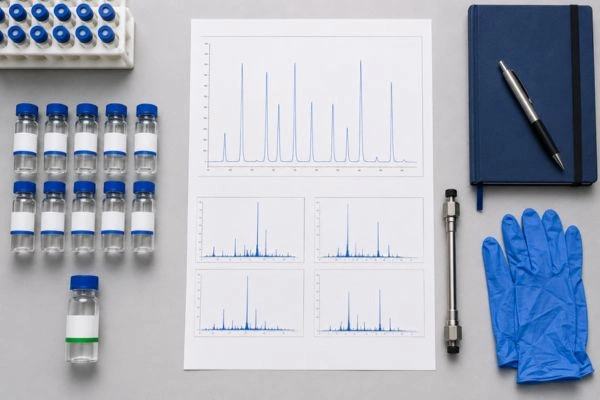
To verify a GLOW blend effectively, assemble the elements into a coherent sequence. Begin by developing and validating an RP-HPLC method that achieves baseline resolution of every component, using diode array detection to monitor peak purity across wavelengths. Confirm the identity of each peptide through retention matching against reference standards and LC-MS mass confirmation.
Quantify each component with its own calibration curve, then verify that the measured content and ratio match the intended composition. Add stability monitoring and mass balance as ongoing checks, and document every method parameter, reference standard, and data processing setting so the analysis is fully reproducible. A workflow built this way turns a complex multi-peptide sample into a clearly characterized research material.
Conclusion
Quality control of a multi-peptide blend like GLOW is fundamentally about resolving complexity. A single HPLC method must separate, identify, and quantify several peptides that differ widely in size, polarity, and chemistry, including a metal-peptide complex with its own behavior. Success depends on a well-developed separation, diode array detection to guard against co-elution, LC-MS confirmation of each component, and per-component calibration to verify both content and ratio. By combining these steps with thorough validation, stability monitoring, and complete documentation, analytical chemists and academic researchers can verify GLOW blends with the rigor and reproducibility that credible research requires.
Disclaimer: All products and reference materials referenced are intended strictly for laboratory research and educational use only. GLOW is not for human consumption, is not for diagnostic or therapeutic use, and is not intended to treat, cure, or prevent any condition. Nothing in this article constitutes medical, clinical, or professional advice. This content is provided for informational and educational purposes for qualified researchers and academic professionals. Handling, storage, and use of research materials must comply with all applicable institutional guidelines, safety protocols, and local, state, and federal regulations.
Frequently Asked Questions
How do I develop an HPLC method that resolves every peptide in the GLOW blend?
Start with reversed-phase HPLC on a C18 column, running a gradient of water and acetonitrile modified with an ion-pairing agent such as trifluoroacetic acid, or formic acid when you need mass spectrometry compatibility. Aim for baseline resolution of every component from every other component and from closely eluting impurities. Identify the critical peak pairs, the ones that elute closest together, and optimize the gradient, often a shallower slope, until those pairs separate reliably. Adjust column choice, temperature, flow rate, and mobile phase composition to fine-tune selectivity. Treat a method that lets any critical pair merge as unfit for blend QC.
Why use diode array detection for a multi-peptide blend?
Use diode array detection because a single wavelength cannot fully protect a blend against hidden co-elution. Detect at approximately 214 nanometers to capture the peptide bond signal shared by all components, then record the full ultraviolet and visible spectrum across each peak. Run peak purity assessment: if a peak’s spectrum shifts across its width, treat that as a signal that more than one species may be co-eluting. Rely on the array to capture distinct features too, such as the absorbance the GHK-Cu copper complex produces beyond the range of a plain peptide.
How do I confirm the identity of each peptide in the blend?
Confirm identity component by component using two lines of evidence. First, match the retention time of each peak to an authentic reference standard run under identical conditions. Because retention matching alone grows ambiguous when many peaks are present, couple the separation to mass spectrometry as LC-MS to assign a definitive mass to each component. Lean on LC-MS to reveal whether a single chromatographic peak actually contains more than one mass, catching co-elution that diode array detection might miss. Combine retention and mass evidence before you trust the blend’s profile.
How do I quantify each component and verify the blend ratio?
Quantify each peptide with its own calibration curve, built from its individual reference standard, because every component has a distinct detector response factor driven by its structure and the detection wavelength. Do not rely on a single calibration for the whole blend, since a peptide with aromatic residues and one without will not produce the same signal per unit mass. With per-component calibration in place, report the content of each peptide and confirm that the measured ratio matches the intended composition. Treat ratio verification as the defining quality control step for the blend.
What stability and validation checks should a blend method include?
Extend every single-peptide validation parameter across all analytes. Demonstrate specificity for the whole blend, and establish linearity, the limit of detection, the limit of quantification, precision, and accuracy for each component individually. Add robustness testing under small deliberate variations, and run system suitability with each analysis, centered on resolution of the critical peak pairs along with theoretical plates, tailing factor, and injection repeatability. Monitor the chromatographic profile over storage to catch any component that degrades faster than the others, and assess mass balance so the main components and identified impurities account for the expected total.