❌ Not for Human Consumption
●
✅ For Research Use Only
●
All products are intended strictly for laboratory research purposes only
●
❌ Not for Human Consumption
●
✅ For Research Use Only
●
All products are intended strictly for laboratory research purposes only
●

Comparative Stability: BPC-157 Vs TB-500 In Standard Reconstitution Buffer

Written By: Gary Hite, Research Content Writer
Reviewed By: Natalie Kunsman, M.D., Board-Certified Physician
Last Reviewed: July 28, 2026
Research Disclaimer: BPC-157 and TB-500 referenced throughout this article are sold strictly for laboratory research and educational purposes only. These compounds are not intended for human consumption, diagnostic use, therapeutic application, or veterinary use. This content is written for professional researchers and academics working in controlled laboratory settings. Nothing in this article constitutes medical advice, dosing guidance, or any recommendation for use outside of bench research. No medical claims are made or implied.
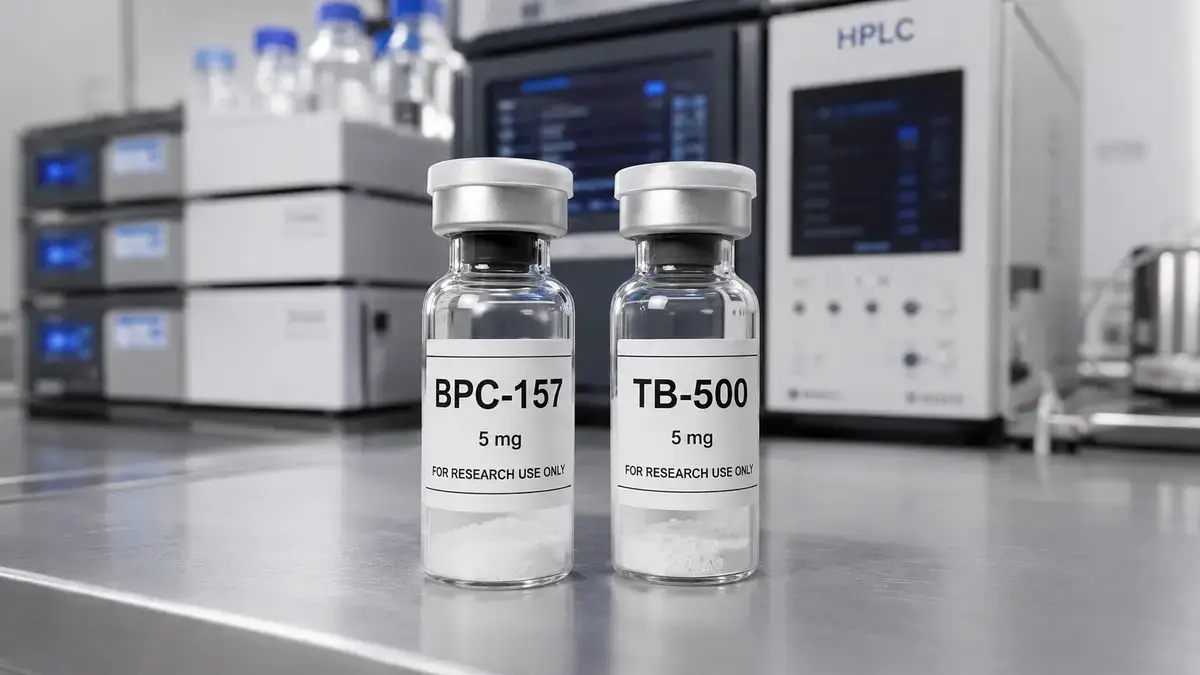
BPC-157 holds its primary structure for weeks in bacteriostatic water at refrigerated temperatures. TB-500, despite a reputation in some research circles for comparable durability, contains residues that begin degrading within days under identical storage conditions. That single structural difference drives most of what researchers observe when running purity assays on aged stock solutions, and it changes how each compound should be handled across a multi-week study window.
This article compares the two peptides on stability grounds only, using bacteriostatic water as the reference vehicle. The goal is to give research professionals defensible expectations for how purity moves over time in standard storage conditions, and what handling adjustments matter when designing comparative work.
What “Standard Reconstitution Buffer” Actually Means in Research Settings
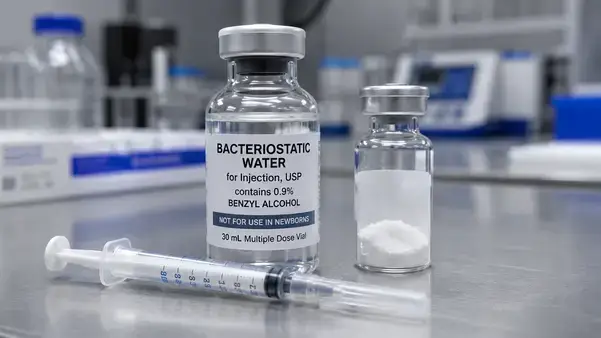
Most published BPC-157 and TB-500 research protocols use bacteriostatic water containing 0.9% benzyl alcohol as the reconstitution vehicle. Some labs substitute sterile water for injection (SWFI) without the preservative, particularly for short-term in vitro assays where bacterial growth is not a concern. The two vehicles are not interchangeable from a stability standpoint.
Benzyl alcohol provides bacteriostatic protection for up to 28 days post-reconstitution at 2 to 8°C, which matches the working window most research timelines need. SWFI offers no such protection, so any reconstituted peptide in SWFI should be used within 24 hours or aliquoted and frozen immediately after preparation.
Phosphate-buffered saline (PBS) at pH 7.4 appears in some in vitro protocols, but it introduces its own complications. Phosphate ions can accelerate certain peptide degradation pathways, particularly methionine oxidation, and the buffered pH doesn’t add meaningful stability benefit for either compound discussed here.
For the rest of this analysis, “standard reconstitution buffer” refers to bacteriostatic water with 0.9% benzyl alcohol stored at 2 to 8°C, since that’s the condition documented in the bulk of comparative peptide stability literature.
BPC-157 Stability Profile
BPC-157 is a 15-amino-acid peptide with a molecular weight of approximately 1419 Da. Its sequence (GEPPPGKPADDAGLV) lacks the residues most commonly associated with rapid degradation in aqueous solution. There is no methionine, no cysteine, and no easily oxidized residue in the chain. The structure is heavy on proline and glycine, both of which contribute to conformational stability.
Published in vitro stress test data show BPC-157 retains over 90% of starting purity after 14 days at 25°C in aqueous solution, and over 95% at 4°C across the same period. HPLC analysis of aged stock typically shows minimal degradation peaks. The main observable change at higher concentrations (above 5 mg/mL) is slight aggregation, which can usually be reversed through gentle warming to room temperature without vortexing.
BPC-157 also tolerates a wide pH range. Original characterization work documented structural retention in simulated gastric fluid at pH 2.0, which is unusual for a peptide of its size. For laboratory storage purposes, this translates into forgiveness around minor pH drift in working buffers and reduced sensitivity to handling errors.
The practical research implication is straightforward. BPC-157 stock solutions prepared in bacteriostatic water can be used across a typical 21 to 28 day study window without significant purity loss, assuming proper refrigeration and minimal freeze-thaw cycling.
TB-500 Stability Profile
TB-500 is a synthetic fragment of Thymosin Beta-4, typically corresponding to the 17-23 amino acid sequence (LKKTETQ) in most commercial research preparations, though some suppliers offer extended sequences or full-length TB-4. The 17-23 fragment has a molecular weight around 889 Da. Full-length TB-4 is closer to 4963 Da and contains 43 residues. This distinction matters because the two versions behave differently in solution and they are not always clearly labeled in vendor documentation.
The longer constructs and full-length TB-4 contain methionine at position 6. Methionine oxidizes readily in aqueous solution exposed to atmospheric oxygen, producing methionine sulfoxide. The oxidized form shifts HPLC retention times and creates measurable purity loss within 5 to 10 days at room temperature, even faster if the solution contains trace metal contaminants or is exposed to light.
The 17-23 fragment alone (LKKTETQ) lacks methionine, so it avoids that specific degradation pathway. However, the lysine residues at positions 1 and 2 are susceptible to slow oxidation, and threonine residues can undergo beta-elimination under prolonged storage. Stability in bacteriostatic water at 4°C is reasonable for the fragment, with most labs reporting acceptable purity through 14 days.
Researchers working with TB-500 should verify which version they have on hand before designing a stability-sensitive protocol. The 17-23 fragment and the full-length peptide behave differently enough that conflating the two creates reproducibility problems that look like biological variability but are actually compound identity issues.
Side by Side: What the Data Shows
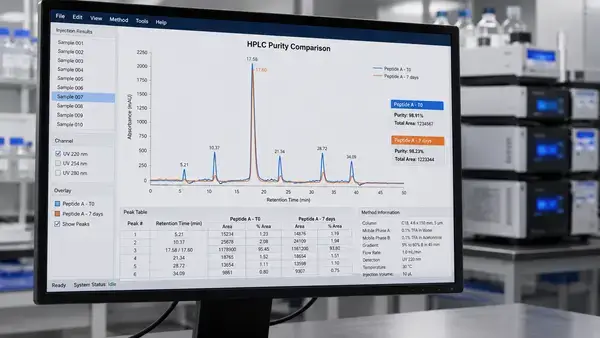
Across published stability assays and in-house testing across the research peptide supply industry, the pattern is consistent.
At 4°C in bacteriostatic water over 28 days, BPC-157 typically retains 92 to 96% of starting purity by HPLC. TB-500 (17-23 fragment) typically retains 85 to 90%. Full-length TB-4 drops faster, often to 75 to 80% by day 28, with methionine oxidation accounting for most of the loss.
At 25°C over 14 days, the gap widens. BPC-157 holds 88 to 92% purity. TB-500 fragment drops to 78 to 84%. Full-length TB-4 can drop below 70% over the same window.
Freeze-thaw cycling affects both compounds, but TB-500 shows aggregation faster. After three freeze-thaw cycles, TB-500 stock often develops visible turbidity or precipitate, particularly at concentrations above 2 mg/mL. BPC-157 tolerates 5 to 6 cycles before similar effects appear. Best practice for both compounds is to aliquot before the first freeze and never refreeze a thawed working solution.
The pattern researchers should plan around: BPC-157 forgives handling errors. TB-500 does not.
Practical Handling Implications for Research Protocols
Three concrete adjustments most labs benefit from making when working with TB-500:
Aliquot at the point of reconstitution. Working from a single vial across multiple sessions accelerates degradation through repeated temperature shifts and headspace oxygen exposure. Single-use aliquots of 100 to 500 µL stored at -20°C eliminate this variable from the experimental design.
Run HPLC purity verification on TB-500 stocks older than 10 days if they’re being used for any quantitative assay. The degradation curve is steep enough that day-1 calibration data will not apply to day-14 samples without correction.
Avoid PBS for long-term TB-500 storage. The phosphate ions can catalyze methionine oxidation in some conditions, and the pH 7.4 environment offers no stability benefit over bacteriostatic water for this peptide class.
For BPC-157, the protocol is simpler. Reconstitute, refrigerate, use within 28 days. Standard handling produces reliable results without aggressive aliquoting or mid-study purity checks for most research designs.
Why This Matters for Comparative Research Design
The stability gap between these two compounds has direct implications for any study comparing them head to head. If a researcher reconstitutes both peptides on day 1 and runs an assay on day 21, they’re not comparing equivalent compounds. They’re comparing fresh BPC-157 against partially degraded TB-500.
This is the source of a meaningful amount of contradictory data in the published research literature. Studies that don’t control for solution age, storage temperature, and freeze-thaw history produce results that look like biological differences but are actually handling artifacts. The effect size attributed to one compound or the other can shift substantially depending on which lab prepared the working stocks and how.
For any comparative research design, the recommendation is direct. Prepare both peptides fresh on the same day from lyophilized stock. Run parallel HPLC checks at the start and end of the study window. Document storage conditions precisely in any internal report or publication, including specific temperature, time post-reconstitution, freeze-thaw count, and vehicle composition.
A Note on Sourcing and Documentation
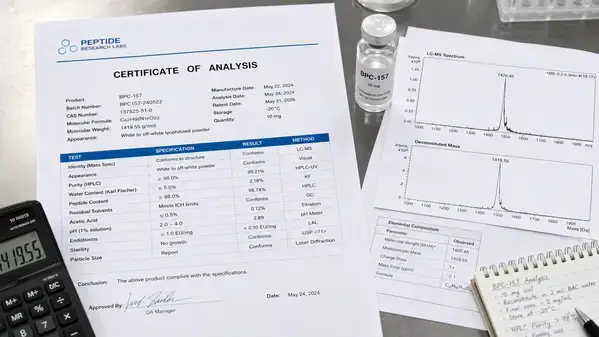
Stability data is only as reliable as the starting material. Peptides supplied with batch-specific HPLC purity data and mass spec confirmation give researchers a defensible baseline for downstream stability work. Material without documentation introduces variables that cannot be controlled for after the fact.
When designing comparative stability research, request the certificate of analysis (COA) for each batch, verify sequence accuracy through independent analysis when budget permits, and store lyophilized stock at -20°C or lower until the day of reconstitution. Lyophilized peptides degrade orders of magnitude more slowly than reconstituted material, so any time spent in dry storage is time the experimental clock has not started.
The most defensible comparative stability work is built on documented starting purity, controlled handling protocols, and HPLC verification at multiple timepoints. Without those three elements, conclusions about relative stability are difficult to defend regardless of how well the experimental design otherwise reads.
Conclusion
The stability gap between BPC-157 and TB-500 isn’t an interesting footnote buried in a methods section. It’s a variable that has to be controlled for in any research design that compares them or runs them past a one-week window. Labs that treat both compounds with identical handling protocols publish data confounding biological signal with degradation kinetics, and the effect size can be large enough to flip a study’s conclusion in either direction.
The action items are concrete. Aliquot TB-500 before the first freeze. Run HPLC purity verification on TB-500 stocks past day 10. Skip PBS for long-term storage of either compound. Document temperature, freeze-thaw count, and vehicle composition in every protocol. For comparative work, prepare both peptides fresh from lyophilized stock on the same day from documented batches.
The compounds themselves are stable enough for serious research when handled correctly. The handling is where most of the experimental variance lives.
FAQs
How long can BPC-157 be stored in bacteriostatic water before purity loss becomes a research concern?
BPC-157 in bacteriostatic water held at 2 to 8°C typically retains over 95% purity for 14 days and over 90% for 28 days under standard handling. For most research timelines, 21 to 28 days is a defensible working window. Past 28 days, the bacteriostatic protection from 0.9% benzyl alcohol begins to weaken and contamination risk climbs even if the peptide itself remains structurally intact. Discard aged stock and reconstitute fresh past that point rather than extending the window.
Should I reconstitute TB-500 in bacteriostatic water, sterile water, or PBS?
Use bacteriostatic water with 0.9% benzyl alcohol for any TB-500 stock that will be sampled across multiple sessions. Use sterile water for injection (SWFI) only for single-use preparations where the working solution will be consumed within 24 hours. Avoid PBS for storage because phosphate ions can accelerate methionine oxidation in TB-500 preparations that contain methionine residues. If your assay requires PBS conditions, dilute into PBS immediately before use rather than storing in it.
What’s the actual difference between TB-500 and full-length Thymosin Beta-4 for stability work?
TB-500 most commonly refers to the synthetic 17-23 fragment of Thymosin Beta-4 with sequence LKKTETQ and molecular weight near 889 Da. Full-length Thymosin Beta-4 is a 43 amino acid peptide with molecular weight near 4963 Da and contains methionine at position 6. The fragment lacks methionine and is more stable in solution. The full-length version oxidizes faster and shows steeper purity loss curves over time. Always verify sequence and molecular weight on the COA before designing stability-sensitive protocols, since vendor labeling is inconsistent across the research peptide market.
How many freeze-thaw cycles can BPC-157 and TB-500 tolerate before measurable degradation?
BPC-157 tolerates 5 to 6 freeze-thaw cycles before visible aggregation appears in most preparations. TB-500 typically shows turbidity or precipitate after 3 cycles, particularly at concentrations above 2 mg/mL. The most defensible approach for both compounds is to aliquot the working stock into single-use volumes (100 to 500 µL is typical) at the point of reconstitution and never refreeze a thawed aliquot. This removes freeze-thaw count as an experimental variable entirely and is worth the extra 10 minutes of prep time on day one.
How do I detect peptide degradation without running HPLC every week?
Visual inspection catches the obvious failures. Turbidity, visible precipitate, color shift from clear to yellow, or any particulates all indicate the stock has degraded and should be discarded immediately. Beyond visual checks, mass spectrometry confirms identity and detects oxidation products like methionine sulfoxide. For labs without in-house analytical capability, request HPLC and mass spec verification from the supplier at batch release, then design study windows that stay inside the documented stability range rather than pushing past it and hoping for the best.