❌ Not for Human Consumption
●
✅ For Research Use Only
●
All products are intended strictly for laboratory research purposes only
●
❌ Not for Human Consumption
●
✅ For Research Use Only
●
All products are intended strictly for laboratory research purposes only
●

DSIP Stability In Aqueous Solution: Degradation Kinetics For Laboratory Use

Written By: Gary Hite, Research Content Writer
Reviewed By: Natalie Kunsman, M.D., Board-Certified Physician
Last Reviewed: July 29, 2026
A 2mg/mL DSIP stock in plain water at room temperature can lose 15 to 25% of its intact peptide content within 48 hours. The driver isn’t hydrolysis or microbial contamination. It’s a quiet structural rearrangement at the Asp5-Gly6 bond that produces isoaspartate, a product that co-elutes closely with parent peptide on standard reverse-phase columns and silently inflates apparent recovery in routine QC.
This article maps the degradation pathways that govern Delta Sleep-Inducing Peptide stability in aqueous systems, the kinetic models that describe them, and the buffer and storage choices that change observed half-life by an order of magnitude. All discussion applies to in vitro research applications conducted by qualified scientific personnel.
Disclaimer: DSIP (Delta Sleep-Inducing Peptide) is sold and intended strictly for in vitro research and laboratory use by qualified professional researchers and academic institutions. It is not a drug, dietary supplement, food product, or cosmetic. It is not intended for human consumption, human application, veterinary use, diagnostic use, or any therapeutic application. No representation is made regarding safety or biological activity in humans or animals, and no medical claims are made or implied.
The Structural Problem
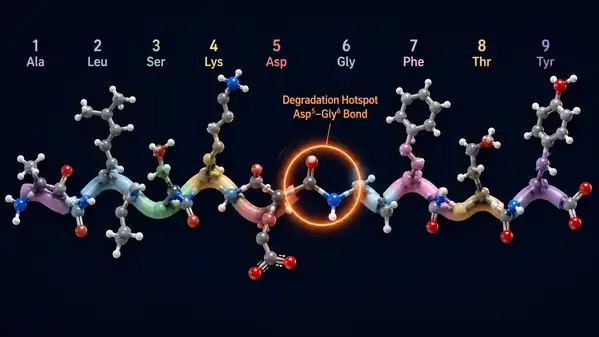
DSIP is a nonapeptide with the sequence Trp-Ala-Gly-Gly-Asp-Ala-Ser-Gly-Glu. Two features dominate its instability profile in solution.
First, the Asp-Gly motif at positions 5 and 6 is a known degradation hotspot. Aspartate residues flanked by glycine undergo intramolecular cyclization through a succinimide intermediate, which then hydrolyzes to a mixture of L-Asp and L-isoaspartate. Glycine’s lack of a side chain removes steric protection, so this conversion runs faster here than at most other Asp positions in peptides.
Second, the N-terminal tryptophan is oxidation-prone. Trace dissolved oxygen, transition metal contamination from water sources, and ambient light all push Trp toward N-formylkynurenine and kynurenine derivatives. The resulting peptide shows reduced UV absorbance at 280nm, which complicates concentration verification by spectrophotometry.
Hydrolytic cleavage of peptide bonds is a slower third pathway. It’s measurable on a timescale of weeks at ambient temperature, not hours.
Degradation Kinetics in Aqueous Buffers
Peptide degradation in solution typically follows pseudo-first-order kinetics under defined pH and temperature, and DSIP is no exception. The rate constant k can be extracted from a plot of ln(C/C0) versus time. Half-life is then t1/2 = 0.693/k.
Published studies on DSIP and structurally similar nonapeptides containing Asp-Gly motifs report k values that span roughly two orders of magnitude across the pH range 3 to 9. The minimum degradation rate, meaning the maximum solution stability, sits between pH 4 and pH 5 for the isomerization pathway. Below pH 3, direct acid-catalyzed hydrolysis dominates. Above pH 6, the succinimide intermediate forms more readily, and above pH 8 the rate climbs sharply.
Temperature dependence follows Arrhenius behavior across the range tested in most studies (4C to 60C). For Asp-Gly isomerization in short peptides, activation energies generally fall between 20 and 25 kcal/mol, giving a Q10 (rate increase per 10C) of around 3 to 4. Practically, this means a peptide with a 48-hour half-life at 25C has a half-life closer to 8 to 12 hours at 40C and roughly 6 to 8 days at 4C.
Freeze and thaw cycling introduces a separate degradation mode that doesn’t fit the Arrhenius model cleanly. Concentration of solutes at the ice interface during slow freezing exposes the peptide to locally elevated pH and ionic strength. Three freeze and thaw cycles can reduce intact DSIP recovery by 5 to 15% depending on buffer composition and cooling rate.
Buffer Composition Changes Everything
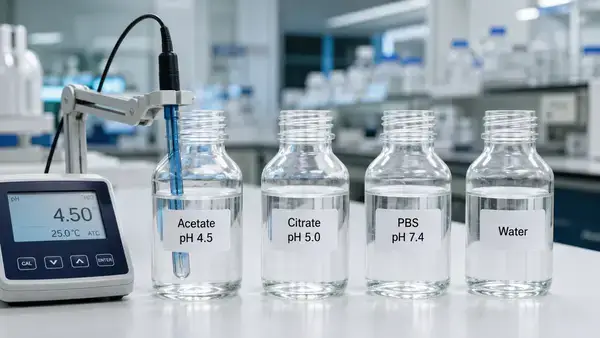
The choice between water, PBS, and a citrate or acetate buffer at pH 4.5 isn’t cosmetic. It changes solution half-life by a factor of 5 to 10.
Plain water is the worst common option. It has no buffering capacity, so dissolved CO2 from air contact slowly drives pH down, and any contaminating base drives it up. Both extremes accelerate isomerization. Trace iron and copper from water of inadequate purity (anything less than Type 1, 18.2 megohm resistivity) catalyze Trp oxidation.
PBS at pH 7.4 is convenient for cell-based assays but sits in the unfavorable pH window for DSIP. Solution stability at 4C is acceptable for short-term use (24 to 72 hours). Stability at ambient temperature is poor.
Acetate buffer at pH 4.5 or citrate buffer at pH 5.0, both at 20mM, give the longest aqueous half-lives. For experimental work that tolerates this pH range, this is the right starting point. Adding 0.1mM EDTA to chelate trace metals reduces Trp oxidation further.
Bacteriostatic preparations containing benzyl alcohol introduce their own considerations. Benzyl alcohol can react with the peptide N-terminus over weeks, and the additive itself can interfere with downstream analytical methods like RP-HPLC at 220nm.
Container Choice Matters More Than Most Labs Account For
Peptide adsorption to container walls produces concentration losses that look identical to chemical degradation in a recovery assay. Glass vials lose 2 to 8% of low-concentration peptide (under 100 mcg/mL) to silanol-mediated adsorption within 24 hours. Standard polypropylene microcentrifuge tubes show similar losses for short hydrophobic peptides, though DSIP’s polar character reduces this effect somewhat.
Low-binding polypropylene (often labeled “protein lobind” or equivalent) reduces adsorption losses by 60 to 80% compared to standard tubes. For working solutions below 50 mcg/mL, this matters. For 1mg/mL stocks, the relative loss is negligible.
Carrier proteins like BSA at 0.1% can saturate adsorption sites in containers, but they introduce a confounding variable for downstream analytical work and aren’t appropriate for many research applications.
Analytical Methods for Tracking Degradation
Three methods cover most stability assessment work.
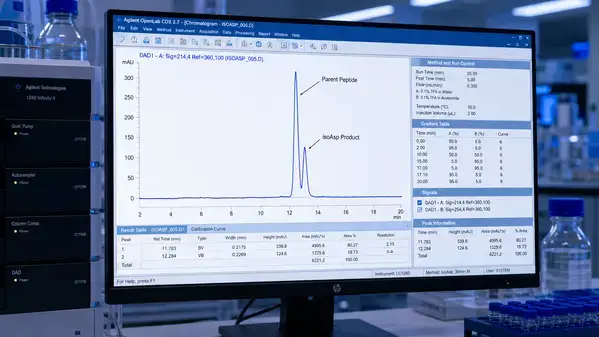
Reverse-phase HPLC with UV detection at 220nm (peptide bond) or 280nm (Trp) is the workhorse. The isoaspartate product elutes very close to parent DSIP on C18 columns, sometimes within 0.2 minutes. A shallow gradient (0.5% acetonitrile per minute around the elution window) and a longer column (150 to 250mm) improve separation. If isoAsp and Asp DSIP co-elute, total recovery looks high while the peptide is actually drifting toward the isomerized form.
LC-MS resolves this ambiguity. The two forms have identical mass, but their fragmentation patterns differ. The b/y ion ratio across the Asp-Gly bond shifts measurably between the two isomers.
The PIMT (protein L-isoaspartyl methyltransferase) assay quantifies isoaspartate directly by methylating the isoAsp carboxyl with radiolabeled or fluorescent SAM. This is the definitive method when isomerization is the suspected degradation route.
For Trp oxidation, the loss of 280nm absorbance combined with appearance of new peaks at 320 to 360nm (kynurenine derivatives fluoresce in this range) confirms the pathway.
Storage Recommendations for Research Stock
Lyophilized DSIP stored at minus 20C in a sealed vial with desiccant retains greater than 95% purity for 12 to 24 months in most published stability data. Storage at minus 80C extends this further. The lyophilizate is the reference state for long-term laboratory storage.
For working solutions, the practical hierarchy looks like this. Reconstitute in 20mM acetate buffer at pH 4.5 with 0.1mM EDTA. Aliquot immediately to single-use volumes in low-binding tubes. Store at minus 20C. Avoid repeated freeze and thaw. Under these conditions, working solutions hold acceptable purity for 30 to 60 days based on first-order extrapolation from short-term data.
Reconstitution in PBS or cell culture media should happen on the day of experimental use, not in advance.
What This Means for Experimental Design
If a 72-hour cell experiment receives DSIP at day 0, the molecule being assayed at day 3 isn’t the molecule added at day 0. Anywhere from 10 to 40% of the original peptide has converted to isoAsp or oxidized forms, depending on temperature, media composition, and oxygen exposure.
This isn’t an argument against the assay. It’s an argument for daily dosing schedules in any in vitro experiment longer than 24 hours, or for time-course sampling that tracks intact peptide rather than assuming a stable concentration. Research that ignores degradation will produce data with quietly inflated EC50 values and apparent loss of effect over time that has nothing to do with the underlying biology.
The single most useful change most laboratories can make: switch the reconstitution buffer from PBS or water to pH 4.5 acetate for stock solutions, and dilute into assay medium at the time of dosing. Half-life triples. Inter-experiment variability drops.
Conclusion
DSIP stability isn’t a quality control afterthought. It’s a variable that belongs in the experimental design phase, sitting alongside cell line selection, vehicle controls, and dosing intervals. Treating it that way changes what data the experiment actually produces and what conclusions hold up under scrutiny.
The chemistry behind Asp5-Gly6 isomerization and N-terminal Trp oxidation isn’t unique to DSIP. The same logic applies to any peptide with vulnerable residues, which describes most of them. Researchers who internalize the kinetic framework here can apply it across their full peptide library: identify hotspots from the sequence, predict the dominant degradation pathway, choose a buffer system that suppresses it, and verify with a method that actually separates parent from product.
The labs producing reproducible peptide data aren’t using better compounds. They’re controlling for degradation that other labs are quietly absorbing into their error bars. That’s the difference worth chasing.
FAQs
What is the half-life of DSIP in aqueous solution at room temperature?
At ambient temperature in plain water or PBS, DSIP at typical research concentrations shows pseudo-first-order degradation with a half-life of roughly 24 to 72 hours, depending on pH and oxygen exposure. The dominant pathway is isomerization at the Asp5-Gly6 bond. In acetate buffer at pH 4.5 with 0.1mM EDTA, half-life extends by a factor of 5 to 10.
Which buffer gives the longest DSIP solution stability for in vitro work?
20mM acetate buffer at pH 4.5 or citrate buffer at pH 5.0 with 0.1mM EDTA gives the longest aqueous half-life for DSIP research preparations. This pH range minimizes both succinimide formation (which drives isoaspartate generation) and acid-catalyzed hydrolysis. PBS at pH 7.4 sits in the unfavorable window and should be reserved for same-day dilutions into assay media.
Can isoaspartate formation be detected by standard reverse-phase HPLC?
Sometimes, but not reliably. IsoAsp DSIP elutes very close to parent peptide on most C18 columns, often within 0.2 minutes, and may co-elute entirely under fast gradient conditions. Use a shallow gradient (around 0.5% acetonitrile per minute through the elution window) and a 150 to 250mm column for adequate separation. For definitive identification, LC-MS with fragment ion analysis or the PIMT enzymatic assay is required.
How does freeze and thaw cycling affect DSIP integrity in research samples?
Three freeze and thaw cycles reduce intact DSIP recovery by 5 to 15% in typical aqueous buffers, with damage compounding on each additional cycle. The mechanism involves cryoconcentration of solutes at the ice interface, which exposes the peptide to locally elevated pH and ionic strength. Single-use aliquots stored at minus 20C eliminate this variable from the experimental system.
What is the recommended long-term storage condition for DSIP research stock?
Lyophilized DSIP sealed under desiccant at minus 20C retains greater than 95% purity for 12 to 24 months in most published stability data. Storage at minus 80C extends this further. Reconstituted working solutions should be aliquoted to single-use volumes in low-binding polypropylene, stored at minus 20C, and used within 30 to 60 days when held in pH 4.5 acetate buffer with EDTA.