❌ Not for Human Consumption
●
✅ For Research Use Only
●
All products are intended strictly for laboratory research purposes only
●
❌ Not for Human Consumption
●
✅ For Research Use Only
●
All products are intended strictly for laboratory research purposes only
●

Solid-Phase Peptide Synthesis (SPPS): How GH Secretagogue Research Peptides Are Manufactured And Purified

Written By: Gary Hite, Research Content Writer
Reviewed By: Natalie Kunsman, M.D., Board-Certified Physician
Last Reviewed: August 14, 2026
A 29-residue peptide like CJC-1295 (No DAC) requires 29 coupling reactions and 29 deprotection cycles to assemble. At 99% efficiency per step, which is already an optimistic figure for difficult sequences, fewer than 56% of the chains on the resin will be the full-length target. The rest are deletion sequences, truncations, and side-reaction products. Everything that happens after the final wash, the cleavage, the precipitation, the HPLC fractionation, the mass spec verification, exists to separate the target from that chemical noise.
That math is the whole reason SPPS labs care about purification as much as synthesis. A 95% pure peptide on the certificate of analysis is not 95% of a perfect product. It is the result of a careful, expensive filtering of a messy crude.
Disclaimer: CJC-1295 (No DAC) is intended for research use only. Not for human consumption. Not for veterinary use. Not for use in diagnostic procedures. This material is sold only to qualified researchers at institutions, laboratories, or businesses engaged in legitimate research activities. Buyers are responsible for compliance with all applicable laws and regulations governing the acquisition, possession, and use of research chemicals in their jurisdiction. Nothing in this article constitutes medical advice, a health claim, or an endorsement of any unapproved use.
Why SPPS replaced solution-phase synthesis for peptides
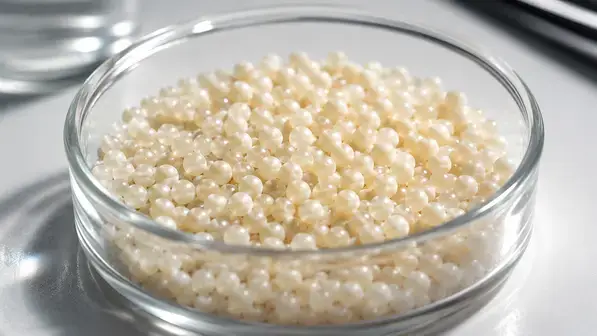
Solution-phase synthesis still has its place for very short peptides and certain industrial scales. For research-grade GH secretagogues in the 5 to 40 residue range, SPPS is the default. Two competing chemistries dominate:
- Boc chemistry, the original Merrifield protocol, uses tert-butoxycarbonyl protection and hydrogen fluoride for final cleavage. HF handling requires specialized fluoropolymer apparatus that most contract labs no longer maintain.
- Fmoc chemistry, developed in the 1970s, uses 9-fluorenylmethoxycarbonyl protection and mild base (piperidine in DMF) for deprotection. Final cleavage uses trifluoroacetic acid. This is what runs in nearly every modern automated synthesizer.
Almost all research-grade GHRH analogs and ghrelin mimetics on the market today are Fmoc-built. The rest of this article assumes Fmoc protocols.
The synthesis cycle, in plain terms
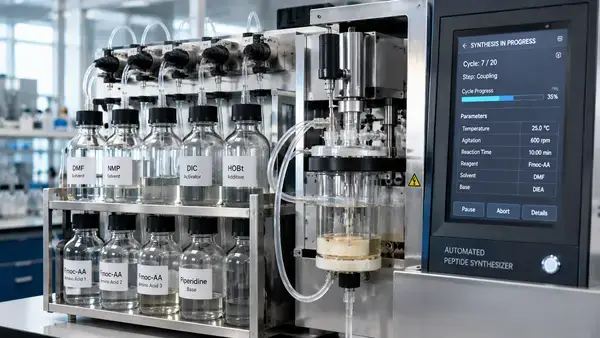
Each amino acid is added in a three-stage cycle that takes anywhere from 15 minutes to 2 hours depending on the residue and the activation method.
Stage one: deprotection. The Fmoc group on the N-terminus of the resin-bound chain gets stripped with 20% piperidine in DMF. The reaction releases a yellow dibenzofulvene-piperidine adduct that absorbs at 301 nm, which is how automated synthesizers monitor completion in real time.
Stage two: coupling. The next Fmoc-protected amino acid arrives pre-activated with a uronium reagent like HBTU or HATU, plus a base like DIPEA or NMM. The activated carboxyl attacks the free amine on the resin-bound chain and forms the new amide bond. Most labs use 3 to 5 molar excess of the incoming residue to push coupling to completion.
Stage three: washing. DMF rinses clear the resin of unreacted reagents and side products before the next deprotection. This is the boring step that decides whether the next coupling will work cleanly.
For CJC-1295 (No DAC), with its sequence Tyr-D-Ala-Asp-Ala-Ile-Phe-Thr-Gln-Ser-Tyr-Arg-Lys-Val-Leu-Ala-Gln-Leu-Ser-Ala-Arg-Lys-Leu-Leu-Gln-Asp-Ile-Met-Ser-Arg, two structural features make this cycle harder than it looks on paper.
First, the D-Ala at position 2 is a non-natural residue requiring special Fmoc-D-Ala-OH stock, which costs noticeably more than the L-isomer and has to be tracked separately to prevent cross-contamination. The D-Ala substitution is the whole reason this peptide resists dipeptidyl peptidase-IV cleavage in research models, so the chirality has to be right.
Second, the run of three leucines (positions 22 to 23 to also adjacent Leu residues) and the multiple glutamines create a sequence that is prone to aggregation on the resin. Aggregated chains fold in on themselves and hide the reactive amine, which means subsequent couplings fail. Experienced peptide chemists handle this by switching to pseudoproline dipeptides at specific positions, using elevated temperature (microwave-assisted synthesis at 70 to 90 degrees Celsius), or running double couplings on the difficult residues. Every contract manufacturer worth working with has internal SOPs for which positions in CJC-1295 (No DAC) need double couplings.
Cleavage and side reactions you actually have to worry about
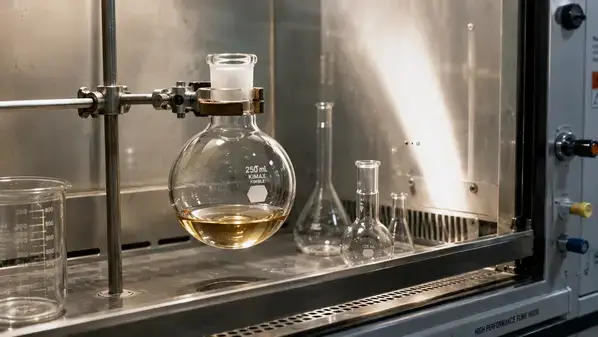
Once the chain is fully assembled on the resin, the peptide gets cleaved with a TFA-based cocktail. The exact recipe matters more than newcomers expect.
Reagent K is one common formulation: 82.5% TFA, 5% phenol, 5% water, 5% thioanisole, 2.5% ethanedithiol. The non-TFA components are scavengers. They trap the carbocations released when side-chain protecting groups come off (tBu, Trt, Pbf, Boc), which would otherwise alkylate the deprotected peptide and create modifications that show up as +56 or +100 mass shifts on the mass spec.
Three side reactions cause most of the headaches in GH secretagogue synthesis:
- Aspartimide formation at Asp-Gly and Asp-Ser junctions. CJC-1295 (No DAC) has Asp residues at positions 3 and 25, neither of which sits next to a Gly, but the Asp-Ile bond at 25-26 can still cyclize under prolonged piperidine exposure. The fix is shortened deprotection times or addition of 0.1 M HOBt to the piperidine solution.
- Methionine oxidation to the sulfoxide. The Met at position 27 is vulnerable to air oxidation during the post-cleavage workup. Storing intermediates under argon and minimizing time between cleavage and lyophilization helps. Some manufacturers add small amounts of methionine free amino acid to the cleavage cocktail as a sacrificial scavenger.
- Diketopiperazine formation at the first two residues after cleavage from certain resin linkers. This is mostly a Wang resin and 2-chlorotrityl chloride resin problem; Rink amide resins, which give C-terminal amides like the one on CJC-1295 (No DAC), are less prone.
After cleavage, the crude peptide gets precipitated into cold diethyl ether. This pulls the peptide out of the TFA mixture as a fluffy solid that can be collected by centrifugation. Ether washes remove residual scavengers and TFA salts.
RP-HPLC purification: the actual quality gate
The crude peptide off the resin is typically 60 to 85% target by HPLC area, depending on sequence difficulty. For CJC-1295 (No DAC), 70 to 78% is a reasonable expectation from a well-run synthesis. Everything that follows is about pushing that number into research-grade territory.
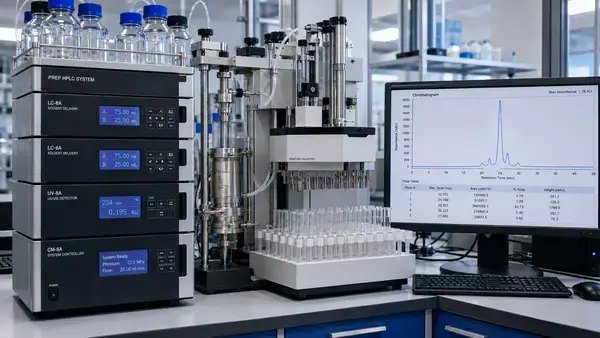
Preparative reverse-phase HPLC does the heavy lifting. The standard setup:
- Column: C18 silica, 10 to 30 micron particle size, 100 to 250 mm length, 21 to 50 mm internal diameter for prep scale.
- Mobile phase A: water with 0.1% TFA. The TFA acts as an ion-pairing agent, masking basic residues (Arg, Lys, His) and giving sharper peaks.
- Mobile phase B: acetonitrile with 0.085 to 0.1% TFA.
- Gradient: typically 20% B to 50% B over 30 to 60 minutes for a peptide in this molecular weight range.
- Detection: UV at 220 nm (amide bond) and 280 nm (aromatic residues, in this case Tyr and Phe).
The chemist collects fractions across the main peak and the immediate shoulders, then runs analytical HPLC on each to identify which fractions hit the target purity threshold. Fractions below the threshold get either re-purified or discarded depending on volume.
Research-grade purity standards run from 95% (acceptable for most in vitro work) to 99%+ (required for some structural biology and binding studies). The marginal cost of moving from 95% to 99% can double the price per milligram, because the high-purity cut sacrifices yield at the peak edges.
Here is the part that most spec sheets gloss over: the missing 1 to 5% is not random noise. It is a defined population of deletion sequences (missing one residue), single-amino-acid substitutions, and oxidation products that co-elute with the target. A 98% pure peptide can contain 0.5% des-Leu impurity, 0.3% Met-sulfoxide variant, 0.4% deamidation product (Asn or Gln to Asp or Glu), and 0.8% other minor peaks. For most research applications this background is irrelevant. For receptor-binding kinetics or NMR structural work, those impurities can absolutely show up in the data.
Verification: mass spec, analytical HPLC, and sequence confirmation
A certificate of analysis without a mass spectrum is not a certificate of analysis. The two relevant techniques:
- ESI-MS (electrospray ionization) gives a series of multiply charged ions. For CJC-1295 (No DAC) at approximately 3367.9 Da monoisotopic, you’d expect to see [M+3H]3+ at about 1123.6 m/z, [M+4H]4+ at about 843.0 m/z, and so on. Deconvolution software recovers the parent mass.
- MALDI-TOF gives a single dominant [M+H]+ peak around 3368.9 m/z. MALDI tolerates salts and detergents better than ESI but has worse mass accuracy at the high end.
Either technique should report observed mass within 0.5 Da of theoretical for a research-grade peptide. Larger discrepancies point to oxidation (+16 Da per oxygen), incomplete deprotection (+42 Da for residual acetyl, +56 Da for residual tBu, +100 Da for residual Boc), or wrong sequence.
Analytical HPLC at higher resolution than the prep run confirms purity. The standard is a 5 micron C18 analytical column with a shallow gradient that resolves the target from close-eluting impurities. Reporting purity as “HPLC area % at 220 nm” is the industry norm.
Some manufacturers also run amino acid analysis or Edman degradation for sequence confirmation, particularly for novel analogs. For established GH secretagogues like CJC-1295 (No DAC), Sermorelin, GHRP-2, GHRP-6, and Ipamorelin, mass spec plus HPLC is usually sufficient documentation.
Final processing: lyophilization, salt counter-ions, and storage
The purified peptide elutes from prep HPLC as a dilute solution in acetonitrile and water with TFA. To get a stable solid, the fractions go through three more steps:
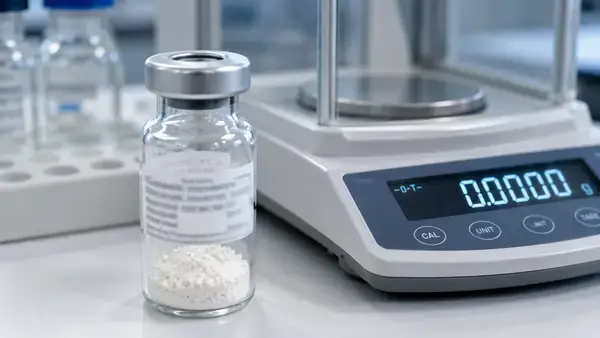
First, the acetonitrile gets rotovapped off, leaving an aqueous solution. Second, the solution gets shell-frozen in lyophilization flasks. Third, the frozen solution gets freeze-dried under vacuum for 24 to 72 hours. The resulting solid is a white to off-white fluffy powder.
The TFA from the mobile phase stays with the peptide as the counter-ion, typically at 5 to 15% by mass for a peptide with multiple basic residues like CJC-1295 (No DAC), which has 2 Arg and 2 Lys. Some research applications, particularly cell culture work where TFA cytotoxicity matters, require the peptide to be converted to acetate salt through ion exchange. Acetate-salt CJC-1295 (No DAC) costs more and ships with documentation of the counter-ion swap.
Storage: lyophilized peptide kept at minus 20 degrees Celsius is stable for 2 to 3 years for most sequences. Reconstituted peptide in bacteriostatic water is a different story. Solution-phase peptides degrade through deamidation, oxidation, and hydrolysis at rates that depend heavily on sequence, pH, and temperature. Most spec sheets recommend 28 days at 4 degrees Celsius after reconstitution, which is a conservative figure backed by accelerated stability data on similar GHRH analogs.
What separates a good research-peptide supplier from a bad one
The synthesis side of this industry is more uniform than the purification and QC side. Most contract synthesizers use the same automated Fmoc protocols on the same brands of equipment. Where suppliers diverge is in:
- Whether they run mass spec on every lot or batch test once and reuse the data
- Whether the HPLC trace they ship is the actual lot or a representative chromatogram from a prior batch
- Whether they characterize the counter-ion or just call it “trifluoroacetate” by default
- Whether they retain samples for stability testing or ship every milligram
- Whether they declare their purity threshold honestly or round 92% up to 95%
The questions a research buyer should ask before placing an order are direct: What is the lot-specific COA? Can I see the mass spec and HPLC trace for the specific batch I’m getting? What is the counter-ion? How was purity calculated, and at what wavelength?
Suppliers who answer those questions in writing are operating a different business than suppliers who don’t.
Conclusion
The chemistry of SPPS is open knowledge. The same Fmoc protocols, the same C18 columns, the same mass spec verification methods run in every legitimate peptide lab on Earth. What changes between suppliers is not the synthesis route but the discipline applied to documenting it. A 98% HPLC purity number means something different depending on whether the trace came from your specific lot or from a representative batch run six months ago.
Read every COA like a chemist, not a customer. Check the integration baseline, the wavelength used for purity calculation, the observed mass against theoretical, and the counter-ion declaration. Ask for the analytical HPLC method, not just the result. Verify the lot number on the documentation matches the vial in your hand.
The peptide chemistry decides what is possible. Your quality control discipline decides what ends up in your assay. Suppliers who skip that documentation are selling a guess in a vial.
FAQs
What HPLC purity should I order for my research application?
Most in vitro work runs cleanly on 95% purity. Receptor-binding kinetics, NMR structural studies, and any application where impurities at the 1 to 2% level could confound the readout justify paying for 99% or higher. The price gap between the two often doubles per milligram because the high-purity cut sacrifices yield at the peak edges. If your assay tolerates a few percent of structurally similar impurities, 95% is the right spend. If it doesn’t, don’t save money on the input that defines your output.
Why does my CJC-1295 (No DAC) ship as a TFA salt, and when do I need acetate instead?
TFA is the standard ion-pairing reagent in reverse-phase HPLC, so it stays with the peptide through the final lyophilization. Most peptides with multiple basic residues carry 5 to 15% TFA by mass. CJC-1295 (No DAC), with two arginines and two lysines, sits in that range. For binding assays, enzyme kinetics, and most cell-free work, this is acceptable. For sensitive cell culture, particularly primary neurons or stem cell systems, residual TFA can show cytotoxicity. Acetate-salt conversion through ion exchange adds processing cost but is the right choice when vehicle effects could be confused with peptide activity. CJC-1295 (No DAC) remains for research use only in either salt form.
How long is lyophilized CJC-1295 (No DAC) stable, and what changes after reconstitution?
Lyophilized CJC-1295 (No DAC) stored at minus 20 degrees Celsius is typically stable for 2 to 3 years. Solution stability is much shorter and sequence-dependent. After reconstitution in bacteriostatic water, 28 days at 4 degrees Celsius is the conservative shelf life supported by accelerated stability data on similar GHRH analogs. Methionine oxidation at position 27 and deamidation at the asparagine and glutamine residues drive degradation in solution, both faster at higher temperatures. Single-use aliquoting before the first freeze-thaw cycle preserves more material than repeated thawing of a single vial. This stability data is for research handling only and makes no claims about any other use.
What should a lot-specific Certificate of Analysis include?
Five items, non-negotiable: peptide sequence with single-letter codes, theoretical and observed mass from MS (within 0.5 Da is the standard), HPLC purity percentage with the detection wavelength explicitly stated, the actual HPLC trace from your lot rather than a representative chromatogram, and the counter-ion identity. Items that signal a serious supplier beyond the minimum: amino acid analysis, water content by Karl Fischer titration, residual solvent levels (acetonitrile, ether, DMF), and endotoxin testing where relevant. If the COA is generic, undated, or missing the lot number printed on your vial, treat the documentation as marketing rather than data.
Why do prices for the same peptide vary so much between suppliers?
Three real cost drivers, separate from margin. First, synthesis difficulty: sequences with non-natural amino acids like the D-Ala at position 2 in CJC-1295 (No DAC), or aggregation-prone regions like the leucine cluster near the C-terminus, require more reagent excess and double couplings. That can double or triple raw material cost. Second, QC depth: running lot-specific mass spec and HPLC traces on every batch costs more than testing once and reusing the data. Third, counter-ion processing: acetate-salt material requires an ion-exchange step after the standard prep run. Suppliers undercutting market price by 50% are almost always cutting one of these three corners. The relevant question is whether the corners they cut affect your specific experiment.Three real cost drivers, separate from margin. First, synthesis difficulty: sequences with non-natural amino acids like the D-Ala at position 2 in CJC-1295 (No DAC), or aggregation-prone regions like the leucine cluster near the C-terminus, require more reagent excess and double couplings. That can double or triple raw material cost. Second, QC depth: running lot-specific mass spec and HPLC traces on every batch costs more than testing once and reusing the data. Third, counter-ion processing: acetate-salt material requires an ion-exchange step after the standard prep run. Suppliers undercutting market price by 50% are almost always cutting one of these three corners. The relevant question is whether the corners they cut affect your specific experiment.