❌ Not for Human Consumption
●
✅ For Research Use Only
●
All products are intended strictly for laboratory research purposes only
●
❌ Not for Human Consumption
●
✅ For Research Use Only
●
All products are intended strictly for laboratory research purposes only
●

How To Verify The Quality Of Reconstitution Water Before Use In Peptide Research

To verify the quality of reconstitution water before use in peptide research, researchers should complete seven key checks: review the Certificate of Analysis (COA) for endotoxin, sterility, and pH data; measure water resistivity and conductivity to confirm ionic purity; visually inspect for particulates and discoloration; examine vial seal integrity and container condition; test Total Organic Carbon (TOC) levels for organic contaminants; confirm proper storage temperature and shelf life compliance; and perform in-house microbiological testing when working with new suppliers or large batch orders.
Reconstitution water is the solvent used to dissolve lyophilized (freeze-dried) peptides back into solution for laboratory analysis. The two most common types are sterile water, which contains no preservatives and is designed for single-use research applications, and bacteriostatic water, which contains 0.9% benzyl alcohol as an antimicrobial preservative for multi-access laboratory protocols. Both are laboratory reagents sold exclusively for research purposes and are not intended for human or animal consumption.
Water quality verification matters because contaminants in the solvent directly compromise peptide stability, solubility, and the reproducibility of experimental results. Endotoxins can trigger false biological responses in cell-based assays. Dissolved ions alter conductivity and interfere with binding affinity measurements. Organic impurities co-elute with peptides during HPLC purification and distort UV absorbance readings. Sub-visible particulates confound aggregation studies and optical density baselines.
This guide provides research professionals and academic scientists with a step-by-step verification protocol for every category of reconstitution water used in peptide solubilization, receptor binding assays, structural analysis, and in vitro study.
Disclaimer: All products referenced in this article, including reconstitution water and bacteriostatic water, are intended strictly for laboratory research and educational purposes. Nothing described here is intended for human consumption, injection, or therapeutic application. No medical claims are made or implied. Researchers should follow all institutional, local, and federal regulations when handling laboratory reagents.
Understanding the Types of Water Used in Peptide Research
Before verification begins, it helps to distinguish the primary categories of water encountered in peptide research laboratories.
Sterile water for research is purified water that has undergone filtration and autoclaving or irradiation to eliminate microbial contamination. It contains no preservatives and is best suited for single-use applications in controlled laboratory environments.
Bacteriostatic water for research contains a small concentration of benzyl alcohol (typically 0.9%) that inhibits microbial growth. This makes it useful for multi-use scenarios in laboratory settings where repeated sampling from the same vial is necessary. The benzyl alcohol acts as an antimicrobial preservative, extending the functional shelf life of the reconstituted peptide solution for research purposes.
Ultrapure water (Type I reagent-grade water) has been processed through deionization, reverse osmosis, and UV oxidation. It meets the specifications required for sensitive analytical techniques like HPLC and mass spectrometry.
Each type serves a distinct role in peptide solubilization, and each requires its own verification protocol.
Important: Reconstitution water sold for research use is not approved for human or animal consumption. It is a laboratory reagent designed exclusively for scientific investigation.
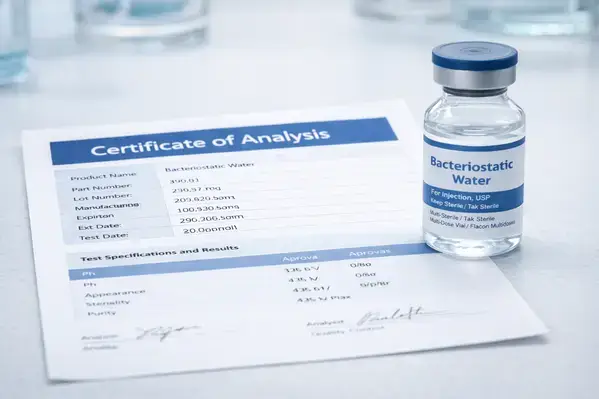
Step 1: Inspect the Certificate of Analysis (COA)
The first and most accessible quality checkpoint is the Certificate of Analysis. Any reputable supplier of reconstitution water will provide a COA for each lot. This document serves as a verified record of testing performed on the product batch.
When reviewing a COA, researchers should confirm the following parameters:
Endotoxin levels should be reported and fall below acceptable thresholds for research-grade solvents. Endotoxin contamination, measured in endotoxin units per milliliter (EU/mL), can trigger biological responses in cell-based assays and skew results. The Limulus Amebocyte Lysate (LAL) test is the standard method for detecting bacterial endotoxins.
Sterility testing results should confirm that the water has passed microbial growth assays. The United States Pharmacopeia (USP) outlines standard methods for sterility testing of water-based laboratory reagents.
pH measurement should fall within a narrow, acceptable range, typically between 5.0 and 7.0 for purified water. A pH reading outside this range may indicate ionic contamination or degradation of the container.
Benzyl alcohol concentration (for bacteriostatic water) should be confirmed at the labeled percentage, usually 0.9% w/v. Deviations can affect the preservative efficacy and potentially alter peptide behavior in solution.
If a supplier cannot produce a COA upon request, that is a significant red flag for any research procurement decision.
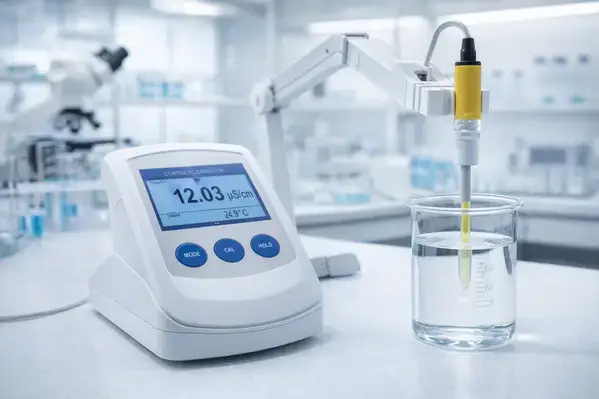
Step 2: Measure Resistivity and Conductivity
Water purity can be quantified by measuring its resistivity or, inversely, its conductivity. These measurements reveal the concentration of dissolved ions in the sample.
Ultrapure water (Type I) should exhibit a resistivity of 18.2 megohm-centimeters (MΩ·cm) at 25°C. This value represents the theoretical maximum for water and indicates an extremely low concentration of dissolved ionic species.
For standard sterile or bacteriostatic water, acceptable resistivity values will be somewhat lower due to the presence of preservatives or trace minerals. However, conductivity readings that are significantly elevated beyond the expected range suggest contamination from dissolved salts, metals, or other ionic impurities.
Laboratory conductivity meters and inline resistivity monitors are widely available and straightforward to operate. Incorporating a resistivity check into the incoming quality control protocol for reconstitution water takes minimal time and provides immediate, quantitative feedback on solvent purity.
Step 3: Evaluate Visual Clarity and Particulate Matter
A simple but essential verification step involves visual inspection of the reconstitution water under controlled lighting conditions.
Hold the sealed vial against a bright, uniform light source (a light box or backlit inspection panel works well). Examine the solution for visible particulates, fibers, cloudiness, or discoloration. High-quality reconstitution water should appear completely clear and colorless with no detectable particulate matter to the unaided eye.
For more rigorous inspection, a light obscuration particle counter can quantify the number and size distribution of sub-visible particles suspended in the water. USP Chapter 788 provides standardized methods for particulate matter testing in parenteral-grade solutions, and these protocols are commonly adapted for research-grade solvent evaluation.
Particulate contamination in reconstitution water can interfere with peptide aggregation studies, optical density measurements, and any technique that relies on solution clarity as a baseline.
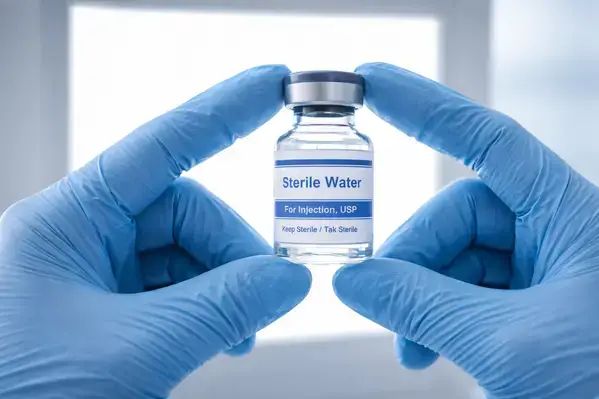
Step 4: Verify Container Integrity and Packaging
The quality of reconstitution water depends not only on the water itself but also on the container system that holds it.
Before opening any vial, inspect the following:
Seal integrity is paramount. Check that the flip-off cap is intact and the aluminum crimp shows no signs of tampering, lifting, or corrosion. A compromised seal can allow microbial ingress and airborne particulate contamination.
Vial condition should be free of cracks, chips, or scratches, particularly around the neck and shoulder of the container. Borosilicate glass (Type I glass) is the preferred material for pharmaceutical-grade vials because of its chemical inertness and low extractable profile.
Rubber stopper quality matters as well. Butyl rubber stoppers are standard for injectable-grade containers and offer low moisture vapor transmission and chemical compatibility with aqueous solutions. Inspect for any visible degradation, discoloration, or particulate shedding from the stopper surface.
Labeling accuracy should match the COA. Verify that the lot number, expiration date, volume, and composition (sterile water vs. bacteriostatic water with 0.9% benzyl alcohol) are clearly printed and consistent with the supplier’s documentation.
Step 5: Test for Total Organic Carbon (TOC)
Total Organic Carbon analysis measures the concentration of carbon-containing compounds dissolved in the water sample. Elevated TOC levels can indicate the presence of organic contaminants such as residual solvents, plasticizers leached from packaging, or microbial metabolic byproducts.
For research-grade purified water, TOC values should generally fall below 500 parts per billion (ppb). Ultrapure water systems routinely achieve TOC levels below 50 ppb.
TOC analyzers use UV oxidation or combustion-based methods to convert organic carbon to carbon dioxide, which is then measured by a non-dispersive infrared (NDIR) detector or conductivity sensor. Many modern systems offer inline, real-time TOC monitoring for laboratories that process large volumes of purified water.
Elevated TOC in reconstitution water is a concern for peptide research because organic impurities can co-elute with peptides during HPLC purification, interfere with UV absorbance measurements, or introduce unwanted reactivity during chemical modification studies.
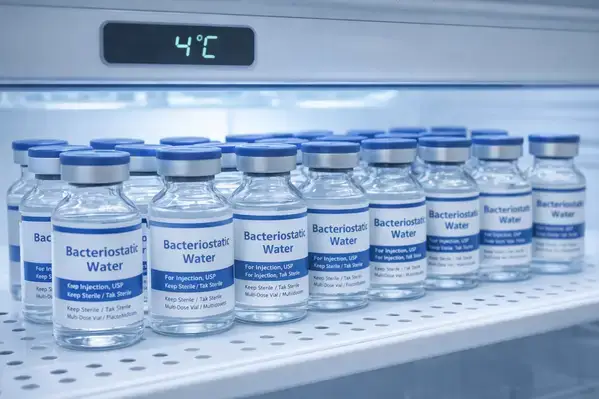
Step 6: Confirm Proper Storage Conditions
Even verified, high-quality reconstitution water can degrade if stored improperly.
Reconstitution water should be stored according to the manufacturer’s recommendations, which typically include:
Keeping vials at controlled room temperature (20°C to 25°C) away from direct sunlight and heat sources. UV radiation can promote the formation of free radicals and accelerate the degradation of benzyl alcohol in bacteriostatic formulations.
Storing vials upright to minimize contact between the solution and the rubber stopper, which reduces the potential for extractable and leachable compounds to migrate into the water over time.
Monitoring expiration dates and rotating stock using a first-in, first-out (FIFO) inventory management system. Expired reconstitution water may no longer meet its labeled sterility or purity specifications, even if it appears visually acceptable.
Once a vial of bacteriostatic water has been punctured, the in-use stability period should be tracked. While the benzyl alcohol preservative inhibits microbial growth, repeated needle punctures increase the risk of particulate contamination and stopper coring.
Step 7: Perform In-House Microbiological Testing (When Applicable)
Laboratories conducting sensitive cell culture work or long-duration peptide stability studies may benefit from performing their own microbiological testing on incoming reconstitution water, particularly when working with new suppliers or unusually large batch orders.
Common in-house methods include:
Membrane filtration followed by incubation on selective agar media can detect viable bacteria and fungi at very low concentrations. This approach is described in USP Chapter 71 and is the gold standard for sterility verification.
Rapid microbiological methods (RMMs) such as ATP bioluminescence or flow cytometry-based cell counting offer faster turnaround times compared to traditional culture methods. These techniques are increasingly adopted in research settings where time-sensitive experiments depend on confirmed solvent sterility.
Environmental monitoring data from the supplier can supplement in-house testing. Request information about the clean room classification, air handling specifications, and filling line validation for the facility where the reconstitution water was manufactured. ISO Class 5 (or equivalent) filling environments represent the benchmark for aseptic processing of sterile aqueous solutions.
Best Practices Summary for Research Teams
Verification of reconstitution water quality is not a single action but a systematic process that should be embedded into the standard operating procedures (SOPs) of any peptide research laboratory. A few guiding principles can streamline the process:
Establish incoming material specifications for every type of water used in the lab, and reject any lot that fails to meet those criteria. Document every inspection and test result in a laboratory notebook or electronic quality management system. Build relationships with suppliers who are transparent about their manufacturing processes, testing protocols, and regulatory compliance. Train all laboratory personnel who handle reconstitution water on proper aseptic technique, visual inspection methods, and storage requirements.
When these practices become routine, they create a foundation of solvent quality that supports reliable, reproducible peptide research outcomes.
Conclusion
Verifying the quality of reconstitution water is not optional. It is a fundamental responsibility for any researcher working with lyophilized peptides in a laboratory setting. Each step outlined in this guide, from reviewing the Certificate of Analysis to conducting in-house microbiological assays, serves as a safeguard against contamination, degradation, and unreliable experimental outcomes. The integrity of peptide solubility data, binding affinity measurements, and stability profiles all trace back to the purity of the solvent used during reconstitution. Make water quality verification a non-negotiable part of your laboratory workflow. Standardize your incoming inspection procedures, hold suppliers accountable for transparent documentation, and train every team member on proper handling techniques. When researchers treat reconstitution water with the same rigor they apply to the peptides themselves, the result is stronger data, fewer failed assays, and a more dependable foundation for scientific discovery. Start implementing these verification steps today.
FAQs
What is the difference between sterile water and bacteriostatic water for research use?
Sterile water for research is purified, preservative-free water designed for single-use laboratory applications. Once the vial is opened, it should be used promptly and discarded because it contains no antimicrobial agent to prevent contamination over time. Bacteriostatic water for research contains 0.9% benzyl alcohol, which functions as an antimicrobial preservative. This allows the vial to be accessed multiple times during ongoing experimental protocols while maintaining microbial inhibition. Researchers should select the appropriate type based on whether their protocol requires single-draw or multi-draw access. Both products are laboratory reagents intended exclusively for scientific investigation and are not approved for human or animal consumption.
How do I know if my reconstitution water has been contaminated?
Start with a visual inspection under controlled lighting. Look for cloudiness, floating particulates, fibers, or any discoloration in the solution. However, many critical contaminants are invisible to the naked eye. Endotoxins, dissolved organic compounds, and sub-visible particles all require analytical testing to detect. Conduct a pH measurement and compare the result against the Certificate of Analysis. Run a conductivity or resistivity test to identify unexpected dissolved ions. If your laboratory has the capability, perform a Total Organic Carbon (TOC) analysis and an endotoxin screen using the LAL method. Combining visual inspection with these quantitative tests gives you the most complete picture of solvent integrity before the water ever contacts your research peptide.
Can I use tap water or standard distilled water to reconstitute peptides for research?
Tap water is unsuitable for peptide reconstitution. It contains variable concentrations of chlorine, fluoride, dissolved minerals, and potential microbial contaminants that can degrade peptides, alter pH, and introduce confounding variables into assay results. Standard distilled water removes many of these impurities but does not guarantee the sterility, low endotoxin levels, or documented purity that sensitive peptide research demands. Purpose-manufactured reconstitution water, whether sterile or bacteriostatic, is produced under controlled conditions, tested against defined specifications, and accompanied by a Certificate of Analysis. For reproducible results in receptor binding assays, stability studies, and structural analysis, always use verified, research-grade reconstitution water with full lot documentation.
How should I handle reconstitution water in a shared laboratory environment?
Establish a clear handling protocol and make it accessible to every team member who works with reconstitution water. Label each vial of bacteriostatic water with the date of first puncture immediately upon opening. Designate a specific, temperature-controlled storage area away from direct sunlight and heat-generating equipment. Require all personnel to use proper aseptic withdrawal technique, including swabbing the vial stopper with an alcohol wipe before each needle insertion. Limit the number of punctures per vial to reduce the risk of stopper coring and particulate introduction. Assign one team member as the responsible party for monitoring expiration dates and rotating inventory on a first-in, first-out basis. Document all handling activities in the laboratory’s quality management system.
How long can I use a vial of bacteriostatic water after it has been opened for research?
The in-use stability period of bacteriostatic water depends on the manufacturer’s guidelines, but a commonly referenced benchmark in research settings is 28 days from the date of first puncture. The 0.9% benzyl alcohol preservative inhibits microbial growth but does not eliminate all risk of contamination over extended periods, especially when the stopper is punctured repeatedly. Track the opening date on every vial and discard any bacteriostatic water that exceeds the recommended use window, regardless of its visual appearance. If your research protocol spans a longer timeline, plan your vial inventory accordingly and open new vials as needed rather than extending the use of a single container. Proper documentation and disciplined rotation protect both your data and your laboratory’s compliance standards.