❌ Not for Human Consumption
●
✅ For Research Use Only
●
All products are intended strictly for laboratory research purposes only
●
❌ Not for Human Consumption
●
✅ For Research Use Only
●
All products are intended strictly for laboratory research purposes only
●

GHK-Cu And Fibroblast Activity: What Cell Culture Research Has Uncovered

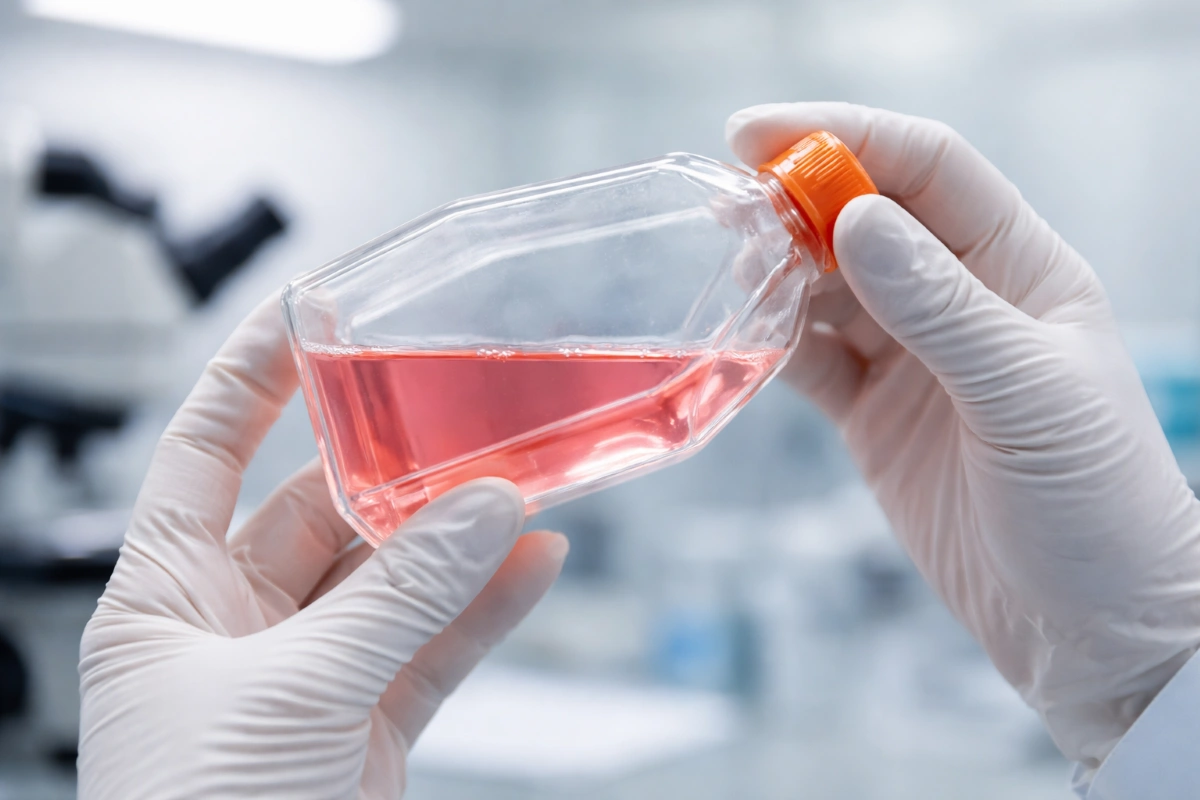
For research use only. Not for human consumption. This article is intended for licensed researchers, academic institutions, and laboratory professionals.
When Pickart and Margolina ran GHK-Cu expression data through the Broad Institute’s Connectivity Map database, the analysis flagged modulation of roughly 4,000 human genes – approximately one-third of all protein-coding genes profiled in the reference set. That kind of transcriptional reach is unusual for a three-amino-acid peptide, and it’s one of the reasons cell culture researchers keep returning to glycyl-L-histidyl-L-lysine-copper as a study compound.
This article walks through what in vitro work has actually shown about GHK-Cu and fibroblast behavior, what the concentration-response data looks like, where the literature converges, and where it leaves genuine gaps. Everything below applies to cell culture and educational research contexts only.
What GHK-Cu is, in the context of lab work
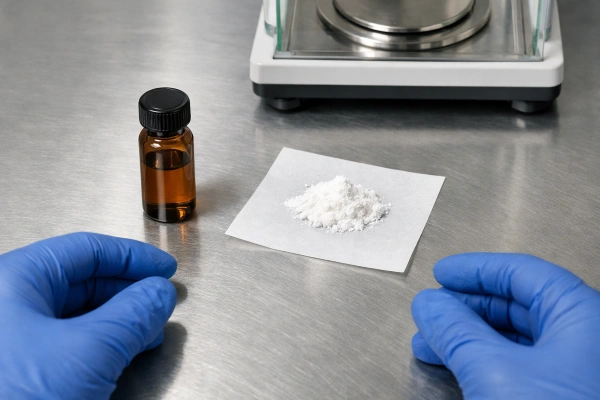
GHK-Cu is the copper-binding tripeptide glycyl-L-histidyl-L-lysine complexed with Cu(II). Loren Pickart isolated the peptide from human plasma in 1973 while investigating why plasma from older donors behaved differently in hepatocyte culture than plasma from younger donors when added to the same media. Measured plasma GHK concentrations decline from roughly 200 ng/mL at age 20 to under 80 ng/mL by age 60 – a detail that anchored much of the early aging-related fibroblast work.
In cell culture, GHK-Cu is typically reconstituted in sterile water or buffered media, where solvent selection influences peptide stability, and applied at nanomolar to low-micromolar concentrations. Most of the foundational fibroblast studies landed in the 1 nM to 1 µM range, with 10 nM appearing repeatedly as a working concentration for collagen and proliferation endpoints. Researchers sourcing research-grade GHK-Cu should confirm copper stoichiometry and peptide purity before locking in a protocol.
Collagen and extracellular matrix synthesis
Maquart and colleagues published one of the earliest direct fibroblast findings in FEBS Letters in 1988, reporting that GHK-Cu stimulated collagen synthesis in cultured dermal fibroblasts at concentrations as low as 10⁻⁹ M. That picomolar-to-nanomolar activity threshold remains one of the more striking features of the peptide. Follow-up work from the same French research program extended findings to glycosaminoglycan production, with Wegrowski and coauthors reporting increased dermatan sulfate proteoglycan synthesis in 1992.
The ECM picture that emerged from subsequent studies has more texture than “GHK-Cu increases collagen.” Siméon and colleagues documented increased decorin synthesis – a small leucine-rich proteoglycan that regulates collagen fibril diameter rather than bulk collagen quantity. Other groups have reported elastin modulation. Matrix metalloproteinase work, particularly on MMP-2, shows shifts in the balance between matrix deposition and remodeling rather than uniform suppression or activation.
The part that’s easy to miss: the ECM response to GHK-Cu in fibroblast cultures reads as a remodeling signature, not a blanket buildup. Researchers running matrix assays should expect changes in the ratio of components, not uniform increases across the board. This has practical implications for endpoint selection.
Fibroblast proliferation – smaller effect than most protocols assume
Direct proliferation effects of GHK-Cu on fibroblasts are more modest than the ECM data might suggest. Across multiple cell counting, MTT, and BrdU incorporation studies, proliferation increases typically land in the 15-40% range over untreated controls. The effect is concentration-sensitive and plateaus or reverses at higher doses, particularly above 1-10 µM in serum-containing media.
If you’re designing a fibroblast proliferation assay expecting dramatic numbers, the literature suggests tempered expectations. The more distinctive signal sits in the matrix composition and gene expression readouts, not cell count.
The gene expression evidence
Pickart and Margolina’s 2012 analysis, expanded in the 2015 BioMed Research International review, laid out the gene-level case: GHK-Cu exposure correlates with modulation of thousands of genes across cell types, including clusters involved in DNA repair, antioxidant defense, and ECM organization. Independent groups working with human fibroblasts have reported transcriptional shifts consistent with partial reversal of age-associated expression patterns in late-passage cells, though the magnitude and reproducibility of these shifts vary by cell source and passage number.
A few caveats researchers should hold onto: this is largely microarray and bioinformatics data, not functional rescue of cellular senescence. The cells don’t become young. The transcriptional signature shifts. Whether that shift translates to functional endpoints – telomere dynamics, mitochondrial function, secretory phenotype – depends entirely on the specific assay and the specific genes being tracked. The gap between transcriptomic and functional rescue is where a lot of the interesting unpublished work sits.
Concentration matters more than many protocols acknowledge
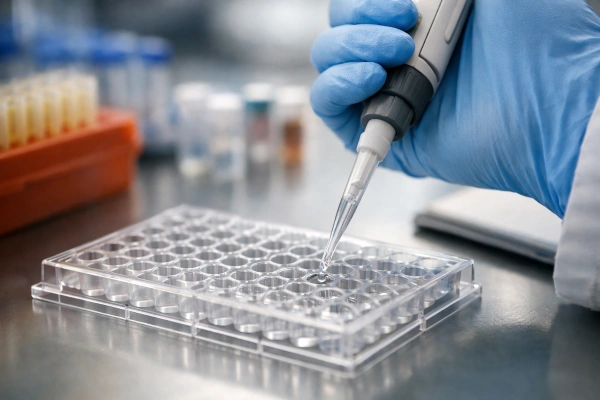
One counterintuitive finding from the cell culture literature: GHK-Cu shows a biphasic response in several fibroblast endpoints. Low concentrations stimulate. Higher concentrations can flatten or become cytotoxic, particularly during longer exposures where free copper release and oxidative effects become concerns.
Dose-response design should span at least three orders of magnitude – 1 nM, 10 nM, 100 nM, 1 µM, 10 µM. Assuming higher doses produce stronger effects is a common design error in this peptide class. The copper-to-peptide stoichiometry, buffer composition, and serum content of the media all shift where the optimal window sits, which is why direct comparison across published studies requires careful attention to methods sections.
Handling notes that rarely make the abstract
A few things come up repeatedly in methods sections and almost never in summaries:
GHK-Cu stability in serum-containing media isn’t indefinite. Several studies refresh peptide at 24-48 hour intervals during longer exposures. Serum carboxypeptidase activity and oxidation of the histidine imidazole both contribute to degradation, and degraded GHK loses its copper-binding profile. Reconstituted peptide storage protocols vary widely across published work, which is worth keeping in mind when comparing results between groups.
Copper speciation matters. GHK-Cu behaves differently from free Cu(II) at equimolar concentrations, which is why copper-only and peptide-only controls are essential for any ECM or gene expression readout attributed to the complex specifically. Skipping these controls is one of the most common critiques of older GHK literature. Verifying copper content in the source material before experiments begin is a related and often overlooked step.
Vehicle and carrier controls deserve more attention than they typically get. Some GHK-Cu preparations include trace stabilizers or carriers that produce measurable effects in sensitive assays. Source-to-source variability in research-grade material is real, which is why formal stability and sterility evaluations on incoming lots are worth building into lab intake rather than treating as optional.
Where the literature still leaves gaps
Several questions remain genuinely open in fibroblast cell culture work. The primary receptor or binding target for GHK-Cu in fibroblasts has not been definitively identified – candidate interactions include copper transport proteins, copper-responsive transcription factors, and redox-sensitive signaling nodes, but no consensus target has emerged. The mechanistic bridge between transcriptional changes and functional cellular outputs needs tighter connection. Comparative data across fibroblast subtypes – dermal, cardiac, pulmonary, synovial – is patchy, with dermal dominating the published record.
For researchers entering this space, these gaps represent real opportunities to contribute rather than settled questions to restate.
Conclusion
The GHK-Cu fibroblast literature rewards researchers who design for modulation signatures rather than amplitude. Four practical takeaways carry across the strongest published work. First, prioritize matrix composition and transcriptional endpoints over bulk proliferation counts, since that’s where the reproducible signal sits. Second, run dose-response curves across at least three orders of magnitude, with 10 nM as a reasonable anchor point for pilot work. Third, always include copper-only and peptide-only controls, because without them the complex-specific effect cannot be separated from free copper activity. Fourth, refresh peptides at 24-48 hour intervals during longer exposures and document degradation assumptions in methods.
Researchers who build these four habits into their protocols from day one spend less time troubleshooting inconsistent results and more time generating data that holds up under peer review and comparative analysis. The compound isn’t difficult to work with in cell culture. It’s just unforgiving of sloppy controls and vague reporting.
FAQs
What concentration range is typically used for GHK-Cu in fibroblast cell culture?
Published fibroblast studies commonly test GHK-Cu across nanomolar to micromolar concentrations, with low-nanomolar exposures appearing often in collagen and gene-expression work. A practical study design is to run a dose-response curve over several log steps rather than relying on a single concentration, because responses can vary by endpoint and dose. In the classic 1988 fibroblast paper by Maquart and colleagues, collagen stimulation began between 10^-12 and 10^-11 M and peaked around 10^-9 M.
Does GHK-Cu increase fibroblast proliferation in published research?
Sometimes, but not as consistently as matrix-related endpoints. Published fibroblast research more reliably shows effects on collagen synthesis, extracellular-matrix remodeling, and gene-expression changes than on large increases in raw cell number. Some experiments report proliferative effects, but proliferation is generally a less robust readout than matrix composition or transcriptional profiling.
Why do GHK-Cu experiments require copper-only controls?
Copper-only controls help distinguish the biological effects of the intact GHK-Cu complex from the effects of free copper ions alone. In well-designed fibroblast experiments, researchers often also include peptide-only and untreated controls so that changes in extracellular-matrix synthesis, gene expression, or proliferation can be attributed more specifically to the copper-peptide complex rather than to copper exposure by itself.
How long does GHK-Cu remain stable in cell culture media?
GHK-Cu should not be assumed to remain fully stable indefinitely in cell culture conditions. Stability can vary with media composition, serum content, temperature, and exposure time, and the peptide is known to be susceptible to enzymatic breakdown. For longer experiments, many researchers refresh treatment during media changes and report that schedule in the methods section to improve reproducibility.
Which fibroblast endpoints show the strongest response to GHK-Cu exposure?
Matrix-related and transcriptional endpoints usually produce the clearest signals. Published fibroblast work has reported effects on collagen synthesis, elastin production, glycosaminoglycan and proteoglycan-related remodeling, MMP-related gene expression, and broader gene-expression shifts identified in later gene-profile analyses. Compared with those readouts, pure proliferation counts are usually less striking and less consistent.
Research Use Disclaimer
GHK-Cu sold by Penguin Peptides is intended strictly for in vitro laboratory research and educational purposes. It is not a drug, dietary supplement, cosmetic, food product, or medical device. GHK-Cu is not for human or veterinary consumption, injection, inhalation, topical application, or any other form of in vivo administration. Products are made available only to qualified researchers, academic institutions, and licensed laboratories operating in compliance with applicable federal, state, and local regulations.
No statements in this article are intended to diagnose, treat, cure, prevent, or mitigate any disease or health condition, and no medical, therapeutic, cosmetic, or performance claims are made or implied. Citations to published research are provided for academic reference only and do not constitute endorsement of any use outside of controlled laboratory settings. Researchers are solely responsible for ensuring their work complies with institutional review requirements, biosafety protocols, and all relevant laws.
By purchasing GHK-Cu from this company, the buyer affirms that they are a qualified professional, that the material will be used exclusively for legitimate research or educational purposes, and that it will not be administered to humans or animals.