❌ Not for Human Consumption
●
✅ For Research Use Only
●
All products are intended strictly for laboratory research purposes only
●
❌ Not for Human Consumption
●
✅ For Research Use Only
●
All products are intended strictly for laboratory research purposes only
●

CJC-1295 (No DAC) & Ipamorelin In The Lab: Reconstitution, Storage, And Handling Best Practices

Research-Use Disclaimer
CJC-1295 (No DAC) and Ipamorelin are sold and supplied strictly for in-vitro laboratory research and educational use by qualified investigators at licensed institutions. These materials are not FDA-approved for human or veterinary use. They are not drugs, dietary supplements, cosmetics, or consumer products. Nothing in this article constitutes medical advice, a therapeutic claim, or guidance on any form of human or animal administration. Any use outside of controlled laboratory research is prohibited.
Most CJC-1295 (No DAC) and Ipamorelin data that fail reproducibility checks don’t fail because of the peptide. It fails because of how the peptide was handled between arrival at the loading dock and insertion into an assay plate. A single freeze-thaw cycle on reconstituted stock, held at 4°C for three weeks, can shift measured concentration enough to throw dose-response curves off by a meaningful margin. Researchers who don’t track that drift end up blaming noise on the molecule.
This piece is for research staff and PIs who want their in-vitro work on CJC-1295 and Ipamorelin to hold up under peer review. Not a protocol for administration. Not a therapeutic discussion. A lab-bench reference for the three windows where peptide integrity is won or lost: reconstitution, storage, and daily handling.
Why CJC-1295 (No DAC) and Ipamorelin Require Different Handling Than You Might Expect
CJC-1295 (No DAC) is a 30-amino-acid peptide with a molecular weight of approximately 3,367 Da. It’s structurally a modified GHRH(1-29) analogue. The “No DAC” distinction matters enormously for handling: the DAC-modified variant includes a drug affinity complex that extends its in-vivo half-life to roughly eight days, while the No DAC version has an in-vitro functional half-life closer to 30 minutes once exposed to serum or enzymatic activity. This isn’t academic trivia. It determines how quickly you must run your assay after dilution into working media.
Ipamorelin is a pentapeptide – Aib-His-D-2-Nal-D-Phe-Lys-NH2 – with a molecular weight of about 711.86 Da. Smaller, simpler, and generally more forgiving in solution than CJC-1295, but still a biologically active peptide that degrades with poor technique.
Both arrive lyophilized. Both are hygroscopic. Both lose potency through mechanisms your average organic chemist doesn’t think about twice: thermal cycling, surface adsorption onto polypropylene, agitation-induced fragmentation, and oxidation of exposed residues.
Before You Touch The Vial: Receiving Inspection
Your handling protocol starts before the shipper hands off the package. Check three things within the first 15 minutes of receipt.
First, confirm the cold chain. Reputable research peptide suppliers ship lyophilized CJC-1295 (No DAC) and Ipamorelin with cold packs or dry ice depending on transit time, even though lyophilized peptide is stable at room temperature for days. If your package arrived warm after a 72-hour ground shipment, document it and decide whether to use that lot for critical experiments or hold it for exploratory work.
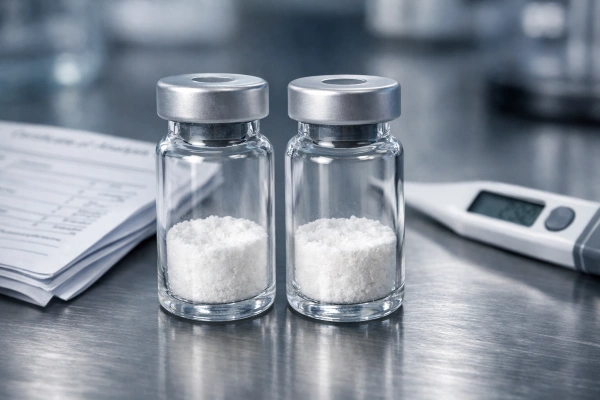
Second, inspect the lyophilized pellet visually. It should sit as a uniform white to off-white cake or powder at the bottom of the vial. A pellet that has partially liquefied, turned yellow, or migrated up the vial wall indicates a thermal event or seal failure in transit.
Third, log the certificate of analysis against the vial label. Match lot number, peptide purity (HPLC should typically report above 98% for research-grade material), net peptide content, and any salt-form notes. Net peptide content is not the same as vial weight. If your CoA shows 85% net peptide for a vial labeled 5mg, you have 4.25mg of actual peptide in that vial – and that’s what your concentration math needs to use.
Lock the CoA into your lab notebook or ELN before the vial is opened.
Reconstitution: The Math Nobody Should Be Doing From Memory
Bacteriostatic water containing 0.9% benzyl alcohol is the standard diluent for in-vitro peptide stock preparation when the solution will be stored for more than 48 hours. For short-window use (same day into assay), sterile water for injection or 0.1% acetic acid solutions are also common, with the acid preferred for peptides that show precipitation in neutral aqueous solution. Choosing the right solvent for a given compound is its own rabbit hole, and worth the time before you commit a lot to a poorly-matched diluent.
CJC-1295 (No DAC) dissolves readily in water at research-relevant concentrations and generally doesn’t require acidified diluent. Ipamorelin is also highly water-soluble. Neither requires DMSO for primary reconstitution at typical working concentrations.
Here’s the concentration calculation most teams get wrong on their first run. If you have a 5mg vial (assume 100% net peptide for this example) and reconstitute with 5mL of bacteriostatic water, your stock concentration is 1mg/mL, or 1000 mcg/mL, or 1,000,000 ng/mL. If you reconstitute the same 5mg vial with 2mL, your stock is 2.5mg/mL. The choice depends entirely on your working concentration and the pipetting range of your instruments. For plate-based bioassays where you’ll be dosing in the low ng/mL range, a more dilute stock makes serial dilution cleaner. For long-term storage of aliquots, a more concentrated stock reduces the surface-area-to-volume ratio and slows degradation.
The mechanics matter as much as the math. Three rules.
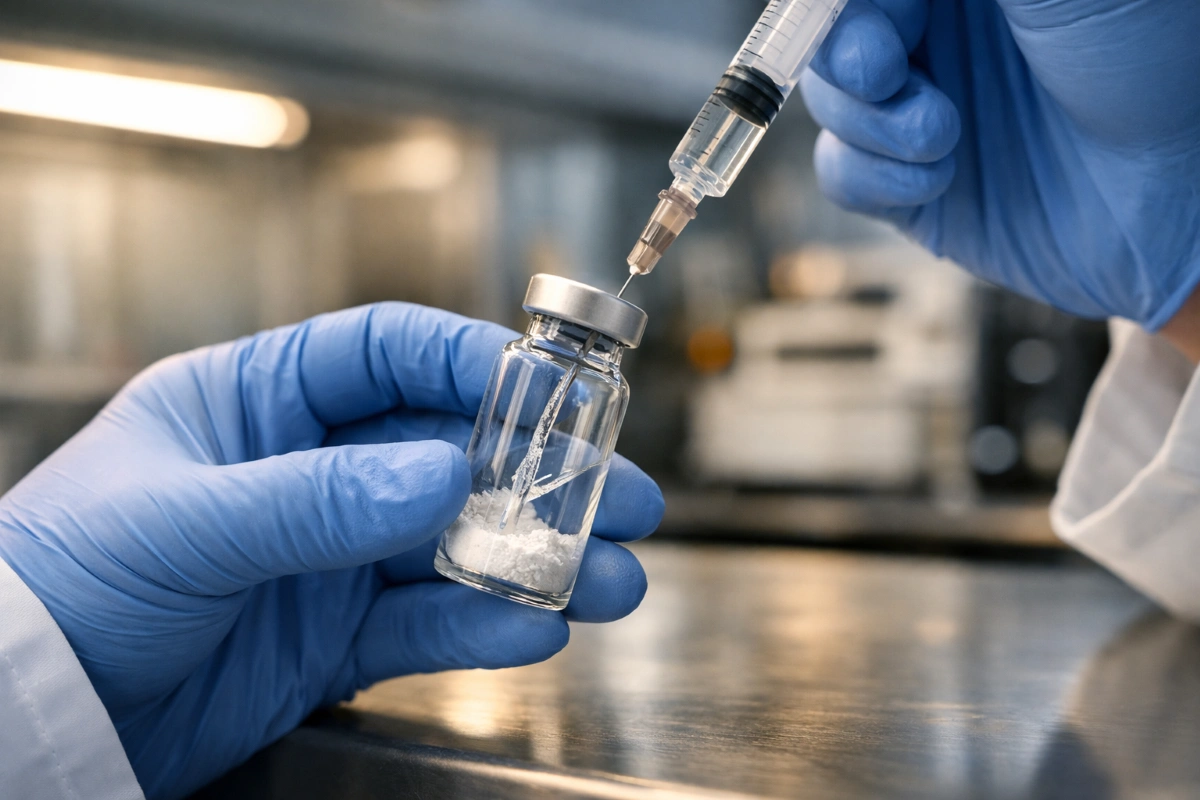
Don’t inject the water stream directly onto the peptide pellet. Angle the needle so the diluent runs down the inner wall of the vial. High-velocity contact shears peptide chains.
Don’t shake. Ever. Agitation creates air-water interfaces where peptide molecules denature and aggregate. Swirl the vial gently or invert it a few times. If the pellet hasn’t fully dissolved after two minutes of gentle swirling, give it another five minutes at room temperature rather than reaching for the vortex.
Let the reconstituted solution sit for 10 to 15 minutes before drawing from it. Full dissolution isn’t always visible to the eye, and premature pipetting from an incompletely dissolved vial gives you a non-uniform stock.
Storage: Lyophilized vs. Reconstituted
Lyophilized CJC-1295 (No DAC) and Ipamorelin stored at -20°C in sealed vials remain stable for 24 months or longer based on manufacturer stability data, though most labs run through lots well inside that window. At 2-8°C, lyophilized stability runs in the range of several months. At room temperature, stability is measured in days to weeks, which is fine for transit but not for long-term storage.
Reconstituted peptide is a different story. Once water hits the pellet, the clock starts.
Reconstituted CJC-1295 (No DAC) in bacteriostatic water held at 2-8°C in the dark is generally usable for in-vitro work for about two to three weeks, with measurable degradation accumulating after that. Reconstituted Ipamorelin under the same conditions is similar. For longer storage, aliquot the reconstituted stock into single-use volumes in low-binding polypropylene tubes, freeze at -20°C or -80°C, and thaw each aliquot only once.
The single-use aliquot rule is where most labs cheat themselves out of reproducible data. Every freeze-thaw cycle introduces a nucleation event, redistributes concentration via ice-exclusion gradients, and exposes the peptide to denaturing interfaces. After three cycles, you should assume your stock is compromised for quantitative work. Use fresh aliquots for dose-response experiments. Reserve multi-thaw vials for qualitative checks only. The same general principles apply to storing peptide solutions that arrive pre-mixed, though the stability windows are typically tighter.
Two storage details labs routinely overlook: amber vials or foil-wrapped tubes for light-sensitive protection, and avoiding no-frost freezers. Auto-defrost cycles in standard lab freezers cause micro thermal cycling that accumulates damage over months.
Handling During Experiments
Aseptic technique isn’t optional for in-vitro work where contamination can invalidate cell-based assays. A biosafety cabinet or laminar flow hood is the right environment for drawing working dilutions. Wipe the vial septum with 70% isopropanol and let it dry before each draw. Use a fresh sterile needle and syringe per draw if you’re using a multi-dose vial.
Calibration discipline on pipettes is where peptide work exposes sloppy labs. A 2% error on a 10µL draw at a 1mg/mL stock is 0.2µg of peptide, which at low working concentrations is a significant fraction of your dose. Verify pipette calibration against NIST-traceable weights monthly if you’re generating publication data.
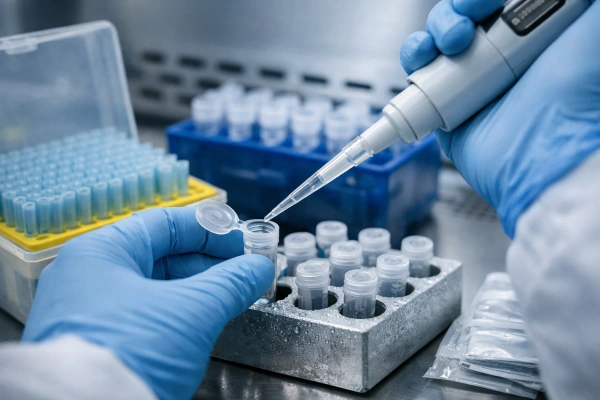
Use low-protein-binding tips and tubes for all dilution steps below 10µg/mL. Standard polypropylene adsorbs peptide at interfaces, and at low concentrations that loss is measurable. The difference between a standard 1.5mL tube and a low-binding equivalent can be the difference between a clean standard curve and one that drifts at the bottom end.
Prepare working dilutions the day of the assay. Don’t pre-make a week of working stocks in assay buffer and hold them at 4°C. The No DAC variant of CJC-1295 degrades measurably in serum-containing buffers over 24 hours, and even in serum-free buffer you’re introducing variability you don’t need. If you’re evaluating a new lot or a new supplier, run the intake stability and sterility checks before the material touches a plate that matters.
The Mistakes That Invalidate Data
Four patterns show up repeatedly in research groups new to peptide work.
Miscalculating concentration from gross vial weight rather than net peptide content. If your CoA reports 82% net peptide, you have 820µg in a “1mg” vial, and dosing math that assumes 1mg produces a systematic 18% high-dose bias. Every published dose-response curve from that lab carries that error.
Treating No DAC and DAC variants of CJC-1295 as interchangeable. They aren’t. The literature and the handling protocols diverge sharply. Citing a DAC-variant study to justify your No DAC stability assumptions will burn you at peer review.
Relying on room-temperature stability claims from shipping documentation as permission for bench-top storage during active experiments. Shipping stability and bench stability are different claims under different conditions.
Not documenting the reconstitution date and lot on every aliquot. When an experiment produces unexpected results six weeks later, you need to know whether you’re looking at biology or at a three-week-old reconstituted stock that has drifted.
Documentation And Compliance
Every research program using CJC-1295 (No DAC) and Ipamorelin should maintain chain-of-custody documentation from supplier to assay. Lot number, receipt date, storage location, reconstitution date, aliquot inventory, and disposal records. This isn’t bureaucratic overhead. It’s the paper trail that lets you defend your data and lets your institution demonstrate compliant research-use handling.
Label every vial and every aliquot with the compound name, concentration, diluent, reconstitution or aliquot date, and “RESEARCH USE ONLY – NOT FOR HUMAN CONSUMPTION.” If your lab works with multiple peptides, labeling discipline is what prevents cross-contamination errors and protects the regulatory posture of the institution.
Institutional biosafety committee approval, if your research involves cell lines or animal tissue, should be current and should specifically cover the peptides you’re using. Research peptide suppliers typically require a statement of research intent and institutional affiliation before fulfilling orders, and that requirement exists to keep these materials inside the research channel where they belong.
Conclusion
Peptide research reproducibility comes down to habits formed in the first 30 seconds of a shipment arriving and the last 30 seconds before a pipette touches an assay plate. Labs that treat CJC-1295 (No DAC) and Ipamorelin handling as a documented protocol rather than tribal knowledge generate cleaner data, defend it more easily at peer review, and burn through less material doing so.
Build the checklist now: net peptide math off the CoA, wall-down reconstitution with bacteriostatic water, single-use aliquots in low-binding tubes, dated labels on every vial, and freeze-thaw cycles tracked in the ELN. Train every new team member against the same written procedure so technique doesn’t drift with personnel turnover. Keep a designated lot for calibration runs, audit your freezer inventory quarterly, and retire any vial that can’t be accounted for on paper. The compound is doing its job. The open question is whether your handling lets it.
FAQs
What’s the half-life difference between CJC-1295 No DAC and CJC-1295 with DAC, and why does it matter for research design?
The No DAC variant has an in-vitro functional half-life of roughly 30 minutes, while the DAC-modified version extends to approximately eight days through its drug affinity complex. That gap changes assay windows, working-solution timing, and how quickly you need to run downstream measurements after dilution. Citing DAC-variant literature to justify No DAC stability assumptions is one of the more common reproducibility failures at peer review.
What’s the correct diluent for reconstituting CJC-1295 No DAC and Ipamorelin in a research setting?
Bacteriostatic water containing 0.9% benzyl alcohol is the standard for stock preparation stored beyond 48 hours. Sterile water for injection works for same-day use. Both peptides are highly water-soluble at typical research concentrations and don’t require DMSO or acidified diluents for primary reconstitution. Angle the diluent down the vial wall rather than onto the pellet, and swirl gently instead of shaking.
How many freeze-thaw cycles can reconstituted peptide tolerate before the data gets unreliable?
Treat three cycles as the practical ceiling for quantitative work, and aliquot into single-use volumes from the first reconstitution to avoid the question entirely. Every cycle creates ice-exclusion concentration gradients and exposes peptide to denaturing interfaces. Use fresh aliquots for dose-response curves. Reserve any multi-thaw vials for qualitative checks only.
Should I calculate stock concentration from gross vial weight or net peptide content on the CoA?
Always use net peptide content. A vial labeled 5mg with 85% net peptide content contains 4.25mg of actual peptide. Using the gross 5mg figure in your concentration math produces a systematic 15% high-dose bias across every experiment from that lot. Log net peptide content and lot number into the ELN before reconstitution, not after.
What’s the correct storage temperature for lyophilized versus reconstituted CJC-1295 No DAC and Ipamorelin?
Lyophilized material keeps longest at -20°C, with 2-8°C acceptable for shorter windows and room temperature stable through shipping. Reconstituted stock held at 2-8°C in the dark is generally usable for two to three weeks. For longer retention, aliquot reconstituted material into low-binding polypropylene tubes and freeze at -20°C or -80°C, thawing each aliquot only once. Avoid auto-defrost freezers for long-term storage.
Compliance Notice
CJC-1295 (No DAC) and Ipamorelin discussed throughout this article are research chemicals intended exclusively for in-vitro laboratory investigation and academic study by credentialed researchers. No statement in this article should be construed as a recommendation, endorsement, or instruction for human or veterinary administration. These compounds have not been evaluated by the FDA for safety or efficacy in any therapeutic context, and no therapeutic claims are made or implied. Orders are fulfilled only to verified research institutions and qualified investigators. Diversion outside the research channel is prohibited and may violate federal and state law.