❌ Not for Human Consumption
●
✅ For Research Use Only
●
All products are intended strictly for laboratory research purposes only
●
❌ Not for Human Consumption
●
✅ For Research Use Only
●
All products are intended strictly for laboratory research purposes only
●

What Challenges Do Researchers Face When Reconstituting KLOW Blends?

Written By: Gary Hite, Research Content Writer
Reviewed By: Natalie Kunsman, M.D., Board-Certified Physician
Last Reviewed: October 9, 2026
Disclaimer: KLOW is sold by Penguin Peptides for laboratory research purposes only. It is not intended for human consumption, therapeutic use, or diagnostic application. The statements in this article have not been evaluated by the U.S. Food and Drug Administration. This content is written for professional researchers and academics conducting in vitro and preclinical studies.
Reconstituting KLOW blends is harder than reconstituting any of its four peptides alone. KLOW combines 80mg of GHK-Cu (50mg), TB-500 (10mg), BPC-157 (10mg), and KPV (10mg) in a single lyophilized vial. Each compound has different solubility behavior, pH sensitivity, and degradation triggers. Get the solvent wrong, mix too aggressively, or store at the wrong temperature, and you can lose up to 30% of a peptide’s bioactivity before you run your first assay. This article covers the eight specific challenges researchers face when reconstituting KLOW blends and the protocols that address each one.
KLOW is a research-grade lyophilized peptide blend containing four compounds (GHK-Cu, TB-500, BPC-157, and KPV) formulated at 80mg per vial for in vitro and preclinical laboratory applications, including tissue repair models, immune modulation studies, and inflammatory response research.
Why is a 4-in-1 blend harder to reconstitute than a single peptide?
Single-peptide reconstitution is straightforward. You pick the right solvent, add the right volume, swirl gently, and refrigerate. A 4-in-1 blend like KLOW forces you to satisfy four different stability profiles with one solvent, one pH, one mixing protocol, and one storage condition.
That’s the core problem. GHK-Cu is a metallopeptide chelated to copper(II) ions. TB-500 is a 43-amino-acid fragment of Thymosin Beta-4. BPC-157 is a 15-amino-acid pentadecapeptide derived from gastric proteins. KPV is a tripeptide with just three amino acids. These compounds don’t behave the same way in solution.
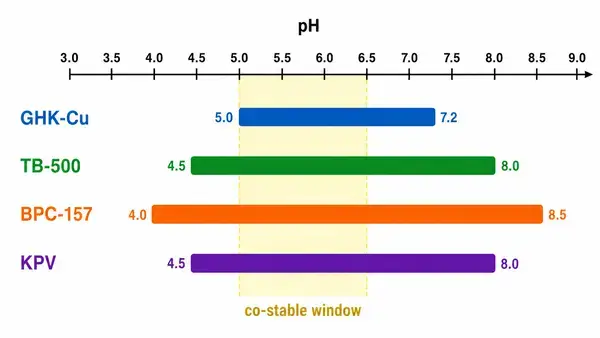
GHK-Cu needs a mildly acidic to neutral pH (roughly 5.0 to 6.5) to keep its copper coordination intact. Push the pH above 7.5, and the copper can dissociate and precipitate out of solution. BPC-157 and TB-500 are both water-soluble and tolerant of a wider pH range, but BPC-157’s proline-rich structure gives it a different aggregation profile than TB-500’s larger molecular weight. KPV, as a small tripeptide, dissolves readily but can degrade faster than the larger peptides if exposed to proteases.
The researcher’s job is to find the narrow overlap where all four compounds remain stable. That overlap exists, but it’s tighter than most single-peptide protocols require.
How does pH create problems during KLOW reconstitution?
pH is the single biggest variable in KLOW reconstitution, and it’s the one most researchers underestimate.
GHK-Cu’s copper(II) chelate is pH-dependent. At a pH below 4.0, the copper dissociates from the GHK tripeptide and the compound loses its functional coordination. Above pH 7.5, copper can precipitate out of solution. Research published in the Journal of Inorganic Biochemistry has confirmed that GHK-Cu is most stable between pH 5.0 and 7.2, with peak chelate stability around pH 5.5 to 6.5.
The other three peptides in KLOW are more forgiving. BPC-157 remains stable across a broader pH range. TB-500 dissolves well in neutral to slightly acidic conditions. KPV, as a small alpha-MSH fragment, doesn’t present significant pH-driven stability concerns in this range.
The practical takeaway: bacteriostatic water (BAC water) sits naturally near pH 5.5. That places it inside the co-stable window for all four KLOW peptides without additional buffering. Phosphate-buffered saline (PBS) at physiological pH 7.4 technically works but sits right at the upper edge of GHK-Cu’s stable range, which increases precipitation risk over time.
This is where many researchers run into trouble. They default to PBS because that’s what their cell culture protocols call for, without accounting for the copper chelation chemistry in the blend.
What solvent should researchers use for KLOW blends?
Solvent selection is the second challenge, and it’s directly tied to pH.
BAC water (0.9% benzyl alcohol) is the standard choice for multi-use reconstitution in research settings. It sits near pH 5.5, inhibits microbial growth, and dissolves all four KLOW components without requiring an organic co-solvent. For researchers running multiple assays from a single vial over 2 to 4 weeks, BAC water provides the best balance of solubility, stability, and contamination resistance.
Sterile water works for single-use reconstitution. It offers no antimicrobial protection, so the full volume needs to be used within 24 to 48 hours or aliquoted into sterile containers immediately after reconstitution.
A 0.6% acetic acid solution improves solubility for GHK-Cu in cases where copper precipitation occurs. Its lower pH (around 3.0 to 4.0 in typical preparations) sits below the ideal co-stable window for the full blend, so it’s better suited for GHK-Cu alone than for the combined KLOW formulation.
DMSO is sometimes suggested in general peptide reconstitution guides. It’s not appropriate for KLOW. Neither TB-500 nor BPC-157 requires an organic co-solvent, and DMSO can interfere with downstream assays, including cell viability studies.
Here’s the contrarian take most guides won’t give you: the “universal” reconstitution protocols circulating online treat every peptide the same. They don’t account for metallopeptides. A researcher who follows a generic guide and uses PBS or alkaline buffer for a GHK-Cu-containing blend risks copper precipitation that silently reduces the active concentration, producing inconsistent assay results that get attributed to peptide quality rather than reconstitution error. This is supported by coordination chemistry research showing that Cu(II)-GHK complexes are pH-labile above 7.4.
Penguin Peptides carries both bacteriostatic water and acetic acid 0.6% for researchers who need matched solvents for their reconstitution protocols.
What mixing errors cause peptide denaturation?
The third challenge is physical handling during reconstitution. Peptides are fragile. KLOW’s lyophilized powder is a compressed cake of four different compounds, and how you introduce the solvent matters.
The two most common mixing errors are shaking and injecting solvent directly onto the powder cake.
Shaking creates foam. Foam means air-liquid interfaces, and those interfaces cause protein and peptide aggregation. Research on peptide formulation stability has shown that vigorous agitation can reduce bioactivity by up to 30% in susceptible compounds. TB-500, as the largest peptide in the KLOW blend at 43 amino acids, is the most vulnerable to aggregation from mechanical stress.
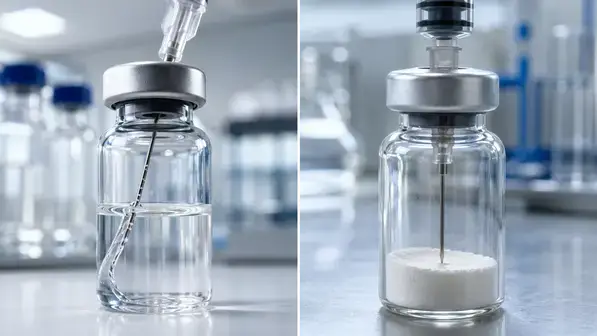
The correct technique: add the solvent slowly along the inner wall of the vial. Let it run down the glass and pool at the bottom. Then tilt the vial gently at a 45-degree angle and rotate it slowly between your fingers. Don’t invert it rapidly. Don’t flick it. Don’t vortex it. Give it 2 to 3 minutes of gentle rotation. If undissolved powder remains, set the vial in the refrigerator for 10 to 15 minutes and then rotate again.
Injecting solvent directly onto the lyophilized cake can also cause problems. The sudden pressure can fragment the cake unevenly, creating pockets of high concentration that take longer to dissolve and increase the risk of localized aggregation.
How should researchers store reconstituted KLOW?
Storage is the fourth challenge, and it starts the moment you add solvent.
Penguin Peptides specifies storing reconstituted KLOW at 36 to 46 degrees Fahrenheit (2 to 8 degrees Celsius) and using it within 30 days. That 30-day window reflects the practical stability of a multi-peptide solution in BAC water under refrigeration.
Unreconstituted KLOW (lyophilized powder) should be stored at -4 degrees Fahrenheit (-20 degrees Celsius). At this temperature, lyophilized peptides remain stable for 24 months or longer when kept in a sealed container with desiccant.
The mistakes researchers make with storage fall into three categories.
First, freezing reconstituted KLOW. Peptide solutions should not be frozen after reconstitution. Freeze-thaw cycles cause aggregation and can physically damage peptide structure. If you need to store portions for later use, aliquot the reconstituted solution into single-use volumes immediately after mixing and refrigerate them individually.
Second, leaving reconstituted vials at room temperature. Reconstituted peptides at room temperature are stable for hours, not days. A vial left on a bench overnight during a long experiment is a vial losing active content to oxidation and aggregation.
Third, exposing vials to light. UV and visible light break chemical bonds in aromatic amino acid residues. GHK-Cu is more vulnerable than the other three components, as light exposure accelerates copper dissociation. Store reconstituted vials wrapped in foil or inside an opaque container in the refrigerator.
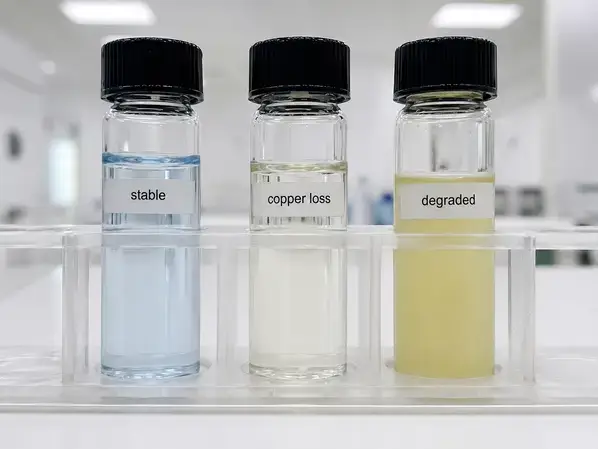
What visual indicators signal degradation in reconstituted KLOW?
One advantage of working with a copper-chelated blend: GHK-Cu provides built-in visual feedback on solution integrity. This is the fifth challenge, and it’s one many researchers don’t know to look for.
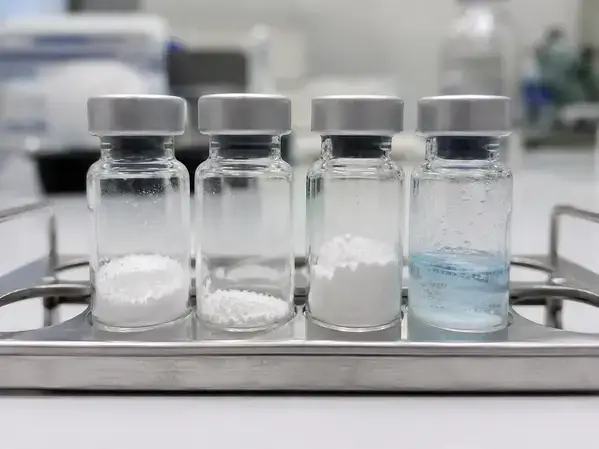
A properly reconstituted KLOW solution with GHK-Cu will have a faint blue tint. That color comes from the copper(II) coordination. It’s your baseline.
If the blue fades to pale or colorless, the copper is dissociating from the GHK peptide. The compound is losing its functional structure. This typically happens when pH drifts upward during storage or when the solution has been exposed to light or heat.
If the color shifts toward green or teal, the pH of the solution has changed. This can indicate microbial contamination (especially in sterile water without preservative) or chemical interaction with impurities.
Cloudiness or visible particles mean precipitation or aggregation has occurred. At this point, the solution should not be used for research. The active concentration is no longer reliable, and suspended particles can interfere with spectrophotometric readings and cell-based assays.
A solution that looks clear but has been stored beyond the 30-day window is also suspect. Peptide degradation is often invisible. A solution can appear clear while losing 30 to 40% of its active content to oxidation or sub-visible aggregation. HPLC analysis is the only way to confirm concentration and purity in reconstituted solutions that have been stored for extended periods.
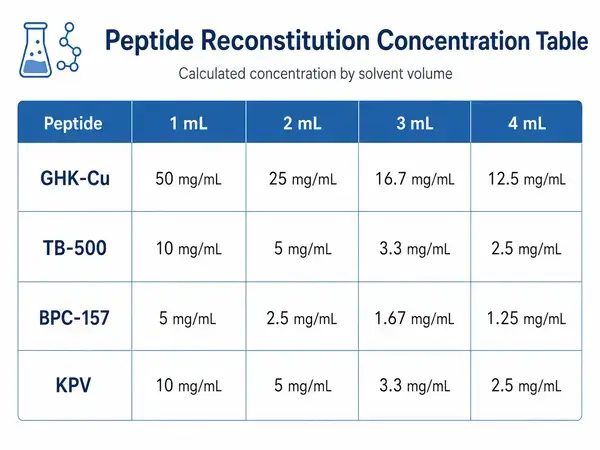
How do researchers calculate accurate concentrations for a 4-in-1 blend?
Concentration math is the sixth challenge. It trips up researchers who are used to single-peptide calculations.
KLOW contains 80mg total peptide content per vial, but that total is split across four compounds at different amounts: GHK-Cu at 50mg, TB-500 at 10mg, BPC-157 at 10mg, and KPV at 10mg. When you add 2mL of BAC water to the vial, you don’t get a single “KLOW concentration.” You get four separate concentrations in one solution.
With 2mL of solvent, the concentrations work out to: GHK-Cu at 25mg/mL, TB-500 at 5mg/mL, BPC-157 at 5mg/mL, and KPV at 5mg/mL. Add 4mL instead, and every concentration halves.
The error researchers make is treating the blend as if it were 80mg of a single compound. They calculate a “total peptide concentration” that doesn’t correspond to any individual component’s actual concentration. When they pull a volume for an assay, the amount of each peptide in that volume depends on its proportion in the blend, not on the total.
For researchers who need a specific concentration of one component (say, BPC-157 at 1mg/mL), the reconstitution volume must be calculated from that component’s individual mass in the vial, not from the total 80mg. In this case, 10mg of BPC-157 in 10mL of solvent gives 1mg/mL of BPC-157, but the GHK-Cu concentration in the same solution drops to 5mg/mL and each of the other peptides to 1mg/mL.
This creates a genuine experimental design consideration. Multi-peptide blends are designed for research protocols that study the combined effects of all four components together. If a protocol requires precise, independent control over each peptide’s concentration, individual reconstitution of separate peptides gives you that control. For synergistic interaction studies, the KLOW blend provides the pre-formulated combination.
What contamination risks exist during KLOW reconstitution?
Contamination is the seventh challenge. Peptides are vulnerable to biological, chemical, and particulate contamination at every step of the reconstitution process.
The biggest biological threat is protease contamination from skin contact. Human sweat and skin oils contain proteases that enzymatically cleave peptide bonds. Touching the vial stopper, the syringe needle, or any surface that contacts the solution can introduce these enzymes. KPV, as a tripeptide with only three amino acids, is the most vulnerable component in KLOW because it has fewer bonds to lose before becoming inactive.
Chemical contamination comes from residues on glassware, improperly cleaned syringes, or contaminated solvents. Using non-sterile solvents introduces microbial load that can degrade peptides through enzymatic hydrolysis and alter pH through metabolic byproducts.
Particulate contamination from vial coring (fragments of the rubber stopper pushed into the solution by the needle) is common but often overlooked. Filter needles or 0.22-micron syringe filters remove particulates but add a handling step that increases exposure time and protease contact risk.
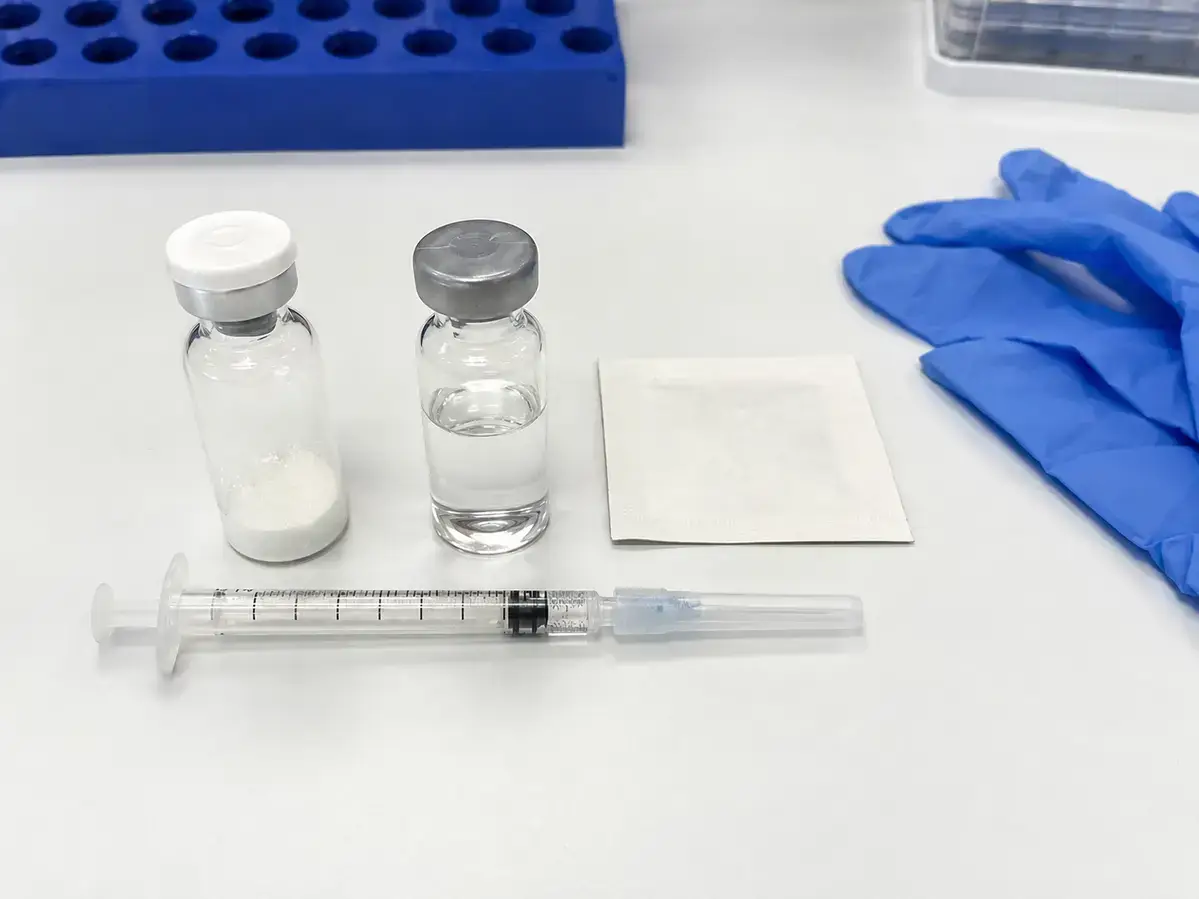
Standard contamination prevention: wear nitrile gloves, work in a clean environment (ideally a laminar flow hood), use only sterile solvents and syringes, swab the vial stopper with an alcohol prep pad before every needle insertion, and minimize the number of times you puncture the stopper.
Penguin Peptides provides third-party lab results verifying 98%+ purity on their KLOW blend, which gives researchers a clean starting point. What happens after the vial is opened is the researcher’s responsibility.
How does reconstitution volume affect downstream research outcomes?
The eighth challenge is a downstream one, but it starts at reconstitution: the volume of solvent you add determines every concentration in the vial, and that decision ripples through your entire experimental protocol.
Too little solvent creates a dense solution that’s harder to measure accurately in small volumes. Syringe graduation errors at high concentrations produce larger absolute errors in the amount of each peptide delivered to the assay.
Too much solvent creates a dilute solution that may require larger volumes per assay, which can affect experimental conditions (particularly in cell culture wells where total volume matters) and depletes the vial faster.
The practical range for most KLOW research protocols is 1mL to 4mL of solvent per vial. The right volume depends on the assay requirements for each component’s concentration and the total number of experimental runs planned from that vial.
Researchers working with recovery research compounds and related peptide blends like the GLOW blend face similar volume-planning considerations. The principle applies across all multi-peptide reconstitutions.
For context on how individual KLOW components behave when reconstituted separately, researchers can reference Penguin Peptides’ individual product listings for BPC-157, GHK-Cu, and the BPC-157 + TB-500 blend.
What separates a clean reconstitution from a failed one
Most reconstitution errors with KLOW blends come down to one oversight: treating a 4-in-1 metallopeptide formulation like a single-compound vial. GHK-Cu’s copper(II) chelate sets the rules for the entire blend. Use BAC water at its natural pH of 5.5 to stay inside the co-stable window for all four peptides. Direct the solvent down the inner glass wall, rotate slowly for 2 to 3 minutes, and never shake. Refrigerate at 2 to 8 degrees Celsius immediately after mixing, and plan to use the solution within 30 days.
Track the blue tint from the copper coordination. Color loss means GHK-Cu is degrading, and no amount of careful assay design fixes a compromised starting material. Calculate concentrations from each peptide’s individual mass (50mg, 10mg, 10mg, 10mg), not the 80mg total. Label every vial with the reconstitution date, solvent type, and volume added.
A 10-minute reconstitution done right protects weeks of downstream research. A careless one turns your next round of data into noise. For researchers who need content strategy support for academic or commercial peptide research, ECL Media works with research suppliers on compliant, research-focused content.
FAQs
Can you use sterile water instead of bacteriostatic water for KLOW reconstitution?
Yes, but with a significant limitation. Sterile water contains no antimicrobial preservative, so the reconstituted solution must be used within 24 to 48 hours or aliquoted into sterile containers immediately. BAC water’s benzyl alcohol preservative inhibits microbial growth for 4 to 6 weeks, making it the better choice for multi-use research protocols with KLOW.
Does KLOW need to be refrigerated before reconstitution?
No. Unreconstituted (lyophilized) KLOW should be stored at -4 degrees Fahrenheit (-20 degrees Celsius), not in a standard refrigerator. After reconstitution, move it to refrigerator temperature (36 to 46 degrees Fahrenheit, or 2 to 8 degrees Celsius). Do not freeze reconstituted KLOW. Lyophilized peptides stored at -20 degrees Celsius with desiccant remain stable for 24 months or longer.
Why does my reconstituted KLOW solution look blue?
The faint blue color comes from the copper(II) ions in GHK-Cu, which makes up 50mg of the 80mg total blend. This color is normal and indicates that the copper chelation is intact. If the blue fades to colorless, the copper may be dissociating, which signals degradation of the GHK-Cu component.
Can I mix KLOW with other research peptides in the same vial?
Combining KLOW with additional peptides introduces compatibility risks. Different peptides may undergo chemical reactions with one another in solution. KLOW’s four components have already been validated for co-formulation by the manufacturer. Adding other compounds to the same vial without compatibility testing can cause precipitation, pH shifts, or accelerated degradation of one or more components.
How do I know if my reconstituted KLOW has gone bad?
Check for three things: color change (blue fading or shifting to green/teal), cloudiness or visible particles, and time since reconstitution. Penguin Peptides recommends using reconstituted KLOW within 30 days when stored at 2 to 8 degrees Celsius in BAC water. Any visible change in clarity or color warrants discarding the vial. For confirmation of active concentration after extended storage, HPLC analysis is the standard method.
What is the co-stable pH window for all four KLOW peptides?
The co-stable pH range for GHK-Cu, TB-500, BPC-157, and KPV sits between approximately 5.0 and 6.5. BAC water naturally falls near pH 5.5, placing it inside this window without additional buffering. PBS at physiological pH 7.4 sits at the upper boundary of GHK-Cu’s stable range and increases copper precipitation risk over time.
Is KLOW approved for human use?
No. KLOW is sold by Penguin Peptides for laboratory research purposes only. It is not approved by the FDA for human consumption, therapeutic application, or diagnostic use. All products are intended strictly for in vitro and preclinical research by qualified professionals.