❌ Not for Human Consumption
●
✅ For Research Use Only
●
All products are intended strictly for laboratory research purposes only
●
❌ Not for Human Consumption
●
✅ For Research Use Only
●
All products are intended strictly for laboratory research purposes only
●

Kisspeptin-10 Vs. Kisspeptin-54: Structural And Functional Comparisons In Research

Written By: Gary Hite, Research Content Writer
Reviewed By: Natalie Kunsman, M.D., Board-Certified Physician
Last Reviewed: September 19, 2026
For research use only. Not for human consumption. This article is intended exclusively for licensed professional researchers, academics, and laboratory institutions. Nothing in this content is medical advice, and none of the compounds discussed are approved for diagnostic, therapeutic, or clinical use in humans or animals.
Researchers working with the kisspeptin family face a recurring decision early in study design: which isoform belongs in the protocol. The two most widely referenced forms, Kisspeptin-10 and Kisspeptin-54, share an identical active core yet behave very differently once introduced into a model system. Understanding why comes down to two things: structure and stability. This guide breaks down both, so investigators can match the right reference compound to the right experimental question.
What Are Kisspeptins?
Kisspeptins are a group of neuropeptides encoded by the KISS1 gene, located on human chromosome 1q32.11. They belong to the Arg-Phe-amide (RF-amide) family, defined by a conserved arginine and phenylalanine motif at the carboxyl terminus that ends in an amide group.
The KISS1 gene first produces a single 145 amino acid precursor protein. Enzymatic processing then cleaves that precursor into four shorter peptides, named for their length: Kisspeptin-54, Kisspeptin-14, Kisspeptin-13, and Kisspeptin-10. Every one of these fragments carries the same C-terminal decapeptide, and that shared region is what allows them to engage their target receptor.
That receptor is KISS1R, originally designated GPR54 (and also recorded in the older literature as AXOR12 and hOT7T175). It is a G-protein-coupled receptor that signals through the Gq/11 pathway, activating phospholipase C, mobilizing intracellular calcium, and triggering downstream kinase cascades including ERK1/2 and p38 MAPK. KISS1R is highly conserved, sharing more than eighty percent sequence homology across human, rat, and mouse models, which is one reason kisspeptin signaling translates reliably across common research species.

Structural Comparison: One Active Core, Two Different Molecules
The single most important fact for any comparison is this: Kisspeptin-10 is contained inside Kisspeptin-54. They are not competing designs. They are a small fragment and the larger parent peptide it was cut from.
Kisspeptin-54
Kisspeptin-54 is the full length cleavage product of the KISS1 precursor, corresponding to residues 68 to 121 of the parent protein. It was originally isolated and named metastin because of its early identification as a metastasis suppressor, and it is still occasionally referenced under that name in older publications. As a 54 amino acid chain with a C-terminally amidated structure, it is by far the larger of the two molecules and carries substantial sequence beyond the active region.
Kisspeptin-10
Kisspeptin-10 is the shortest fragment associated with measurable assay responses in the family, corresponding to residues 112 to 121 of the precursor. Its sequence is the decapeptide YNWNSFGLRF-NH2. This ten residue stretch is the minimal portion required to produce measurable receptor-associated readouts in laboratory models, which makes it a foundational reference compound in receptor and signaling studies. Because the molecule is short and well defined, it is also the most commonly synthesized and most frequently used kisspeptin in laboratory work.
The Shared Decapeptide
The defining structural relationship between the two is the common C-terminal decapeptide. Kisspeptin-54, Kisspeptin-14, Kisspeptin-13, and Kisspeptin-10 all terminate in the identical YNWNSFGLRF-NH2 sequence. This region is so central to function that it is highly conserved across evolution, with key residues such as the asparagine at position four preserved across known orthologues. In practical terms, the larger isoforms can be understood as the active decapeptide carried on progressively longer N-terminal extensions.
| Feature | Kisspeptin-10 | Kisspeptin-54 |
| Length | 10 amino acids | 54 amino acids |
| Precursor residues | 112 to 121 | 68 to 121 |
| Historic name | Decapeptide | Metastin |
| Active C-terminal sequence | YNWNSFGLRF-NH2 | YNWNSFGLRF-NH2 (identical) |
| Role in family | Minimal active fragment | Full length parent peptide |
| Receptor target | KISS1R (GPR54) | KISS1R (GPR54) |
Receptor Interaction: Comparable Binding, Distinct Behavior
When researchers measure how the two isoforms engage KISS1R directly, the surprising result is how similar they are. In vitro binding assays report that Kisspeptin-10 binds the receptor with an affinity comparable to the full length Kisspeptin-54, and the two show similar assay response profiles in cell based systems. This makes sense given that both present the same decapeptide to the receptor binding pocket.
So if binding affinity and in vitro potency are roughly equivalent, why distinguish between them at all? The answer appears once the peptides leave the controlled environment of a binding assay and enter a living model system.
Functional Comparison in Research Models
The most consistent functional difference reported across the literature is durability, not receptor interaction.
In animal models, Kisspeptin-54 has been reported as more potent than Kisspeptin-10 following peripheral administration. The leading explanation is pharmacokinetic rather than structural at the receptor: the larger peptide resists enzymatic breakdown more effectively and therefore demonstrates a longer terminal half-life. Kisspeptin-10, being a short decapeptide, is cleared more rapidly from circulation in vivo, which limits the duration of its observed effect even though its intrinsic receptor activity is intact.
Studies tracking downstream signaling reinforce this picture. Research measuring plasma luteinizing hormone after kisspeptin administration in animal models found that Kisspeptin-54 sustained the response far longer than Kisspeptin-10, pointing to a differential mode of action driven largely by stability and clearance. Additional signaling work has reported subtle differences in the time course of phosphorylated ERK and phosphorylated CREB between the two isoforms, suggesting that the comparison is not perfectly one to one even at the level of intracellular signaling dynamics.
Interestingly, the gap narrows in some contexts. In a controlled physiological study in healthy male volunteers, intravenous Kisspeptin-10 and Kisspeptin-54 produced broadly similar measured endocrine-related readouts within the study at the doses examined, indicating that the magnitude of the difference can depend heavily on species, route, and study design. The takeaway for investigators is that the in vivo advantage of Kisspeptin-54 is real but context dependent, and should be confirmed within the specific model and parameters of a given study rather than assumed.
Stability and Handling Considerations for the Laboratory
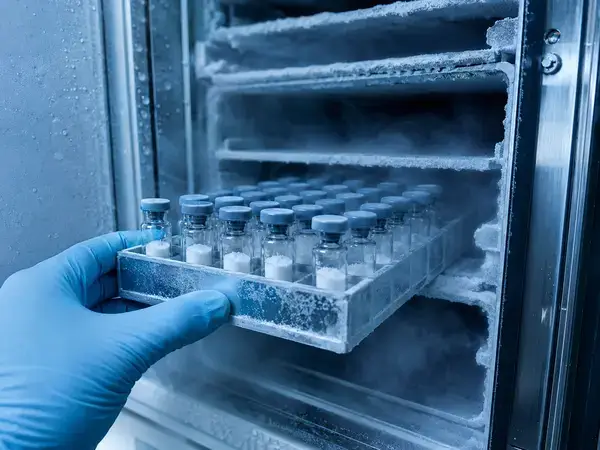
Because the practical difference between these isoforms is largely about stability, handling matters. Both compounds are typically supplied in lyophilized form and are sensitive to repeated temperature cycling. General laboratory best practice for research peptides applies: store lyophilized material at low temperature as specified on the certificate of analysis, reconstitute only in an appropriate research grade solvent according to the experimental protocol, prepare single use aliquots to avoid repeated freeze and thaw cycles, and minimize exposure to light and ambient temperature during preparation.
The shorter Kisspeptin-10 decapeptide is more susceptible to rapid degradation once in solution and in biological matrices, so researchers planning longer observation windows often account for this in their design. Kisspeptin-54, with its greater resistance to proteolysis, may hold up across extended timepoints with fewer stability concerns, though it remains a peptide and should be handled with the same care.

Choosing Between Kisspeptin-10 and Kisspeptin-54 for Experimental Design
The two isoforms answer different research questions, and the selection should follow the objective of the study rather than a general preference.
Kisspeptin-10 is a strong fit when the priority is the receptor itself. Its well defined ten residue structure makes it ideal for binding studies, structure activity relationship work, alanine scan experiments, secondary structure analysis, and any setting where the minimal active sequence is the variable of interest. Its broad use also makes it easy to compare new findings against an extensive body of existing decapeptide literature.
Kisspeptin-54 is the more appropriate choice when extended measurable pathway-associated readouts or prolonged exposure is central to the question. Its longer half-life and greater resistance to enzymatic degradation make it useful in models that examine extended response duration, where the rapid clearance of the decapeptide would otherwise confound the data.
A practical approach many investigators take is to run both in parallel. Including each isoform allows direct, controlled comparison of receptor activity against in vivo durability within a single experimental framework, which is far more informative than inferring the difference from separate studies that used different conditions.
Beyond Reproductive Signaling
While much of the kisspeptin literature centers on the hypothalamic pituitary gonadal axis, the KISS1 gene and the KISS1R receptor are studied across additional research domains. The system traces back to KISS1 being identified first as a metastasis suppressor, and kisspeptin signaling continues to be examined in oncology research as well as in studies of metabolic regulation. These remain active areas of scientific investigation, and both isoforms serve as reference tools across this wider research landscape. None of this work implies any approved application, and all of it sits within controlled laboratory settings.
Conclusion
Kisspeptin-10 and Kisspeptin-54 are not competing molecules but two members of one family, separated by length and durability rather than by target. Both share the active decapeptide YNWNSFGLRF-NH2, both engage the KISS1R receptor, and both show comparable binding in controlled in vitro work. The decisive difference emerges in vivo, where the larger Kisspeptin-54 resists enzymatic degradation and sustains signaling longer, while the compact Kisspeptin-10 delivers a clean, minimal active sequence that has anchored receptor research for decades. For researchers, the takeaway is practical: let the experimental question drive the choice. Reach for Kisspeptin-10 when receptor binding and structure activity work are central, and Kisspeptin-54 when sustained exposure matters, or run both in parallel for the clearest comparison within a single experimental framework. Before any study begins, verify purity documentation, including HPLC and mass spectrometry analysis. Both compounds remain strictly for laboratory research use and are not for human consumption.
FAQs
Is Kisspeptin-10 or Kisspeptin-54 better for research use?
Neither is universally better. The right choice depends on your study goal. Select Kisspeptin-10 for receptor binding and structure activity work where a defined minimal sequence is the variable, and select Kisspeptin-54 when your model requires extended measurable pathway-associated readouts over longer timepoints. For a direct comparison, run both under identical conditions.
Are Kisspeptin-10 and Kisspeptin-54 interchangeable in experiments?
Not reliably. In vitro they show comparable binding affinity and bioactivity at KISS1R, so they can look interchangeable in cell based assays. In vivo they diverge, because Kisspeptin-54 persists longer while Kisspeptin-10 clears faster. Confirm behavior within your specific model rather than assuming equivalence.
Why does Kisspeptin-54 last longer than Kisspeptin-10 in research models?
The difference is pharmacokinetic. As a 54 amino acid peptide, Kisspeptin-54 resists enzymatic breakdown more effectively and shows a longer terminal half-life. The shorter Kisspeptin-10 decapeptide is degraded and cleared from circulation more rapidly, which shortens the duration of its observed effect even though its receptor activity stays intact.
How should researchers store and handle Kisspeptin-10 and Kisspeptin-54?
Both are typically supplied lyophilized and are sensitive to temperature cycling. Store lyophilized material cold as specified on the certificate of analysis, reconstitute only in an appropriate research grade solvent per your protocol, prepare single use aliquots to avoid repeated freeze and thaw cycles, and limit exposure to light and ambient temperature during preparation.
Can Kisspeptin-10 or Kisspeptin-54 be used in humans?
No. Both are intended strictly for laboratory research by qualified professionals. They are not approved drugs, are not for human or veterinary use, and are not for human consumption. They carry no diagnostic, therapeutic, or clinical application.