❌ Not for Human Consumption
●
✅ For Research Use Only
●
All products are intended strictly for laboratory research purposes only
●
❌ Not for Human Consumption
●
✅ For Research Use Only
●
All products are intended strictly for laboratory research purposes only
●

HPLC Purity Verification Methods For Hexarelin Acetate

Written By: Gary Hite, Research Content Writer
Reviewed By: Natalie Kunsman, M.D., Board-Certified Physician
Last Reviewed: September 27, 2026
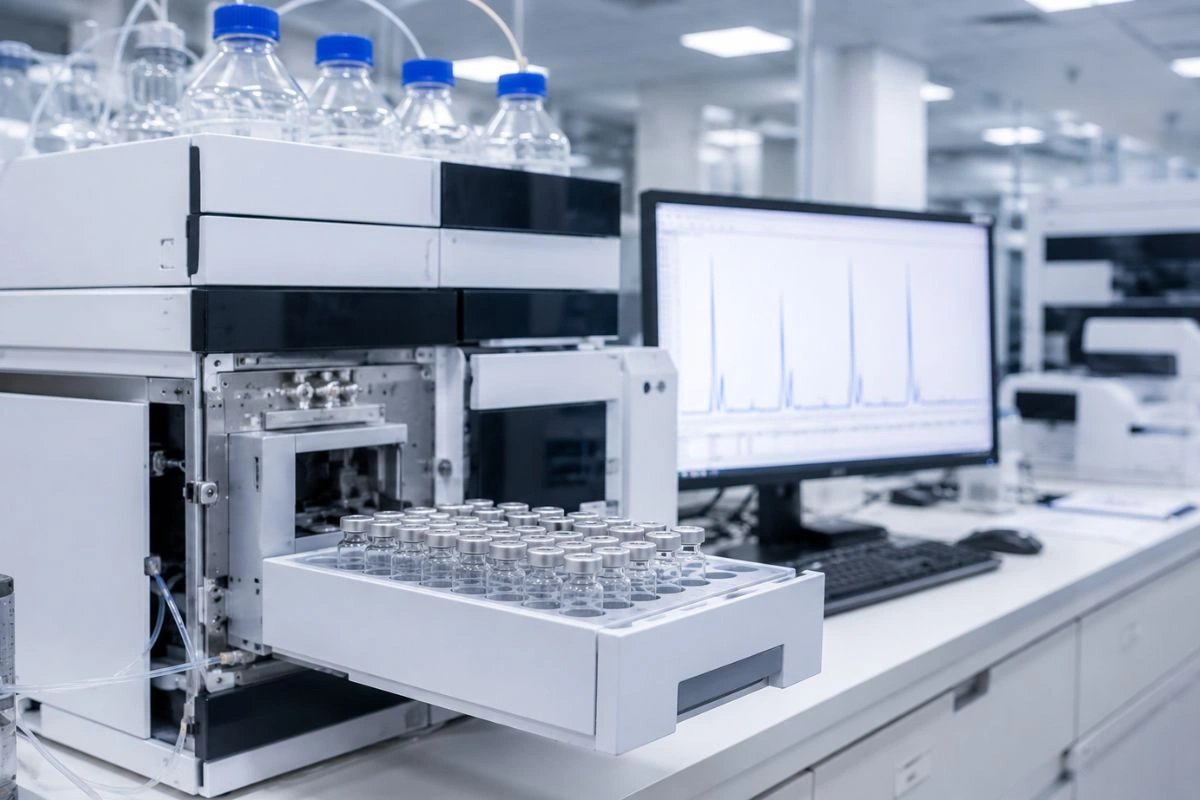
Purity verification is a cornerstone of credible peptide research, and high-performance liquid chromatography (HPLC) is the analytical method most widely relied upon to measure it. For laboratories working with Hexarelin Acetate, a synthetic research peptide supplied as a lyophilized powder, confirming purity before any experimental work supports both data quality and reproducibility. This article explains how HPLC purity verification methods are applied to Hexarelin Acetate in a controlled laboratory setting, covering column selection, mobile phase design, detection, system suitability, and the orthogonal techniques used to confirm identity and characterize impurities.
Disclaimer: Hexarelin Acetate is supplied and intended strictly for in vitro laboratory research and educational purposes only. It is not a drug, food, dietary supplement, or cosmetic, and it is not intended for human or veterinary use, consumption, diagnostic application, or therapeutic application. This material is intended for handling exclusively by qualified researchers and academic professionals within a controlled laboratory setting. The information below is educational and addresses laboratory analysis only. It does not constitute medical, clinical, or professional advice.
Understanding Hexarelin Acetate as a Research Material
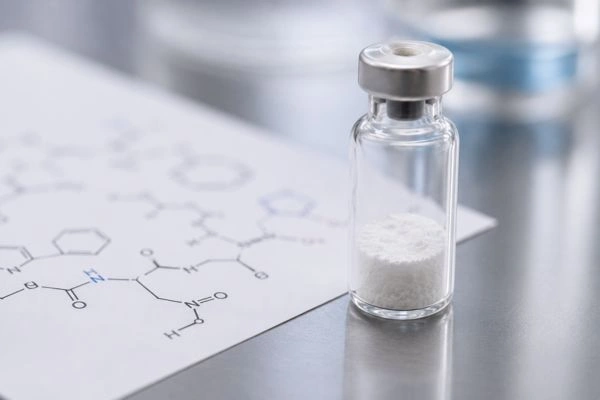
Hexarelin is a synthetic hexapeptide investigated in laboratory research related to growth hormone secretagogue receptor signaling. It is typically supplied as the acetate salt in lyophilized form, with the peptide portion carrying a molecular weight of approximately 887 Daltons. Its sequence includes aromatic amino acid residues, among them tryptophan and phenylalanine. That structural detail has direct relevance to analytical work, because aromatic side chains influence ultraviolet absorbance and therefore the detection strategy a researcher chooses. Understanding the molecular characteristics of the material is the starting point for designing an effective purity verification method.
Why HPLC Is the Standard for Peptide Purity Verification
HPLC separates the components of a sample as they travel through a column at different rates, producing a chromatogram in which each component appears as a distinct peak. For a synthetic peptide such as Hexarelin Acetate, this allows a researcher to distinguish the target peptide from closely related impurities and to quantify how much of the total signal the main peak represents.
Synthetic peptides can carry a range of process-related impurities, including truncated or deletion sequences from incomplete coupling during synthesis, oxidation products affecting residues such as tryptophan, deamidation products, and counterion or residual reagent adducts. HPLC resolves these species so they can be measured rather than overlooked. Because the method is reproducible, sensitive, and quantitative, it has become the reference approach for documenting peptide purity in research settings.
Reversed-Phase HPLC Fundamentals
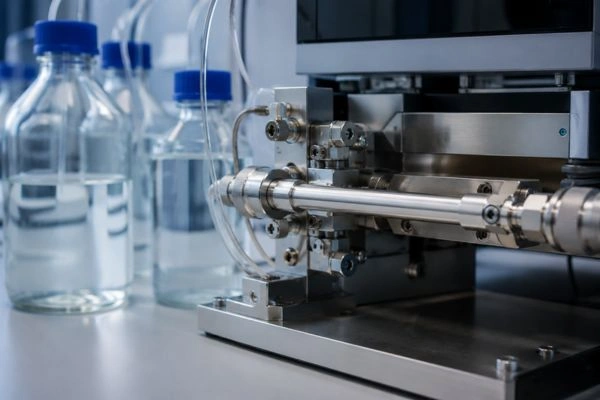
For peptide purity work, reversed-phase HPLC (RP-HPLC) is the dominant mode. It separates compounds based on hydrophobicity, which suits peptides well and provides the resolution needed to distinguish a target sequence from structurally similar impurities.
Column Selection
Begin by selecting an appropriate stationary phase. C18 (octadecylsilane) columns are the most common choice for peptide analysis and serve well for a hexapeptide of this size. C8 columns offer an alternative when different selectivity is required. Practical column considerations include particle size, where smaller particles such as sub-2-micron materials support higher-resolution ultra-high-performance separations, and pore size, where wider pores accommodate larger molecules. Typical analytical dimensions, such as a 4.6 by 150 millimeter column, balance resolution and run time for routine purity checks.
Mobile Phase and Modifiers
Design the mobile phase as a binary system of water and an organic solvent, most often acetonitrile, with an acidic modifier added to improve peak shape and reproducibility. Trifluoroacetic acid at roughly 0.1 percent is a widely used ion-pairing modifier that sharpens peptide peaks. When the method is coupled to mass spectrometry, formic acid is frequently substituted because it is more compatible with ionization. Consistent mobile phase preparation is essential, since small changes in modifier concentration or solvent ratio can shift retention times and affect resolution.
Gradient Elution
Most peptide purity methods use gradient elution, in which the proportion of organic solvent increases over the course of the run. The peptide and its impurities elute at different points along that gradient according to their relative hydrophobicity. A well-developed gradient, paired with a defined flow rate and a controlled column temperature, produces clean separation of the main peak from adjacent impurities and supports consistent results across injections.
Detection Methods
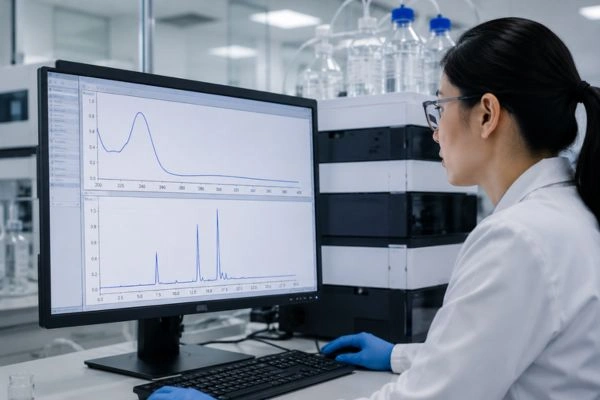
Ultraviolet detection is the standard for peptide purity verification. Detection in the range of approximately 210 to 220 nanometers captures absorbance from the peptide bond and provides broad sensitivity across the sample. A secondary wavelength near 280 nanometers is useful for Hexarelin Acetate specifically, because its aromatic residues absorb in that region, offering complementary information.
A photodiode array or diode array detector adds value by recording a full spectrum across each peak. This supports peak purity assessment, where a researcher checks whether the spectrum is consistent across the entire peak. Spectral consistency suggests a single component, while spectral variation can indicate a co-eluting impurity hidden beneath the main peak.
Sample Preparation
Prepare samples carefully to avoid introducing artifacts. Dissolve the lyophilized material in a diluent compatible with the mobile phase, often the initial mobile phase composition itself, at a concentration appropriate for the detector and the column loading capacity. Filter the prepared solution to remove particulates that could disturb the baseline or damage the column. Handle solutions gently and analyze them promptly, since avoidable degradation during sample handling can be misread as an impurity in the final result.
System Suitability Testing
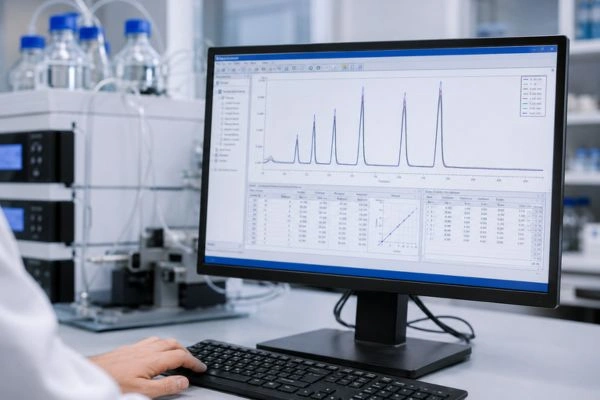
Before reporting a purity value, confirm that the chromatographic system is performing as expected. System suitability testing evaluates parameters that demonstrate the method is reliable for the analysis. Common metrics include:
- Resolution between the main peak and the nearest impurity, confirming adequate separation.
- Tailing factor of the main peak, indicating acceptable peak shape.
- Theoretical plate count, reflecting column efficiency.
- Retention time reproducibility and percent relative standard deviation across replicate injections, confirming consistency.
Meeting predefined acceptance criteria for these parameters gives confidence that any purity figure derived from the run is meaningful.
Calculating Purity and Identifying Impurities
Report purity using the area percent method, in which the area of the main peak is divided by the total area of all integrated peaks and multiplied by one hundred. The resulting percentage represents the proportion of the chromatographic signal attributable to the target peptide. Impurity peaks are reported individually and as a total, giving a fuller picture of sample composition than a single purity number alone.
When evaluating impurities, consider the peptide-specific species most likely to appear, such as deletion or truncated sequences, oxidation products at susceptible residues, deamidation products, and counterion or trifluoroacetic acid adducts. Tracking these consistently across lots and over time supports both quality assessment and an understanding of how a material behaves under given storage conditions.
Orthogonal Confirmation with LC-MS
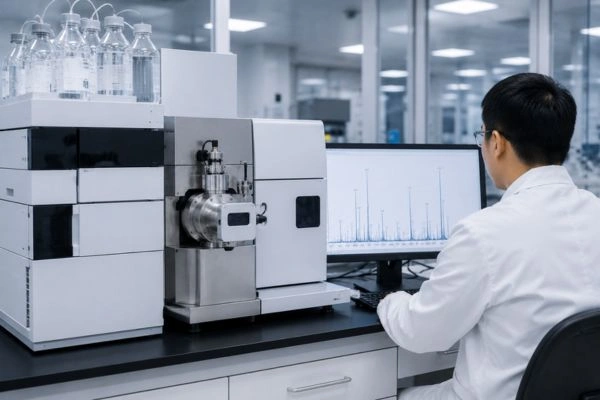
HPLC quantifies purity, but it does not by itself confirm the identity of each peak. Coupling HPLC with mass spectrometry, commonly through electrospray ionization, allows a researcher to measure the mass of the main peak and confirm that it matches the expected value for the peptide. Mass spectrometry also helps characterize impurities by assigning likely structures based on their masses. Using an orthogonal approach, whether LC-MS or a second chromatographic method with different selectivity, strengthens confidence that the main peak is the intended peptide and not a co-eluting species.
Method Validation Considerations
For research that depends on consistent analytical results, method validation establishes that an HPLC method is fit for its purpose. Validation typically examines:
- Specificity, the ability to measure the target peptide in the presence of impurities.
- Linearity and range, confirming a proportional detector response across relevant concentrations.
- Accuracy and precision, including repeatability and intermediate precision across analysts and days.
- Limit of detection and limit of quantitation, defining the smallest reliably detected and measured amounts.
- Robustness, the method’s tolerance to small deliberate changes in conditions.
Documenting these characteristics supports reproducibility and allows results to be compared meaningfully across a research program.

Documentation and Reference Standards
Compare results against a well-characterized reference standard wherever possible, and record method parameters in full, including column, mobile phase composition, gradient, flow rate, temperature, detection wavelength, and injection volume. A certificate of analysis for a research material typically documents purity determined by HPLC, and researchers should consult it as a baseline while validating methods for their own conditions when their work requires it. Thorough documentation ties every reported purity value back to a defined, repeatable procedure.
Conclusion
HPLC purity verification gives peptide researchers a reliable, quantitative basis for trusting the materials they work with. Select a suitable reversed-phase column, design a consistent mobile phase and gradient, detect at wavelengths matched to the peptide, confirm system suitability before reporting, and calculate purity by the area percent method. Pair the chromatographic result with mass spectrometry for identity confirmation, validate the method for the demands of the work, and document every parameter. Applied with discipline, these methods support the accuracy and reproducibility that rigorous research requires.
Disclaimer: This content is provided for educational and informational purposes regarding laboratory analysis only. Hexarelin Acetate is intended strictly for in vitro research and educational use by qualified professionals. It is not for human consumption and is not intended for any diagnostic or therapeutic purpose. Nothing in this article should be interpreted as encouraging or endorsing any use outside of legitimate scientific research.
Frequently Asked Questions
What is HPLC used for with Hexarelin Acetate in research?
In laboratory settings, HPLC is used to verify the purity of Hexarelin Acetate, separate and quantify impurities, and support identity confirmation when combined with mass spectrometry. The material and this analysis are intended only for research and educational purposes and not for human or animal use.
Which HPLC mode is most appropriate for peptide purity verification?
Reversed-phase HPLC, typically with a C18 column and a water and acetonitrile gradient containing an acidic modifier, is the standard mode for assessing peptide purity.
Which detection wavelength is used?
Ultraviolet detection around 210 to 220 nanometers captures the peptide bond signal, while a wavelength near 280 nanometers is useful for aromatic residues. A diode array detector supports peak purity assessment.
How is purity reported?
Purity is commonly reported as the area percent of the main peak relative to the total peak area, with mass spectrometry used as an orthogonal method to confirm identity.
What impurities are typically monitored during peptide HPLC analysis?
Synthetic peptides can carry process-related impurities such as truncated or deletion sequences, oxidation products at susceptible residues like tryptophan, deamidation products, and counterion or trifluoroacetic acid adducts. HPLC resolves these so they can be measured individually and as a total.