❌ Not for Human Consumption
●
✅ For Research Use Only
●
All products are intended strictly for laboratory research purposes only
●
❌ Not for Human Consumption
●
✅ For Research Use Only
●
All products are intended strictly for laboratory research purposes only
●

GHK-CU In Gene Expression Studies: What Microarray And RNA-Seq Data Have Revealed


In the rapidly advancing landscape of peptide research, few compounds have generated as much academic interest at the genomic level as GHK-Cu, the naturally occurring tripeptide-copper complex first identified and isolated from human plasma in the 1970s by Dr. Loren Pickart.
What makes GHK-Cu particularly compelling for modern gene expression researchers is not a single biological interaction, but rather the sheer breadth of genes this small molecule appears to modulate under controlled experimental conditions. With the advent of high-throughput technologies like DNA microarrays and RNA sequencing (RNA-Seq), investigators now have unprecedented tools to explore the scope and magnitude of GHK-Cu’s influence on the transcriptome.
This article explores the key findings that microarray and RNA-Seq studies have revealed about GHK-Cu’s effects on gene expression, examines the methodologies driving these discoveries, and discusses why this peptide remains a focal point for researchers investigating transcriptomic modulation in laboratory settings.
Disclaimer: GHK-Cu (Glycyl-L-Histidyl-L-Lysine Copper Complex) is sold strictly for research and laboratory use only. It is not intended for human consumption, veterinary use, or any therapeutic application. The information presented in this article is intended exclusively for professional researchers, academic scientists, and qualified laboratory personnel. Nothing in this article constitutes medical advice, a treatment recommendation, or an endorsement for any off-label or unapproved use. All references to published studies are cited for educational and informational purposes within a research context.
Understanding GHK-Cu: A Brief Molecular Overview for the Research Community
GHK-Cu (glycyl-L-histidyl-L-lysine: copper(II)) is a tripeptide with a high binding affinity for copper(II) ions. In research literature, it has been characterized as a molecule of interest due to observations in controlled laboratory environments suggesting it may interact with a wide range of biological pathways at the gene expression level.
Key molecular characteristics that make GHK-Cu valuable as a research compound include:
- Low molecular weight – facilitating cellular uptake in in vitro models
- Copper-binding capacity – enabling investigation into metal ion-mediated gene regulation
- Broad transcriptomic footprint – offering a rich dataset for systems biology approaches
- Well-characterized structure – allowing for reproducible experimental design across laboratories
For research teams studying peptide-mediated transcriptional regulation, GHK-Cu presents a unique model compound due to the volume of existing peer-reviewed literature supporting its use in gene expression studies.
The Role of Microarray Technology in Early GHK-Cu Gene Expression Research
How Microarrays Opened the Door
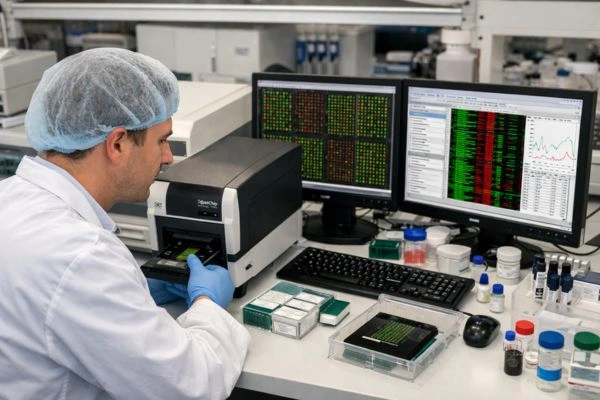
Before the widespread adoption of next-generation sequencing, DNA microarrays were the dominant tool for genome-wide expression profiling. Microarray technology allowed researchers to simultaneously measure the expression levels of thousands of genes, providing a snapshot of the transcriptomic landscape under various experimental conditions.
Several foundational studies utilized microarray platforms to investigate the effects of GHK-Cu on cultured cell lines. The methodology typically involved exposing cells to GHK-Cu at defined concentrations, extracting total RNA at designated time points, and hybridizing labeled cDNA to gene expression arrays.
Key Microarray Findings in GHK-Cu Research
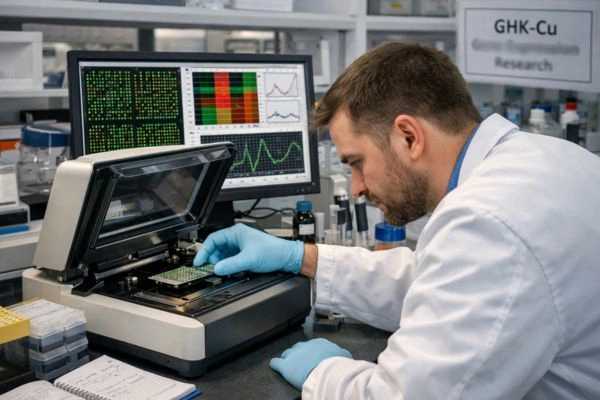
Published microarray analyses, most notably the work catalogued in the Broad Institute’s Connectivity Map (CMap) database, have produced datasets suggesting that GHK-Cu may modulate the expression of a substantial number of genes under controlled experimental conditions. Researchers have reported observations across several gene categories:
Extracellular Matrix (ECM)-Related Genes
Microarray data have indicated differential expression of genes associated with ECM remodeling in GHK-Cu-treated cell cultures. Genes encoding various collagens, matrix metalloproteinases (MMPs), and tissue inhibitors of metalloproteinases (TIMPs) have appeared in differentially expressed gene lists. These findings have been of particular interest to researchers studying ECM biology and tissue remodeling mechanisms in vitro.
Antioxidant and Oxidative Stress Response Genes
Gene expression profiles from microarray experiments have included differential regulation of genes within oxidative stress response pathways, including those encoding superoxide dismutase isoforms and other redox-associated enzymes. These observations have prompted further investigation into the relationship between copper-peptide complexes and cellular oxidative stress signaling in laboratory models.
Ubiquitin-Proteasome Pathway Genes
An intriguing category of genes identified in microarray datasets involves the ubiquitin-proteasome system (UPS). Researchers have noted changes in the expression levels of UPS-related genes in GHK-Cu-treated samples, generating interest in the peptide’s potential role as a research tool for studying protein degradation pathways.
Signal Transduction and Growth Factor-Related Genes
Microarray analyses have also flagged differential expression of genes involved in various signal transduction cascades, including pathways related to TGF-beta superfamily signaling and integrin-mediated signaling. These datasets have provided starting points for hypothesis-driven follow-up studies.
Limitations of Microarray Approaches
While microarray studies were instrumental in generating early hypotheses about GHK-Cu’s broad transcriptomic effects, researchers have noted several inherent limitations of this technology:
- Cross-hybridization artifacts potentially inflating differentially expressed gene counts
- Limited dynamic range compared to sequencing-based methods
- Dependence on pre-designed probe sets, restricting discovery to known transcripts
- Difficulty in detecting low-abundance transcripts and novel splice variants
These limitations set the stage for RNA-Seq to provide a deeper, more nuanced view of GHK-Cu-mediated gene expression changes.
RNA-Seq: A Higher-Resolution Lens on GHK-Cu-Mediated Transcriptomic Changes
The Transition to Sequencing-Based Expression Profiling
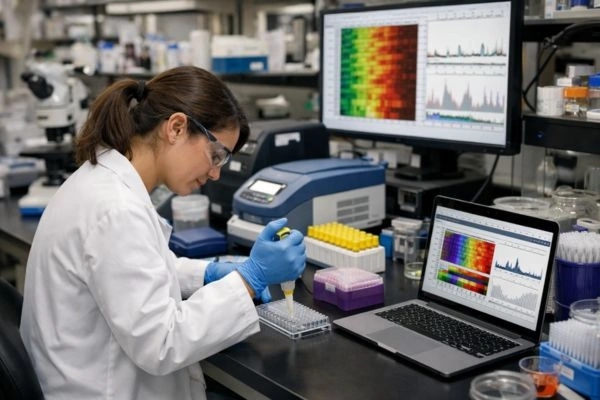
RNA sequencing (RNA-Seq) represents a significant technological advancement over microarrays for transcriptome-wide studies. By directly sequencing cDNA libraries derived from extracted RNA, RNA-Seq offers several advantages that have proven valuable in GHK-Cu research:
- Greater dynamic range – enabling detection of both high- and low-abundance transcripts
- No reliance on pre-designed probes – allowing discovery of novel transcripts, non-coding RNAs, and alternative splicing events
- Single-nucleotide resolution – providing precise mapping of transcript boundaries
- Improved quantitative accuracy – particularly at the extremes of expression levels
What RNA-Seq Data Have Shown in GHK-Cu Studies
As RNA-Seq platforms have become more accessible, several research groups have applied this technology to GHK-Cu studies, generating datasets that both confirm and extend earlier microarray findings.
Confirmation of Core Gene Sets
RNA-Seq analyses have broadly corroborated the gene categories identified in earlier microarray work, lending increased confidence to observations regarding ECM-related, antioxidant-response, and proteasome-pathway genes. The consistency between platforms strengthens the reproducibility of these datasets within the research community.
Identification of Non-Coding RNA Responses
One area where RNA-Seq has provided entirely new information is in the detection of non-coding RNAs, including long non-coding RNAs (lncRNAs) and microRNAs (miRNAs), that may be differentially expressed in response to GHK-Cu treatment. This category of gene expression was largely invisible to earlier microarray platforms and represents a growing area of investigation.
Pathway-Level Enrichment Analyses
Using RNA-Seq-derived differentially expressed gene (DEG) lists, researchers have performed Gene Ontology (GO) and KEGG pathway enrichment analyses to contextualize GHK-Cu’s transcriptomic effects at a systems level. Enriched pathways commonly reported in these analyses include those related to ECM-receptor interaction, focal adhesion, oxidative phosphorylation, and TGF-beta signaling, all within the context of in vitro experimental models.
Dose-Response and Time-Course Studies
RNA-Seq’s quantitative precision has enabled more sophisticated dose-response and time-course experimental designs. Researchers have used these approaches to characterize how GHK-Cu’s effects on the transcriptome vary with concentration and duration of exposure, essential data for standardizing experimental protocols across laboratories.

The Connectivity Map (CMap) and GHK-Cu: A Bioinformatics Perspective
One of the most frequently cited resources in GHK-Cu gene expression research is the Broad Institute’s Connectivity Map (CMap). This publicly available database catalogs gene expression signatures, patterns of up- and down-regulated genes, generated by treating cultured human cells with various bioactive compounds.
GHK-Cu’s inclusion in CMap-derived analyses has allowed researchers to:
- Compare GHK-Cu’s transcriptomic signature against thousands of other compounds, providing context for its gene expression profile relative to other molecules in the database
- Identify potential mechanistic overlaps by examining compounds with similar or opposing expression signatures
- Generate new hypotheses about pathways and biological processes that may be modulated by GHK-Cu under controlled conditions
CMap analyses have reinforced the observation that GHK-Cu’s gene expression signature is unusually broad for a small peptide, affecting gene categories that span structural proteins, signaling molecules, metabolic enzymes, and regulatory factors.
For researchers interested in computational approaches to peptide characterization, the availability of GHK-Cu data within CMap provides a powerful entry point for bioinformatics-driven investigation.

Methodological Considerations for Researchers Studying GHK-Cu and Gene Expression
For research teams designing new gene expression experiments with GHK-Cu, the existing literature provides several important methodological insights:
Experimental Design Best Practices
- Cell Line Selection – Published studies have utilized a variety of cell lines, including fibroblast, keratinocyte, and hepatocyte models. Cell line selection should be guided by the specific research question and the biological pathways under investigation.
- Concentration Range – The literature reports a range of GHK-Cu concentrations used in gene expression studies, typically spanning from nanomolar to low micromolar ranges. Researchers should consider dose-response characterization as a foundational step in any new experimental series.
- Exposure Duration – Time-course data suggest that GHK-Cu’s effects on gene expression may vary significantly between acute (hours) and extended (days) exposure periods. Multi-time-point sampling is recommended for comprehensive transcriptomic profiling.
- Appropriate Controls – Rigorous experimental design requires proper vehicle controls, as well as consideration of copper-ion controls (e.g., CuCl₂ at equivalent copper concentrations) to distinguish peptide-specific effects from copper-mediated effects.
Bioinformatics Pipeline Recommendations
For researchers processing RNA-Seq data from GHK-Cu experiments, standard best practices include:
- Quality control of raw reads using tools such as FastQC
- Adapter trimming and quality filtering with Trimmomatic or similar tools
- Alignment to reference genomes using STAR or HISAT2
- Quantification with featureCounts or HTSeq
- Differential expression analysis with DESeq2, edgeR, or limma-voom
- Pathway analysis using clusterProfiler, GSEA, or Enrichr
Consistency in bioinformatics pipelines is essential for cross-study comparability and meta-analysis efforts.\

Ongoing Research Directions and Open Questions
Despite the substantial body of microarray and RNA-Seq data now available, several important research questions remain open and represent active areas of investigation within the field:
- Single-Cell Resolution Studies – With the increasing accessibility of single-cell RNA-Seq (scRNA-Seq), there is growing interest in characterizing GHK-Cu’s transcriptomic effects at single-cell resolution. This approach may reveal cell-type-specific responses that are masked in bulk RNA-Seq datasets.
- Epigenomic Integration – Researchers are beginning to investigate whether GHK-Cu’s effects on gene expression are accompanied by changes in chromatin accessibility, DNA methylation, or histone modifications. Integrating ATAC-Seq or ChIP-Seq data with RNA-Seq profiles could provide a more comprehensive mechanistic picture.
- Long-Term Transcriptomic Stability – Questions remain about the persistence of GHK-Cu-induced gene expression changes following removal of the compound. Time-course studies extending beyond the initial treatment window are needed to address this question.
- Cross-Species Comparative Genomics – Comparing GHK-Cu’s transcriptomic effects across species and cell types may provide evolutionary context for its observed gene expression profile and contribute to a deeper understanding of conserved versus species-specific responses.

Why GHK-Cu Remains a Valuable Research Tool for Gene Expression Studies
For the genomics and peptide research communities, GHK-Cu continues to offer a uniquely information-rich model system. Its broad transcriptomic footprint, well-characterized molecular structure, and extensive representation in public gene expression databases make it an accessible and scientifically productive compound for laboratory investigation.
Whether a research team is exploring ECM biology, oxidative stress signaling, proteasome function, or non-coding RNA regulation, the existing body of microarray and RNA-Seq data provides a robust foundation upon which new studies can be designed and contextualized.
As sequencing technologies continue to advance, with long-read platforms, spatial transcriptomics, and multi-omic integration becoming more routine, GHK-Cu is well positioned to remain a compound of significant interest for researchers pushing the boundaries of transcriptomic science.
Conclusion
GHK-Cu has established itself as a powerful model compound for gene expression research, with microarray and RNA-Seq data collectively demonstrating its capacity to modulate hundreds of genes across diverse functional categories. Researchers now have access to robust, publicly available datasets, including those housed in the Connectivity Map, that serve as launchpads for new experimental designs and bioinformatics-driven discovery. Moving forward, research teams should prioritize integrating multi-omic approaches, including single-cell RNA-Seq and epigenomic profiling, to resolve the mechanistic layers underlying GHK-Cu’s broad transcriptomic signature. Standardizing experimental protocols around concentration ranges, exposure durations, and appropriate copper-ion controls will be equally critical for ensuring cross-study reproducibility. For investigators seeking a well-characterized, data-rich peptide system to probe transcriptional regulation, GHK-Cu offers an immediate and scientifically productive entry point backed by decades of accumulating genomic evidence.
Disclaimer: GHK-Cu (Glycyl-L-Histidyl-L-Lysine Copper Complex) is sold strictly for research and laboratory use only. It is not intended for human consumption, veterinary use, or any therapeutic application. The information presented in this article is intended exclusively for professional researchers, academic scientists, and qualified laboratory personnel. Nothing in this article constitutes medical advice, a treatment recommendation, or an endorsement for any off-label or unapproved use. All references to published studies are cited for educational and informational purposes within a research context.
Frequently Asked Questions
What high-throughput technologies are used to study GHK-Cu’s effects on gene expression?
Researchers primarily use DNA microarrays and RNA sequencing (RNA-Seq). Microarrays provided the initial genome-wide expression profiles, while RNA-Seq now delivers higher resolution, greater dynamic range, and the ability to detect novel transcripts and non-coding RNAs. Teams designing new studies should consider RNA-Seq as the current standard for comprehensive transcriptomic profiling of GHK-Cu-treated samples.
What gene categories has GHK-Cu been observed to modulate in laboratory studies?
Published datasets report differential expression across several key categories: extracellular matrix genes (collagens, MMPs, TIMPs), antioxidant and oxidative stress response genes, ubiquitin-proteasome pathway genes, and signal transduction genes including those in TGF-beta and integrin-mediated pathways. Researchers should consult the Connectivity Map database for detailed gene-level data to inform their own experimental designs.
How does the Connectivity Map (CMap) support GHK-Cu research?
The Broad Institute’s CMap catalogs gene expression signatures from thousands of bioactive compounds, including GHK-Cu. Researchers can use this resource to compare GHK-Cu’s transcriptomic profile against other molecules, identify mechanistic overlaps, and generate new hypotheses. Access the CMap database directly to benchmark your compound of interest against GHK-Cu’s established signature.
What controls should be included in GHK-Cu gene expression experiments?
Rigorous experimental design requires vehicle controls alongside copper-ion controls, such as CuCl₂ at equivalent copper concentrations, to distinguish peptide-specific transcriptomic effects from those driven by copper alone. Incorporate dose-response and multi-time-point sampling into your protocols to capture the full scope of GHK-Cu’s concentration- and time-dependent gene expression changes.
What are the most promising next steps in GHK-Cu transcriptomic research?
Four directions stand out for active investigation: single-cell RNA-Seq to uncover cell-type-specific responses, epigenomic integration (ATAC-Seq, ChIP-Seq) to map chromatin-level mechanisms, long-term stability studies to assess whether expression changes persist after compound removal, and cross-species comparative genomics. Research teams should evaluate which of these approaches aligns with their laboratory capabilities and scientific objectives.