❌ Not for Human Consumption
●
✅ For Research Use Only
●
All products are intended strictly for laboratory research purposes only
●
❌ Not for Human Consumption
●
✅ For Research Use Only
●
All products are intended strictly for laboratory research purposes only
●

KLOW Blend Components: How Do Researchers Study Them Individually Vs Combined?

Written By: Gary Hite, Research Content Writer
Reviewed By: Natalie Kunsman, M.D., Board-Certified Physician
Last Reviewed: October 11, 2026
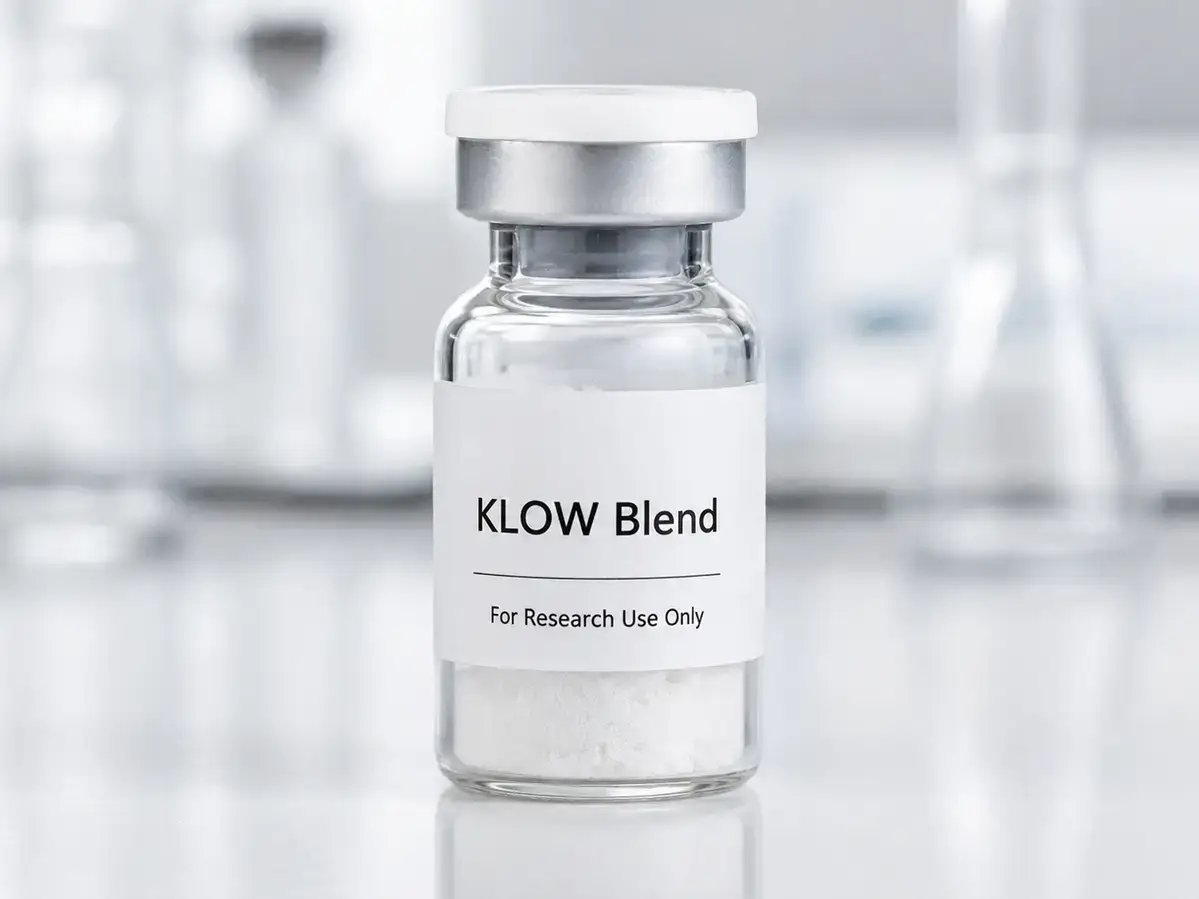
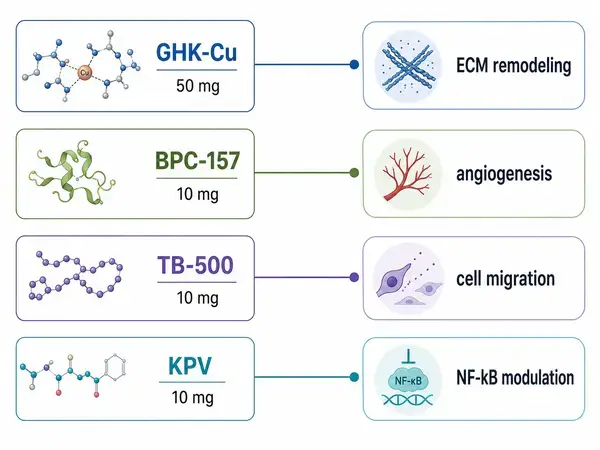
Researchers study KLOW blend components two ways: individually to isolate each peptide’s mechanism of action, and in combination to observe potential interaction effects across shared biological pathways. Both approaches matter. Single-compound protocols tell you what one peptide does. Multi-compound protocols tell you whether the combination produces something the individual compounds don’t. The KLOW blend contains four peptides (GHK-Cu at 50mg, BPC-157 at 10mg, TB-500 at 10mg, and KPV at 10mg) that each act on different pathways in preclinical models. That’s what makes the individual-versus-combined question worth asking.
KLOW is a lyophilized research peptide blend containing GHK-Cu, BPC-157, TB-500, and KPV at a total of 80mg per vial, formulated for in vitro and in vivo research into tissue repair, immune modulation, and cellular recovery. It is sold for laboratory research only and is not intended for human consumption.
Disclaimer: KLOW is for research purposes only and is not for human consumption. This product is not intended to diagnose, treat, cure, or prevent any disease. All information presented is for educational and research purposes. The statements on this page have not been evaluated by the FDA.
What are the four peptides in the KLOW blend?
Each KLOW component targets a different biological system. That separation is what gives researchers a reason to study them both alone and together.
GHK-Cu (50mg) is a naturally occurring copper tripeptide first isolated from human plasma by Loren Pickart in the 1970s. It binds copper(II) ions and delivers them to fibroblasts without the oxidative damage free copper would cause. A 2018 publication in the International Journal of Molecular Sciences documented that GHK modulates the expression of over 4,000 human genes at nanomolar concentrations, across collagen synthesis, antioxidant defense, and DNA repair pathways (Pickart et al., 2018).
BPC-157 (10mg) is a synthetic pentadecapeptide derived from a sequence found in human gastric juice. A 2025 systematic review in HSS Journal analyzed 36 preclinical studies and found that BPC-157 improved functional, structural, and biomechanical outcomes across muscle, tendon, ligament, and bone injury models (Vasireddi et al., 2025). Its mechanism involves modulation of nitric oxide synthase activity, VEGFR2 activation, and the Akt-eNOS signaling axis.
TB-500 (10mg) is a 17-amino-acid synthetic fragment containing the central actin-binding motif (LKKTETQ) of thymosin beta-4. A foundational 1999 study in the Journal of Investigative Dermatology showed that topical thymosin beta-4 increased re-epithelialization by 42% at day 4 and 61% at day 7 in a rat full-thickness wound model, compared to saline controls (Malinda et al., 1999). TB-500 promotes cell migration by sequestering G-actin monomers and modulating the actin cytoskeleton.
KPV (10mg) is a tripeptide (Lys-Pro-Val) corresponding to positions 11 to 13 of alpha-melanocyte-stimulating hormone (alpha-MSH). Research by Brzoska and Luger demonstrated that KPV inhibits NF-kB and MAP-kinase signaling at nanomolar concentrations, and reduced pro-inflammatory cytokine output in intestinal and epithelial cell models (Brzoska et al., 2003).
How do researchers study individual peptide components?
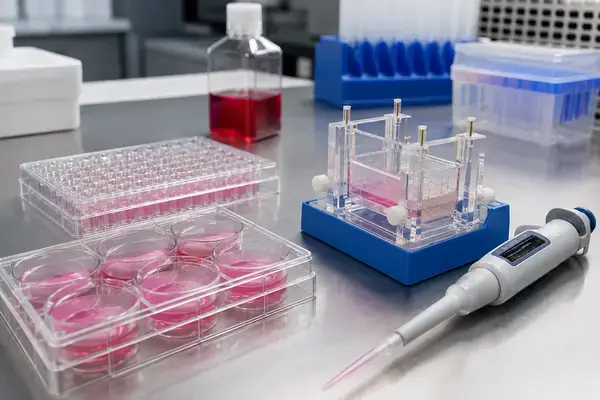
Single-compound research is the standard starting point. Researchers isolate one peptide, apply it to a cell culture or animal model, and measure what changes against an untreated control. This design answers a direct question: does this one compound produce a measurable effect on this specific endpoint?
The protocols differ by component. For GHK-Cu, a common approach involves exposing human dermal fibroblasts to the peptide at varying concentrations (0.01, 1, and 100 nanomolar) and measuring changes in collagen synthesis, MMP expression, and TIMP activity over defined time intervals. Badenhorst and colleagues used this exact protocol and found dose-dependent increases in both matrix metalloproteinases and their inhibitors, . The data suggest GHK-Cu modulates tissue remodeling rather than pushing it in one direction (Badenhorst et al.).
BPC-157 studies typically use rodent injury models. The 2025 HSS Journal systematic review identified muscle, tendon, ligament, and bone as the four tissue types most frequently studied. Researchers create a standardized injury, administer BPC-157 at defined doses, and compare healing metrics (wound closure rate, tensile strength, inflammatory marker levels) against saline controls.
TB-500 research often measures cell migration directly. The Boyden chamber assay is a standard tool here. Malinda et al. showed that as little as 10 picograms of thymosin beta-4 stimulated keratinocyte migration 2 to 3 fold over medium alone. That sensitivity to low concentrations is part of why TB-500 draws research interest.
KPV studies focus on inflammatory pathway suppression. Researchers expose cell lines to an inflammatory stimulus (TNF-alpha is common), then add KPV and measure downstream markers like NF-kB nuclear translocation and cytokine output.
The strength of individual studies is clarity: one variable, one measurement, one conclusion. The limitation is that biological systems don’t operate with one input at a time.
Why do researchers combine peptides in a single protocol?
Biological processes involve multiple pathways running at once. Tissue repair, for example, requires angiogenesis, cell migration, extracellular matrix remodeling, and inflammation control simultaneously. No single peptide acts on all four.
That’s the rationale for multi-peptide research. Researchers want to know whether compounds that act on different pathways produce different outcomes when applied together versus separately.
The KLOW components map onto different parts of the tissue repair process:
GHK-Cu acts primarily on extracellular matrix remodeling and gene expression. BPC-157 acts on angiogenesis and growth factor signaling. TB-500 acts on actin dynamics and cell migration. KPV acts on inflammatory transcription factors.
In a combined protocol, a researcher might apply all four to a cell culture or animal model and measure the same endpoints they’d measure in a single-compound study. The question changes from “does this compound work?” to “does this combination produce an outcome that differs from the sum of individual effects?”
What is the difference between additive and synergistic effects?
This distinction matters for any multi-peptide research design.
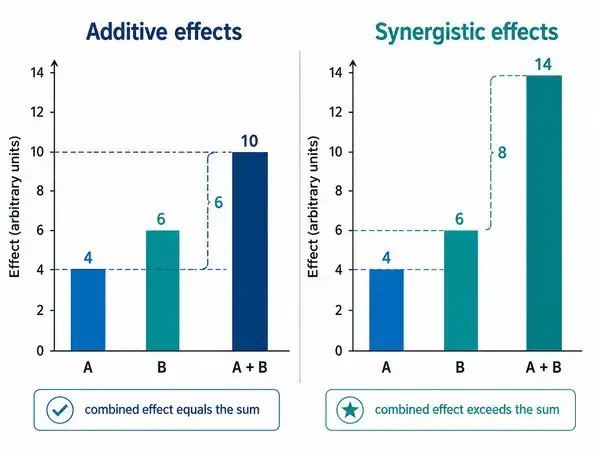
An additive effect means the combination produces results equal to the sum of each compound’s individual contribution. If GHK-Cu alone increases collagen deposition by 20% and BPC-157 alone increases it by 15%, an additive result would be roughly 35%.
A greater-than-additive effect means the combination produces results that exceed the sum. In the same example, a greater-than-additive result might be 60% or higher, because the compounds interact in a way that multiplies each other’s activity rather than just stacking it.
Here’s the contrarian point most articles skip: no published peer-reviewed study has evaluated the four-peptide KLOW combination for greater-than-additive effects. The current evidence base for each component is preclinical and individual. Claims about combined effects in multi-peptide blends are hypotheses, not conclusions. That doesn’t make the hypothesis unreasonable. KPV’s suppression of NF-kB could theoretically reduce matrix metalloproteinase activity that degrades the collagen GHK-Cu promotes, producing a “build and protect” relationship. But “theoretically” is doing the heavy lifting in that sentence.
This is exactly why the combination is worth studying. The hypothesis is grounded in known mechanisms. The confirmation is missing.
How do researchers design controlled multi-peptide studies?
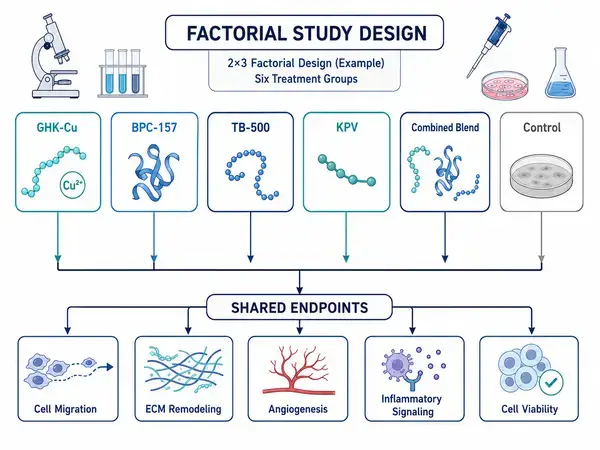
A well-designed multi-compound study includes more than just a “blend” group and a control group. Researchers use factorial designs to isolate interaction effects.
For a four-peptide blend, the full factorial design includes 16 treatment groups (every possible on/off combination of the four compounds, plus the untreated control). That’s resource-intensive. Most labs run partial factorial designs, testing the full blend against each individual compound and the untreated control. That’s a minimum of six groups for KLOW: GHK-Cu alone, BPC-157 alone, TB-500 alone, KPV alone, all four combined, and the control.
Researchers also need to account for dose equivalence. In the KLOW blend, GHK-Cu is present at 50mg while the other three are at 10mg each. A valid comparison requires the individual-compound groups to use the same concentration as the blend provides, not an arbitrary “standard” dose from a different study.
Other variables researchers control for include timing of administration (simultaneous versus staggered), the model system (which cell line or animal strain), and the endpoints measured. A study measuring wound closure might show no interaction effect, while the same compounds measured for cytokine output might show a strong one. The endpoint defines the answer.
What makes the KLOW blend useful for comparative research?
KLOW gives researchers a pre-formulated reference blend with defined ratios. That’s a practical advantage. Instead of sourcing, reconstituting, and mixing four separate compounds, a lab can use one vial with a known composition.
The four components in KLOW act on different mechanisms but converge on related biological endpoints. GHK-Cu and BPC-157 both influence angiogenesis, but through different pathways (copper-dependent ECM signaling versus VEGFR2 activation). BPC-157 and KPV both modulate inflammation, but at different points in the cascade (nitric oxide system versus NF-kB). TB-500 and GHK-Cu both affect tissue remodeling, but through different cellular machinery (actin dynamics versus gene expression modulation).
That overlap-with-distinction is what makes multi-peptide research interesting. A researcher studying BPC-157 and TB-500 together can compare results against the four-compound KLOW blend to see whether adding GHK-Cu and KPV changes the outcome.
Penguin Peptides provides third-party HPLC-verified purity testing and certificates of analysis on every batch. For research applications, verified purity above 98% reduces one more confounding variable: impurity-driven artifacts.
All Penguin Peptides products, including KLOW, are sold for laboratory research purposes only. They are not for human consumption and are not intended to diagnose, treat, cure, or prevent any disease.
How 2026 regulatory standards affect research peptide sourcing
The FDA’s Final Guidance on Research-Grade Peptides, enforceable as of January 2026, established explicit labeling requirements for research peptide suppliers. Compliant suppliers must include “For Research Use Only” labeling on all containers, provide institutional verification documentation, and maintain verifiable chain-of-custody records.
Between January and March 2026 alone, the FDA targeted multiple companies for introducing misbranded and unapproved products into interstate commerce. Researchers sourcing peptides for controlled studies should verify that suppliers meet current FDA labeling standards and provide batch-specific certificates of analysis.
Penguin Peptides maintains “For Research Use Only” labeling, publishes lab results including HPLC purity testing and heavy metals analysis, and operates as a chemical supplier (not a compounding pharmacy) under applicable regulations.
Where KLOW blend component research stands in 2026
The four peptides in KLOW each carry a real preclinical evidence base. GHK-Cu modulates over 4,000 genes. BPC-157 improved outcomes across 36 preclinical injury models. TB-500 increased re-epithelialization by up to 61% in wound studies. KPV suppressed NF-kB at nanomolar concentrations. Those results come from individual-compound research, and they’re the foundation any multi-compound study builds on.
The open question is whether combining all four in defined ratios produces effects that differ from the sum of parts. That question has not been answered in a peer-reviewed publication yet. It’s a research gap, not a dead end. The known mechanisms act on complementary pathways, and the KLOW formulation gives labs a standardized reference blend to test that hypothesis under controlled conditions.
Single-compound studies tell you what each peptide does. Combined studies tell you what happens when they share the same biological environment. Both matter. Researchers who want to explore that comparison can find Penguin Peptides’ KLOW 80mg with batch-specific purity and heavy metals testing published for every lot.
FAQs
What are the components of the KLOW peptide blend?
KLOW contains four research peptides: GHK-Cu at 50mg, BPC-157 at 10mg, TB-500 at 10mg, and KPV at 10mg, totaling 80mg per vial. Each component has been studied independently in preclinical models for different biological mechanisms, including extracellular matrix remodeling, angiogenesis, cell migration, and inflammatory pathway modulation. KLOW is for research use only and is not for human consumption.
Is KLOW approved for human use?
No. KLOW is sold strictly for laboratory research purposes. It is not FDA-approved for human use, and it is not intended to diagnose, treat, cure, or prevent any disease. None of the individual components in KLOW have received FDA approval for therapeutic use in humans.
How do researchers study KLOW blend components individually? Researchers isolate one peptide and apply it to a defined model system (cell culture or animal model) with an untreated control group. They measure specific endpoints like collagen synthesis, cell migration rates, or inflammatory marker levels. This single-variable design identifies what each compound does on its own before combination studies begin.
What is the difference between additive and synergistic peptide effects?
An additive effect means the combined result equals the sum of each compound’s individual contribution. A synergistic effect means the combination produces a result greater than that sum. No published peer-reviewed study has confirmed synergistic effects for the four-peptide KLOW combination. The hypothesis is based on the known mechanisms of each component acting on complementary pathways.
Why does KLOW contain more GHK-Cu than the other three components?
GHK-Cu makes up 50mg of KLOW’s 80mg total, while BPC-157, TB-500, and KPV are each present at 10mg. Research on GHK-Cu has documented activity across a wider gene expression profile (over 4,000 genes at nanomolar concentrations), and its role in copper delivery and ECM remodeling may require higher absolute quantities in research protocols. The specific ratio in KLOW reflects the formulation’s design for multi-pathway research models.
Are there clinical trials on the KLOW blend?
No clinical trials have been conducted on the KLOW blend. Published research on the individual components (GHK-Cu, BPC-157, TB-500, KPV) is primarily preclinical, involving cell culture and animal models. A 2025 systematic review of BPC-157 in orthopaedic applications found only one clinical study among 544 screened articles. KLOW is a research tool, not a clinical product.
Where can researchers find certificates of analysis for KLOW?
Penguin Peptides publishes third-party HPLC purity testing and heavy metals analysis results for each product batch. Researchers can view these results on the Penguin Peptides lab results page or on the KLOW product page, which includes links to both the purity test and heavy metals test for the current batch.