❌ Not for Human Consumption
●
✅ For Research Use Only
●
All products are intended strictly for laboratory research purposes only
●
❌ Not for Human Consumption
●
✅ For Research Use Only
●
All products are intended strictly for laboratory research purposes only
●

Reconstitution And Storage Protocols For 5-Amino-1MQ

Written By: Gary Hite, Research Content Writer
Reviewed By: Natalie Kunsman, M.D., Board-Certified Physician
Last Reviewed: June 29, 2026
DISCLAIMER: 5-Amino-1MQ is sold and intended strictly for in vitro research and laboratory use only. It is not a drug, food, supplement, or cosmetic product. It is not approved by the FDA or any regulatory body for human consumption, veterinary use, or any therapeutic or diagnostic application. This content is provided for educational and informational purposes for qualified researchers and academic professionals. No statements herein constitute medical advice, diagnosis, or treatment recommendations. Purchasers assume full responsibility for compliance with all applicable local, state, and federal regulations governing research chemicals.
Most reconstitution guides for 5-Amino-1MQ get the basics right, add bacteriostatic water, swirl gently, refrigerate and stop there. What they skip is the part that actually matters for reproducible data: how the compound’s quinolinium core structure dictates its degradation pathways, and why a protocol that works for a typical peptide will silently compromise your 5-Amino-1MQ results within days.
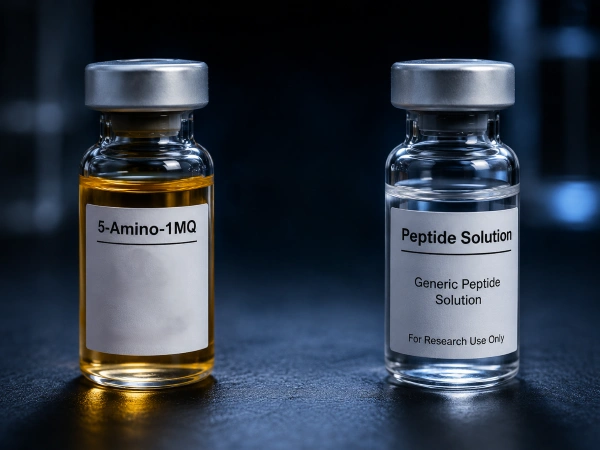
This isn’t a peptide. That distinction drives everything that follows. And if you’re sourcing this compound from Penguin Peptides or any other supplier, the protocols below will help you protect your investment and your data.
Why 5-Amino-1MQ Demands Its Own Protocol
5-Amino-1MQ (5-amino-1-methylquinolinium, CAS 42464-96-0) is a synthetic small molecule with a molecular weight of 286.11 g/mol in its commonly supplied iodide salt form. It was first characterized as a selective NNMT (nicotinamide N-methyltransferase) inhibitor through structure-activity relationship work at the University of Texas at Austin, with the defining medicinal chemistry published in the Journal of Medicinal Chemistry in 2017. That research established its IC50 at approximately 1.2 uM in biochemical assays and an EC50 of 2.3 +/- 1.1 uM for reducing intracellular 1-methylnicotinamide (1-MNA) in living adipocytes.
The compound’s quinolinium scaffold, a nitrogen-containing aromatic heterocycle with a methyl group at the N-1 position and a primary amine at position 5, gives it excellent membrane permeability but also creates specific vulnerabilities that earlier NNMT inhibitors like 1,2,4,8-tetramethylquinolinium didn’t share. That primary amine at the 5-position is particularly susceptible to oxidative degradation and photolytic reactions.
Researchers who treat this compound like a standard peptide reconstitution, and many published protocols implicitly encourage exactly that, risk introducing a degradation variable they can’t see and won’t control for.
Lyophilized Storage Before Reconstitution
Start here, because storage errors before reconstitution are permanent and invisible.
The lyophilized powder (typically a reddish-brown to red-brown crystalline solid) is considerably more stable than its reconstituted form. Standard research-grade 5-Amino-1MQ at 99%+ purity by HPLC remains stable under the following conditions:
- Short-term (days to weeks): 2-8 degrees C in a dark, dry environment. Standard laboratory refrigerator, original sealed vial, no special precautions beyond protecting from light. Lyophilized 5-Amino-1MQ tolerates room temperature for several weeks without measurable degradation, making brief shipping and handling exposures a non-issue for most researchers.
- Long-term (months to years): -20 degrees C is the standard recommendation for storage beyond 30 days. For archival storage exceeding 12 months, -80 degrees C provides maximum stability. One critical detail: avoid frost-free freezers. Their defrost cycles introduce temperature fluctuations that accelerate degradation through repeated micro-thaw events you won’t notice until your assay results drift.
Aliquoting the dry powder before long-term storage is impractical for most vial sizes (5 mg, 10 mg, 50 mg are common formats). Instead, plan purchases around your usage timeline. A sealed lyophilized vial stored at -20 degrees C maintains stability for up to 24 months. Once you break that seal, the clock starts.
Reconstitution Protocol: Step by Step
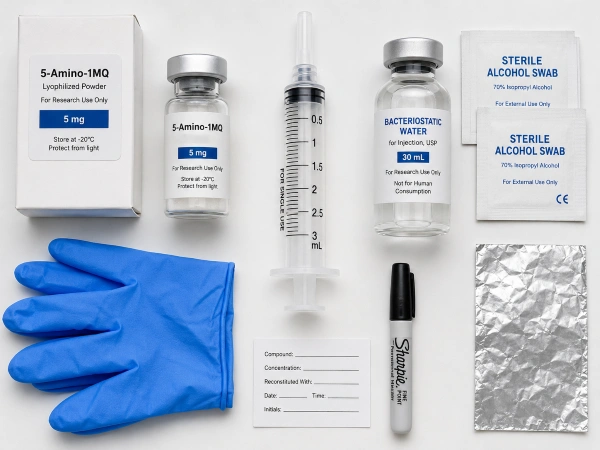
The specific reconstitution ratio you choose affects downstream experimental accuracy. Here’s what we recommend for reproducible results, and why.
Step 1: Thermal equilibration.
Remove the vial from freezer storage and let it sit at room temperature for 15-20 minutes before opening. This isn’t optional. Opening a cold vial introduces condensation, moisture that absorbs into the lyophilized powder and can’t be removed. That absorbed water changes the effective mass of the compound you’re dissolving, introducing a systematic error into every concentration calculation that follows.
Step 2: Solvent selection.
For aqueous reconstitution, bacteriostatic water (containing 0.9% benzyl alcohol) is the standard choice. For a deeper comparison of solvent options, see our guide on choosing your research solvent. The benzyl alcohol suppresses microbial growth, extending the usable window of your reconstituted solution from roughly 24-48 hours (with plain sterile water) to 2-4 weeks. For in vitro cell-based assays where benzyl alcohol could confound results, use sterile water or phosphate-buffered saline (PBS) instead, but plan to use the solution within 24-48 hours or aliquot and freeze immediately.
5-Amino-1MQ also dissolves readily in DMSO at concentrations up to 100 mM, and in methanol. For researchers running cell culture assays, a concentrated DMSO stock diluted into culture media is a common approach, just keep the final DMSO concentration below 0.1% to avoid solvent toxicity artifacts.
Step 3: Reconstitution volumes and target concentrations.
Common formats and their recommended dilutions:
For a 10 mg vial, adding 2.0 mL of bacteriostatic water yields a 5 mg/mL concentration. For a 50 mg vial, 4.0 mL produces 12.5 mg/mL. For in vitro work, the compound dissolves in PBS or culture media at concentrations up to 10 mM without requiring co-solvents – a practical advantage over many research compounds that demand DMSO or PEG-400 vehicles.
Step 4: Dissolution technique.
Direct the solvent stream down the inside wall of the vial, don’t blast it into the lyophilized cake. Gently swirl or roll the vial until the solution is clear. Never vortex or shake vigorously. Foam formation traps compound at the liquid-air interface where oxidative degradation is accelerated, and aggressive agitation can generate localized pH shifts that promote hydrolysis.
If the solution isn’t clear within 2-3 minutes of gentle swirling, the problem is almost certainly insufficient solvent volume or a storage-compromised compound. Adding more solvent is fine (recalculate your concentration). Continuing to shake a cloudy solution is not, cloudiness or visible particulate matter indicates aggregation or degradation products that won’t re-dissolve.
Step 5: Labeling.
Date, concentration, solvent used, operator initials. This sounds basic, but unlabeled vials are the single most common source of dosing errors in multi-researcher laboratories.
Post-Reconstitution Stability and Storage
This is where protocols diverge from standard peptide handling, and where most researchers lose compound integrity without realizing it. For broader context on maintaining liquid compound quality, our overview of evaluating stability and sterility covers foundational principles that apply here.
- Temperature: Store reconstituted solutions at 2-8 degrees C, protected from light. Do not freeze reconstituted solutions. Unlike many peptides that tolerate one freeze-thaw cycle, 5-Amino-1MQ in solution shows accelerated degradation with any freeze-thaw event. The quinolinium ring system is sensitive to the crystal formation and concentration effects that occur at the ice-liquid boundary during freezing.
- Light protection: The compound is photosensitive. Even ambient laboratory fluorescent lighting contributes to degradation over multi-day exposure. Wrap reconstituted vials in aluminum foil or store in opaque containers. This step alone can extend usable solution life by several days – a simple intervention with disproportionate impact on data quality.
- Usable window: With bacteriostatic water at 2-8 degrees C, protected from light, reconstituted 5-Amino-1MQ remains stable for approximately 14-30 days. With sterile water (no preservative), the window drops to 24-48 hours before microbial contamination becomes a risk. We recommend a conservative 14-day use window even with bacteriostatic water for experiments where precise NNMT inhibition kinetics are the primary readout.
- Inert gas overlay: For solutions that will be accessed repeatedly over multiple days, purging the headspace with nitrogen or argon after each withdrawal reduces oxidative degradation of the 5-position amine group. This is particularly relevant for researchers running time-course experiments who need to draw from the same vial across a 7-14 day protocol.
Degradation Indicators: What to Watch For
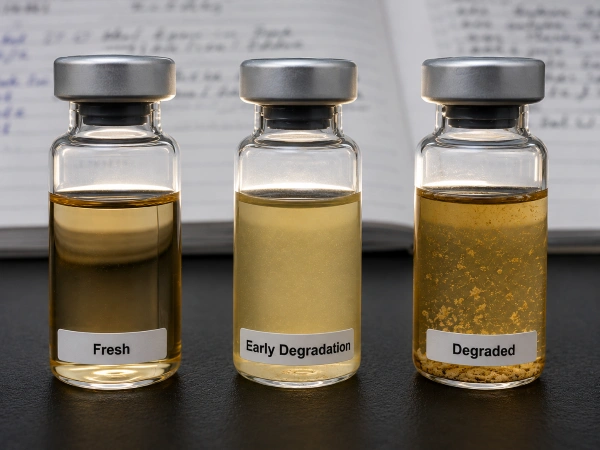
Degraded 5-Amino-1MQ doesn’t always announce itself with dramatic color changes. Subtle signs can precede obvious ones by days:
Cloudiness or visible particulate matter in a previously clear solution is the most reliable visual indicator. Discard the vial. Color shift toward yellow (from the typical faint amber of a fresh solution) suggests oxidative degradation of the aromatic amine. A solution that produces inconsistent or attenuated results despite correct protocol execution, particularly a progressive decline in observed NNMT inhibition across sequential experiments from the same vial, strongly suggests compound degradation even if the solution still looks clear.
If you suspect degradation, don’t troubleshoot around it. Reconstitute a fresh vial and re-run the experiment. The compound cost is trivial compared to the labor and reagent cost of an experiment built on compromised material.
pH Considerations
The pH of your reconstituted solution affects stability more than most researchers account for. Bacteriostatic water typically falls within a suitable range, but if you’re reconstituting in buffer systems for specific experimental applications, target a slightly acidic to neutral range (pH 5.0-7.0). Extreme pH deviations in either direction accelerate hydrolysis of the quinolinium nitrogen and can degrade the primary amine through deamination pathways.
For researchers working with 5-Amino-1MQ in complex buffer systems or culture media, checking the pH of your reconstituted working solution isn’t paranoia, it’s quality control.
Selectivity Context for Study Design
One detail from the foundational research that directly impacts how you design stability controls: published data demonstrated that 5-Amino-1MQ showed no significant inhibition of structurally similar methyltransferases DNMT1, PRMT3, or COMT at concentrations up to 600 uM, and did not inhibitNAD+ salvage pathway enzymes NAMPT or SIRT1. This selectivity profile means that observed changes in your experimental system following 5-Amino-1MQ treatment can be attributed to NNMT inhibition specifically, but only if the compound is intact. Degradation products of quinolinium derivatives don’t necessarily share this selectivity, which is precisely why stability protocols aren’t just about preserving potency. They’re about preserving the mechanistic specificity that makes this compound a useful research tool in the first place.
Practical Workflow for Multi-Week Research Protocols
For researchers running extended studies, here’s the protocol we recommend:
Calculate your total compound requirement for the full study duration before ordering. Reconstitute only what you’ll use within a 14-day window. Store remaining lyophilized vials at -20 degrees C or below. When accessing reconstituted vials, minimize exposure time at room temperature, withdraw your aliquot and return the vial to 2-8 degrees C storage within 2 minutes. Purge with inert gas after each access if feasible. Document every withdrawal with date, volume, and operator for chain-of-custody traceability. Discard reconstituted solutions at the 14-day mark regardless of remaining volume.
This approach trades some compound waste for dramatically improved data reproducibility. Our guide on storing pre-mixed solutions covers additional techniques that complement this workflow. For studies where the primary readout depends on consistent NNMT inhibition across time points, that trade is worth making every time.
Handling and Safety
Only trained laboratory personnel should handle 5-Amino-1MQ. Standard laboratory personal protective equipment (PPE), gloves, eye protection, lab coat, is required. Dispose of unused compound, contaminated materials, and expired reconstituted solutions according to your institution’s chemical waste guidelines. Never dispose of research chemicals in regular waste streams or down laboratory drains. Consult your institutional environmental health and safety office for site-specific disposal procedures.
All handling, storage, and experimental protocols should be documented in compliance with your institution’s standard operating procedures for research chemicals.
Conclusion
Every NNMT inhibition study built on 5-Amino-1MQ carries an unspoken assumption: that the compound in the vial matches the concentration on the label. The protocols above exist to make that assumption true.
Reconstitute with bacteriostatic water at the ratios specified. Store reconstituted solutions at 2-8 degrees C, wrapped in foil, and discard at 14 days. Purge headspace with inert gas when running multi-access protocols. Check for cloudiness or color shift before every use. These aren’t suggestions. They’re the minimum standard for data you can publish with confidence.
The selectivity that makes 5-Amino-1MQ valuable (IC50 of ~1.2 uM against NNMT, no measurable inhibition of DNMT1, PRMT3, COMT, NAMPT, or SIRT1) only holds when the compound is intact. Degradation products don’t inherit that precision. Protect the molecule, and it will give you clean, reproducible mechanistic data. That’s the entire point: removing compound integrity as a variable so the only thing left to interpret is the biology.
FAQs
What solvent should I use to reconstitute 5-Amino-1MQ?
Bacteriostatic water (0.9% benzyl alcohol) is the standard choice. It extends your usable window to 2-4 weeks at 2-8 degrees C. For cell-based assays where benzyl alcohol could confound results, use sterile water or PBS instead and consume within 24-48 hours. DMSO works for concentrated stocks up to 100 mM, but keep the final concentration below 0.1% in working media. Co-solvents like PEG-400 are unnecessary since 5-Amino-1MQ dissolves in PBS or culture media at concentrations up to 10 mM.
How long does reconstituted 5-Amino-1MQ remain stable?
With bacteriostatic water at 2-8 degrees C (protected from light), expect 14-30 days of stability. We recommend a conservative 14-day window for kinetics-sensitive experiments. Plain sterile water cuts that to 24-48 hours. Lyophilized powder is far more resilient, maintaining stability for up to 24 months at -20 degrees C. Never freeze reconstituted solutions, as the quinolinium ring system degrades rapidly through freeze-thaw events.
How do I know if my 5-Amino-1MQ has degraded?
Three indicators, ranked by reliability: cloudiness or visible particles in a previously clear solution (discard immediately), a color shift toward yellow suggesting oxidative degradation of the aromatic amine, and a progressive decline in NNMT inhibition across sequential experiments from the same vial despite consistent protocols. When in doubt, reconstitute a fresh vial rather than troubleshooting around compromised material.
Why can’t I treat 5-Amino-1MQ like a standard peptide during reconstitution?
It isn’t a peptide. It’s a small molecule on a quinolinium scaffold, and that structural difference changes its degradation behavior. The 5-position amine is vulnerable to oxidation and photolytic reactions that peptide protocols don’t address. Vortexing creates foam that accelerates oxidation at the liquid-air interface. Freeze-thaw cycles damage it through concentration effects at the ice boundary. Light sensitivity is more pronounced than with most peptides. Generic peptide handling introduces silent degradation that compromises both potency and mechanistic selectivity.
What is the correct storage temperature for lyophilized 5-Amino-1MQ?
Short-term (days to weeks): 2-8 degrees C, dark and dry. The powder tolerates room temperature for several weeks, so brief transit exposure is fine. Beyond 30 days: -20 degrees C. Beyond 12 months: -80 degrees C. Avoid frost-free freezers entirely since their defrost cycles cause micro-thaw events that silently accelerate degradation. Always equilibrate vials to room temperature for 15-20 minutes before opening to prevent condensation.
5-Amino-1MQ is classified as a research chemical and is intended for laboratory and in vitro research use only. This compound is not intended for human or veterinary use, and is not a drug, dietary supplement, food product, or cosmetic. It has not been approved by the FDA or any regulatory body for any therapeutic or diagnostic purpose. All research must be conducted by qualified professionals in compliance with applicable institutional, local, state, and federal regulations. The information presented in this article is derived from published preclinical research and is provided solely for educational purposes. No claims regarding efficacy, safety, or suitability for any application in humans or animals are made or implied.
References cited include: Journal of Medicinal Chemistry, 2017 (structure-activity relationship study of small molecule NNMT inhibitors). Biochemical Pharmacology, 2018 (preclinical evaluation of selective NNMT inhibitors in murine models).