❌ Not for Human Consumption
●
✅ For Research Use Only
●
All products are intended strictly for laboratory research purposes only
●
❌ Not for Human Consumption
●
✅ For Research Use Only
●
All products are intended strictly for laboratory research purposes only
●

AOD-9604: Structure, Synthesis, And Peptide Chemistry Overview

Written By: Gary Hite, Research Content Writer
Reviewed By: Natalie Kunsman, M.D., Board-Certified Physician
Last Reviewed: July 3, 2026
AOD-9604 is a synthetic peptide compound widely referenced in biochemical literature for its role in structure activity relationship studies of human growth hormone fragments. This article provides a technical overview of its molecular structure, established synthesis routes, and the peptide chemistry principles that govern its handling in a controlled laboratory environment. All information below is intended for licensed researchers, academic institutions, and qualified laboratory professionals studying peptide chemistry, analytical methods, and reference standard characterization.
Disclaimer: Nothing in this article should be interpreted as medical advice, therapeutic guidance, performance recommendation, or instruction for use in or on humans or animals. AOD-9604 referenced products are sold strictly as research chemicals for in vitro investigation and analytical reference work.
What Is AOD-9604 at the Molecular Level
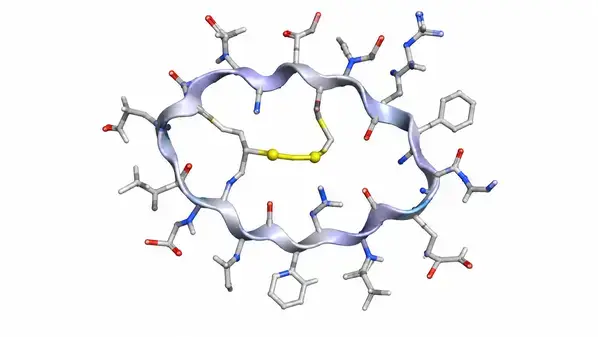
AOD-9604 is a 16 amino acid synthetic peptide originally derived from the C terminal region of the 191 residue human growth hormone (hGH) polypeptide. The fragment corresponds to residues 176 through 191 of the parent sequence, with an additional tyrosine residue appended at the N terminus to support analytical detection and synthetic chemistry workflow.
In the broader landscape of peptide research, AOD-9604 is studied as a defined fragment used in the characterization of cyclic peptide motifs, disulfide bonded loop systems, and short chain hGH derived sequences. Within research settings, it serves as a reference compound for protocols involving HPLC method development, mass spectrometry calibration, immunoassay verification, and structural biochemistry coursework.
This article focuses on chemistry. It does not describe biological effects, pharmacological activity, dosing, administration, or any application involving living subjects.
Primary Structure and Amino Acid Sequence
The published amino acid sequence of AOD-9604, written in single letter code, is:
Y L R I V Q C R S V E G S C G F
Spelled out in three letter code, the sequence reads:
Tyr Leu Arg Ile Val Gln Cys Arg Ser Val Glu Gly Ser Cys Gly Phe
Each residue contributes specific physicochemical properties relevant to the overall behavior of the peptide:
- Tyrosine (Y) at position 1 provides a UV active chromophore with a characteristic absorbance near 274 nanometers, supporting quantitation by UV spectrophotometry.
- Cysteine residues at positions 7 and 14 establish the framework for the internal disulfide bridge that defines the secondary structural element of the peptide.
- Polar and charged residues including arginine, glutamate, and serine contribute to aqueous solubility and influence isoelectric behavior during analytical separation.
- Hydrophobic residues including leucine, isoleucine, valine, and phenylalanine modulate retention behavior on reverse phase HPLC columns.
The empirical molecular formula commonly reported for the disulfide bonded form is approximately C78H123N23O23S2, with a monoisotopic mass near 1815 daltons. Researchers verifying lot specific analytical certificates should always confirm the exact mass against the certificate of analysis supplied with the reference material.
Secondary Structure and the Disulfide Bridge
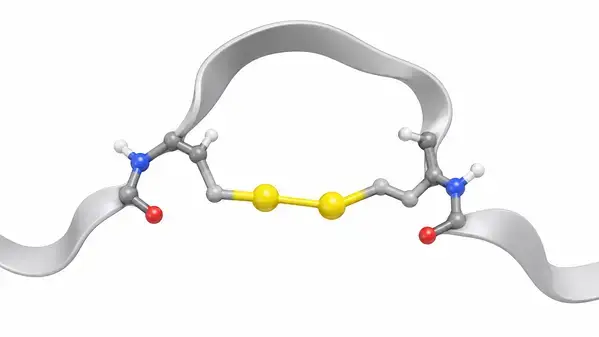
The defining structural feature of AOD-9604 in its oxidized form is the intramolecular disulfide bond formed between Cys7 and Cys14. This linkage closes the peptide into a small cyclic loop containing six residues (Arg, Ser, Val, Glu, Gly, Ser) constrained between the two sulfur atoms.
This cyclic loop is the subject of considerable structural interest in peptide chemistry research because it preserves a conformational motif found within the parent hGH protein. Researchers studying short chain disulfide bonded peptides reference AOD-9604 as an example of how a small, defined ring system can be reproducibly synthesized, oxidized, and characterized using standard laboratory techniques.
In the reduced form, the two cysteine residues exist as free thiols. The oxidized cyclic form is the analytical reference state most commonly used in laboratory research. Distinguishing the two forms requires careful redox handling and analytical confirmation, which is discussed below.
Synthesis Pathways for Research Grade Material
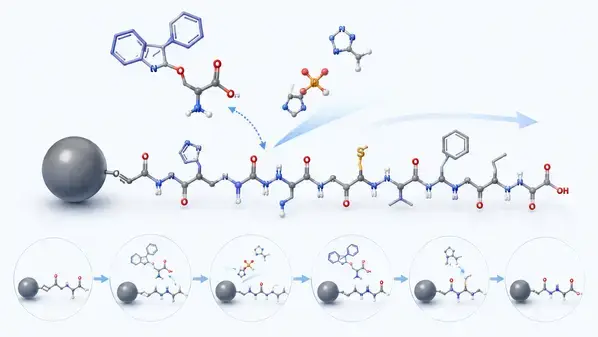
Research grade AOD-9604 is typically prepared by solid phase peptide synthesis (SPPS) and now considered the dominant technique for short to medium length peptide assembly. The most common variant applied to AOD-9604 is Fmoc based SPPS.
Step One: Resin Selection
Synthesis begins with attachment of the C terminal phenylalanine residue to a polymer support. Common resins for this peptide include Wang resin and Rink amide resin, depending on whether the desired terminus is a free carboxylic acid or a primary amide. The choice influences the final mass and analytical profile of the product.
Step Two: Sequential Coupling
Amino acids are added one residue at a time in the reverse direction relative to biological synthesis, moving from C terminus to N terminus. Each cycle includes:
- Removal of the Fmoc protecting group on the resin bound amine using a base such as piperidine in dimethylformamide.
- Coupling of the next Fmoc protected amino acid using activating reagents such as HBTU, HATU, or DIC combined with HOBt or Oxyma.
- Washing the resin to remove excess reagents and byproducts.
Side chain functional groups on residues such as Arg, Glu, Ser, Gln, and Tyr are protected with orthogonal groups (typically Pbf, OtBu, tBu, Trt) that remain stable during repeated Fmoc deprotection steps. The cysteine residues are most often protected with trityl (Trt) groups, which can be removed during global deprotection while leaving the peptide intact.
Step Three: Global Cleavage and Deprotection
Once the full 16 residue chain is assembled, the peptide is cleaved from the resin using a strongly acidic cocktail commonly based on trifluoroacetic acid. Scavengers such as triisopropylsilane, water, and ethanedithiol are added to capture reactive carbocation byproducts and protect the integrity of sensitive residues.
Step Four: Disulfide Bond Formation
After cleavage, the linear peptide is purified and then subjected to controlled oxidation to establish the disulfide bridge between the two cysteine residues. Common oxidation methods include:
- Air oxidation in dilute aqueous buffer at slightly basic pH
- Dimethyl sulfoxide mediated oxidation
- Iodine assisted cyclization
Oxidation must be performed at low peptide concentration to favor intramolecular bond formation over intermolecular dimerization. This is a defining technical challenge in cyclic peptide research and is frequently used as a teaching example in academic peptide chemistry coursework.
Step Five: Purification
The oxidized peptide is purified by preparative reverse phase HPLC, most commonly using a C18 stationary phase and a water acetonitrile gradient with trifluoroacetic acid as ion pairing modifier. Final research grade material is then lyophilized to a dry powder suitable for storage and laboratory reference use.
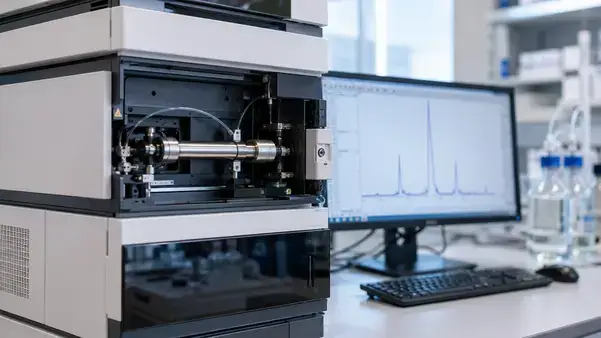
Analytical Characterization
Reference grade AOD-9604 is characterized using multiple orthogonal analytical methods to confirm identity, purity, and structural integrity. Standard characterization includes:
- High performance liquid chromatography (HPLC) to assess purity, typically reported as area percent at 220 nm or 280 nm.
- Mass spectrometry including ESI MS or MALDI TOF to confirm molecular mass and detect adducts or truncated sequences.
- Amino acid analysis to verify compositional accuracy.
- Thiol assay to confirm the absence of free cysteine residues in the cyclized form.
- Karl Fischer titration for residual moisture and HPLC residual solvent analysis for trace organic content.
These analytical methods are standard components of peptide quality control and are useful study material in academic settings teaching analytical biochemistry, separation science, and structural verification techniques.
Solubility, Stability, and Laboratory Handling
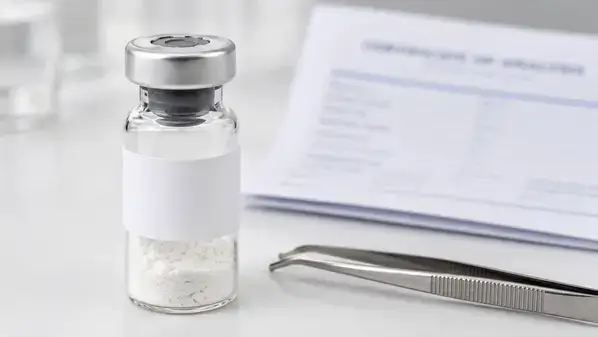
For laboratory research only, AOD-9604 is commonly supplied as a lyophilized white powder. Peptide chemistry literature describes the following properties:
- Solubility in sterile water and aqueous buffers is generally acceptable for analytical work. Slightly acidic or neutral buffers tend to support stable handling.
- Stability in solution depends heavily on pH, temperature, and exposure to oxygen. Disulfide bonded peptides can undergo scrambling under reducing conditions or under strongly basic conditions.
- Storage of lyophilized material is typically recommended at temperatures below freezing and protected from light and moisture.
- Working stock solutions prepared in research settings should be aliquoted to minimize freeze thaw cycles.
These handling notes are provided for context related to laboratory storage of reference materials. They do not constitute guidance for use in any living subject.
Position Within Peptide Chemistry Research
AOD-9604 occupies a defined position in the catalog of short, cyclic, disulfide bonded synthetic peptides studied in academic and industrial laboratory research. Its value to peptide chemists includes:
- Serving as a model substrate for teaching disulfide bridge formation chemistry
- Acting as a known reference compound in HPLC and mass spectrometry method development
- Providing a defined sequence for studies of resin loading, coupling efficiency, and chain assembly in SPPS optimization
- Supporting research into analytical detection of small cyclic peptides in complex matrices
These applications belong squarely within laboratory science and analytical method work. They do not extend to any human or veterinary use.
Compliance Statement and Important Disclaimers
The information presented in this article is educational and technical in nature. It is intended for licensed researchers, academic chemists, analytical method developers, graduate students working under qualified supervision, and laboratory professionals who handle reference compounds in compliance with applicable institutional, federal, and state regulations.
The following points are non negotiable for all materials referenced on this site:
- AOD-9604 supplied through this site is for research use only.
- AOD-9604 is not approved by the United States Food and Drug Administration for any therapeutic, diagnostic, or preventative purpose in humans or animals.
- AOD-9604 is not a dietary supplement, drug, food product, or cosmetic, and it is not labeled, sold, or represented as such.
- AOD-9604 is not intended for human consumption, injection, inhalation, ingestion, topical application, or any contact with a living subject.
- No statement on this site should be interpreted as a medical claim, including but not limited to claims related to body composition, metabolism, fat reduction, weight management, athletic performance, anti aging, recovery, or any other physiological outcome in humans or animals.
- Purchasers represent that they are qualified professionals, that they will handle the material under appropriate laboratory safety controls, and that they will comply with all applicable laws governing the acquisition, storage, and use of research chemicals.
Any individual or organization that cannot meet these conditions should not purchase, request, or handle this material.
Conclusion
AOD-9604 stands as a well characterized 16 amino acid synthetic peptide with a defined disulfide bridge, a published sequence, and a reproducible Fmoc SPPS synthesis route. For research professionals, the molecule offers a useful reference framework for studying short cyclic peptide assembly, oxidative folding, and analytical method development across HPLC, mass spectrometry, and amino acid analysis platforms. Researchers planning new work should verify lot specific certificates of analysis, confirm structural identity through orthogonal analytical techniques, and document storage and handling protocols in accordance with institutional safety standards. Procurement decisions should follow established laboratory chemical management policies, including verification of supplier credentials and complete compliance documentation. These practices keep peptide research aligned with scientific rigor and clear regulatory expectations. AOD-9604 referenced on this site is supplied strictly as a research chemical for in vitro laboratory and educational use. It is not for human consumption and not approved for any therapeutic application.
FAQs
What is AOD-9604 in peptide chemistry terms?
AOD-9604 is a 16 amino acid synthetic peptide corresponding to the C terminal fragment of human growth hormone (residues 176 through 191), extended with an additional tyrosine at the N terminus. Its defining structural feature is an intramolecular disulfide bond between the two cysteine residues, which closes the chain into a small cyclic loop. Researchers reference it as a model compound for short cyclic peptide chemistry and analytical method work.
How is AOD-9604 typically synthesized in a research laboratory?
The standard route is Fmoc based solid phase peptide synthesis (SPPS). The chain is assembled one residue at a time on a polymer resin, deprotected with piperidine, coupled using activators such as HBTU or HATU, and finally cleaved from the resin with a trifluoroacetic acid cocktail. The disulfide bridge is formed afterward by controlled oxidation in dilute aqueous buffer, then the cyclic product is purified by preparative reverse phase HPLC and lyophilized to a dry powder.
Which analytical methods verify AOD-9604 identity and purity?
Reference grade material is characterized using orthogonal techniques. HPLC at 220 nm or 280 nm establishes chromatographic purity. Mass spectrometry, typically ESI MS or MALDI TOF, confirms the molecular mass. Amino acid analysis verifies composition, and a free thiol assay confirms the cysteine residues are properly oxidized into the disulfide form. Residual solvent and moisture testing complete the analytical profile reported on a certificate of analysis.
How should research grade AOD-9604 be stored and handled in the laboratory?
Lyophilized AOD-9604 is generally stored as a dry powder at sub freezing temperatures, protected from light, moisture, and oxygen. Reconstituted working solutions should be aliquoted to limit freeze thaw cycles, kept at near neutral or slightly acidic pH to discourage disulfide scrambling, and handled with standard laboratory personal protective equipment. Each laboratory should follow its own institutional chemical hygiene plan and the storage instructions printed on the supplier certificate of analysis.
Is AOD-9604 approved for human or veterinary use?No. AOD-9604 is not approved by the United States Food and Drug Administration, or by any equivalent regulator known to us, for any therapeutic, diagnostic, preventative, or performance related use in humans or animals. It is not a drug, dietary supplement, food product, or cosmetic. Material supplied through this site is sold strictly as a research chemical for in vitro laboratory and educational use by qualified professionals, and it is not intended for human consumption or for use in any living subject.